Parashat Pinchas: Zelophehad's daughters
An unquenchable thirst for the Land of Israel
Zelophehad's daughters stand as veritable beacons during these dark days, showing us where love for the Land of Israel can lead us.
Zelophehad's daughters stand as veritable beacons during these dark days, showing us where love for the Land of Israel can lead us.
When someone expresses a new theory on a significant matter for consideration, the reflexive response is often, “Where is it written?" or “Who said that?"
When thoughts of repentance arose in the hearts of the sons of Korach, they were moved to atone for their dishonor, by an offering of praise found in the Book of Psalms.

The daughters of Tzelophchad and the mission of Jeremiah.
The Israeli and Diaspora reading cycles conclude their brief divergence this week.

Chukat is the saddest parasha in the entire Torah. And Parashat Balak contains a fascinating and unusual story that illustrates how Jew-hatred is deeply rooted in human existence.
When outside forces try to tie our hands or misread our enemies, our only true defense is our internal clarity, our own independent strength, and our deep faith in Netzach Yisrael.

Israel's true strength lies not in military might or international support, but in faith in Hashem and spiritual resolve.
‘To what can the matter be likened? To that of the king’s cook, who knows the amount of the outlays of the king, for his table.’
The enemies of Israel who seek to dispossess us of our Land and destroy us, understand what Balak and Bilaam understood - that as long as Israel is united they cannot overcome us. Therefore, they make great efforts to drive a wedge and create division within Israel.
The breadth and depth of knowledge required for true Torah scholarship must come at the expense of pleasures and leisure activities that are acceptable for the general population.
Moses is told in this parasha that he wiil not bring the Israelites into the Land. How do commentators explain that?

Is there a connection between the three, all involving heifers?
One of the central questions arising from the Parasha is how a single individual managed to sweep away such a large and significant group and get them to rebel against Moshe.

The modern State of Israel did not create the Jewish connection to the land. It restored Jewish sovereignty in the birthplace of Jewish civilization. A similar argument is made to the Ammonites in the Haftorah.
Where in the Torah do we find an example of the worst possible argument?
After years of experiencing miracles, they had stopped noticing them.

The generation of the spies measured the Land and saw a threat; this generation, passing through fire, has begun to measure itself and to ask what it is here for.
In my experience, some non-sighted people actually have a far greater depth of perception than those who are sighted.

Korach challenged the appointment system, arguing that positions should follow birth order.
We can but look in despair at Jewish communities throughout the world, and ask: Is there a single Rabbi who reaches the level of Korach, Datan, and Aviram, the Tzaddikim of the Sinai Desert, who were plunged into such despair at being deprived of the Land of Israel that they lost all faith?

Am Yisrael does not only operate in terms of practical considerations. An important religious element is involved in political developments.
Torah is called Shalom and has the power to bring peace between the neshamah, soul, and guf, body.

Moses, Aaron and Samuel neither sought power nor exploited it. They served the people with humility and sacrifice.
Human beings rarely become resolute in their positions solely due to a perfect and brilliant logical argument. Korach knew that.
The key to victory and inheriting the land does not depend on the strength of the fortified cities, but on the measure of our devotion and faith in Hashem and His promises.

The struggle over Eretz Yisrael has never been solely a military or political contest. At its core, it is a test of faith, vision and national purpose.
A single gesture toward a baby reverberates throughout History.
Why did the Sages decide to add this particular paragraph about Tzitzit, out of the entire Torah, to the central prayer of Judaism?
We must rectify the ingratitude that brought about weeping for generations. Therefore, we must thank God for the great miracles that have occurred in our days.
First "provoke" followed by the next phrase asking 'How much longer will they not believe in me?' A survey of commentators explaining and contrasting the two dramatic verses.

True humility is a choice.
The core moral failure of the desert generation, and the corrective embodied by those who came next.
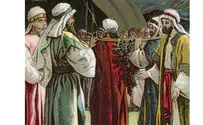
What was sinful about the words of the spies? Weren’t they supposed to give an accurate report of what they had seen? (Ramban)
“We’re all better off, far better off, in the desert, without any distractions," they said. "Maybe one day when there is a Holy Temple in the Land, after Mashiach will have come, it will be time for us to enter the Land of Israel and possess it. But until then, we’re clearly better off remaining in the desert."
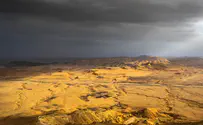
Standing before the same landscape, the spies and Joshua and Caleb reached opposite conclusions. The results were not long in coming.
Historically, it seems that the more accessible the sanctity of Judaism became, the more we were tempted by outside influences.

What is the method of purifying the Levites and why is it written after the offerings at the Tabernacle dedication? Commentators weigh in on the meanings below the surface.
There are temporary shortcomings but we work alongside Hashem to constantly grow and improve on the path to final completion.
Shavuot is two days in the Diaspora, one day in Israel. Thus, whle Israel read the regular weekly portion, Naso, last Shabbat, (and will read Behaalotcha this coming Shabbat), Diaspora Jewry read a Shavuot portion last Shabbat and will read Naso this coming Shabbat.

The Rabbis say that, had Moshe led Bnei Yisrael into the Land, he would have built the Beit HaMikdash (Holy Temple), and it would have never been destroyed.

The balance between continuity and individuality is one of Judaism’s great achievements and it comes to the fore in the parasha.
Before speaking about another person, we should ask ourselves one honest question: Am I truly going to help this person directly and privately, or am I simply using the language of “concern" to give myself something to discuss?
We honor the divine soul and, by extension, the One who implanted it in the human body, by respecting the living as well as the deceased.
Because Yaakov chose Hashem to be his G-d, Hashem chose Israel - Yaakov’s nation - to be His special lot.

Torah, like the desert, must be open and accessible to all of Am Yisrael, with purity, humility, and patience, so that the nation can return to its highest levels of holiness and spiritual greatness.
Like the moon, which wanes before it is renewed, the nation of Israel endured periods of concealment and decline but always held fast to the belief that restoration would come.
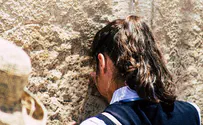
The return to Jerusalem in 1967 marked not only a military triumph but a stage in the ongoing restoration of Jewish sovereignty in our ancestral land. And perhaps that is the deeper lesson of Parshat Bamidbar for our time.
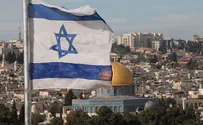
Those of us who were born Jewish are not ordinarily described as Jews by choice. But we must always feel tht we have chosen the Torah.
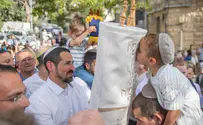
G-d cares enough to discipline us. But He does not abandon us.
Letters are more than just elements of speech. They are the building blocks of creation.
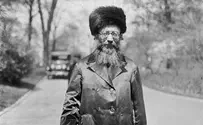
Libi came to our Shabbat table once.She was from a faraway country, a student who wanted to understand the Jewish people. She read books. She asked sharp questions. She said something I still remember.

Eretz Yisrael is more than a place on the map. It is a crucible in which the Jewish people are called upon to refine their identity and fulfill their mission.
Am Yisrael is the eternal nation, and the covenant which the Holy One Blessed be He made with us is an eternal and unbreakable covenant.
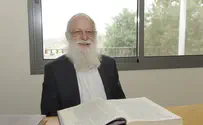
That one letter is also a word and writing four of them in a row also forms a word.

We should feel that we have a “closer" relationship to Hashem when we stroll through the streets of Eretz Yisrael and the holy city of Yerushalayim (Jerusalem), and this should inspire us to a higher level of behavior.
The pairing of Behar-Bechukotai raises the question: were they originally defined as two parashot later joined when needed, or perhaps originally defined as a single parashah that sometimes had to be split? And what is the role of the Kohanim?
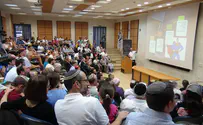
This week's haftorah is a profound statement about resilience, about the ability to endure and even thrive amid adversity when one’s foundations are properly rooted.
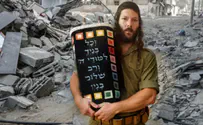
We moved from existential fear as described in the parasha to the heights of national renewal, with the climax being the liberation and reunification of Jerusalem, together with the return to Yehudah and Shomron.
Why did G-d interrupt the sequence of the mitzvot of the Kohanim with the mitzvot of the Festivals?