
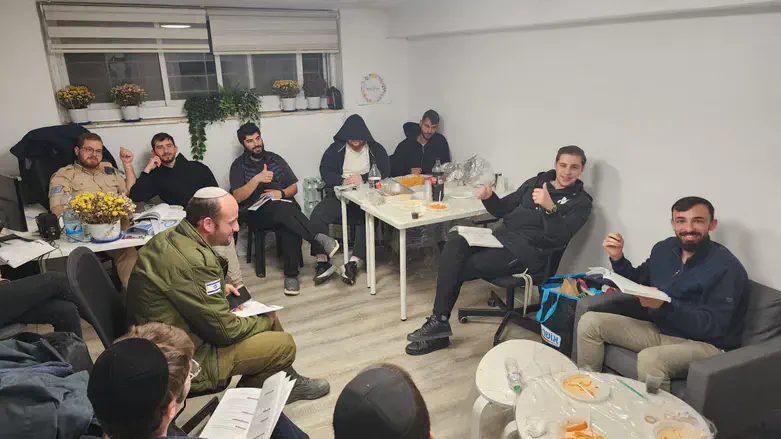
Rabbi Matanya Yadid, a friend of Torah Mitzion is head of the Sifra Center for Education, Community and Government.
Parashat Korach presents us with a fascinating and sobering lesson in the psychological and social mechanisms of human motivation. One of the central questions arising from the Parasha is how a single individual managed to sweep away such a large and significant group-two hundred and fifty heads of the Sanhedrin and leaders of the community-and lead them into open rebellion against Moshe Rabbeinu.
The immediate answer, of course, lies in the ideological arguments Korach presented, and in slogans such as "For all the congregation are holy." However, the Midrash (Bamidbar Rabbah) reveals a much deeper and more practical layer, summed up in one short sentence describing the beginning of Korach's actions: "Korach stood and made a feast for them." Before the speeches, the arguments, and the open rebellion, there was first and foremost a feast.
Korach did not open the campaign with a complex theological speech or an intellectual debate in the Tent of Meeting. He understood that motivating people to action and recruiting partners do not necessarily begin with cold logic, but rather from an experiential and social place. In this context, the feast is not merely a culinary event, but a strategic tool for creating closeness, intimacy, and a sense of belonging.
Human beings rarely become resolute in their positions solely due to a perfect and brilliant logical argument. Most often, conviction stems from a connection to the speaker-from their manner of expression, charisma, and presence, and from the degree of spiritual and material respect accorded to the listeners. The Midrash further notes that immediately after the feast, those same leaders came to Moshe "to claim their gifts," meaning the priestly gifts that Korach had promised them. Even though these gifts did not belong to them at all, Korach gave them the feeling that they had a personal and immediate gain from the move.
In contrast, when Moshe turns to Dathan and Abiram in an attempt to dialogue with them, they lash out at him: "Moreover, you have not brought us into a land flowing with milk and honey." The contrast was sharp: Korach offered a feast and closeness here and now, while Moshe led them on a long and challenging journey through the desert. Our Sages recognized the power of gathering around a table and stated in the Talmud: "Great is a drink (or a meal), for it brings those who are far close." A shared meal is not merely the satisfaction of a physical need, but a primary tool for breaking down barriers and creating a soulful connection.
A profound insight illuminating this principle is brought in the name of the holy Rabbi Mendali of Vorki. Regarding the verses dealing with the sacrifices of the holiday of Sukkot and Shemini Atzeret, Rashi quotes the Midrash Tanchuma, according to which the Torah taught "good manners" (proper etiquette) in the laws of hospitality. The Torah commands us to sacrifice many bulls on the first day of the festival, and to decrease their number each day, until on the eighth day, only a single bull is sacrificed. The Midrash compares this to a person hosting a guest: on the first day, he feeds him fattened fowl, the next day fish, then meat, then legumes, and on the last day, vegetables-the quality and quantity decrease over time. Rabbi Mendali of Vorki wondered about this: what kind of "good manners" is it to diminish the guest's food each day? This seems strange and stingy!
He explained this based on the principle that "great is a drink that brings people close." On the first day, when the host and the guest are still strangers to one another, a grand and lavish feast is required to bridge the gap of unfamiliarity, bring hearts closer, and break the initial ice. However, after a few days of staying together, once a genuine bond has been formed and they have grown close, the need for the "drink" diminishes. Sitting together in friendship becomes the essence, while the food becomes secondary to it. Therefore, there is no longer a need for prolonged feasts and lavish dishes-the connection is already established.
Korach harnessed the motivating power of the "drink" and the bonding feast for the sake of controversy, division, and personal interests. For us, who seek to motivate people to act and do good, the conclusion is the exact opposite: often, the way to a person's heart does not pass through a distant ideological polemic. To connect, bring close, and motivate, one must first create a platform of closeness at eye level-and from that connection of hearts, grow together into positive action.
For comments: ymatanya@gmail.com