
Rabbi Chaim Goldberg is the head of Brit Olam, an organization founded by Rabbi Oury Cherki for Noahiides around the world.
Libi
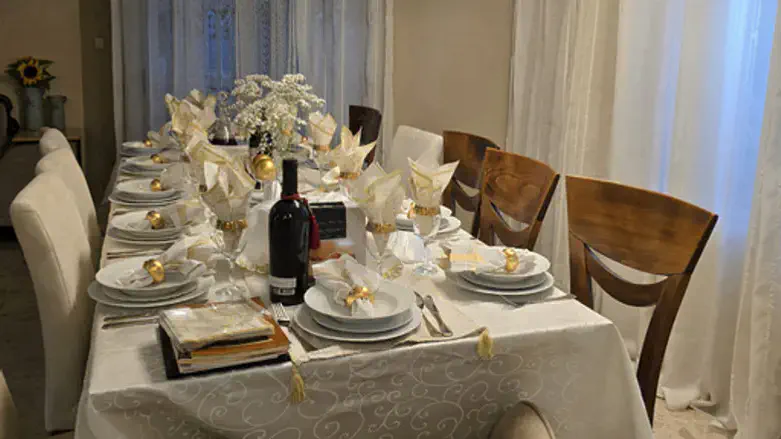
She came from a country far from ours. I still remember her name - Libi. It sounded almost Hebrew, but wasn't. (In Hebrew, libi means "my heart," though her name had no connection to that - a coincidence I noticed only later.) She was studying at the international university near our home, and one Friday, like many before her and many after, she came to eat with us.
She didn't come just to eat. She came to learn. She wanted to understand the Jewish people - what we are, what this strange story is, how a nation so small leaves such a large mark on the world. She had read books. She asked sharp questions. She wanted theory.
And then Shabbat began. What I remember about her isn't the clever questions or the academic discussions - it's the moment my father lifted the cup and began Kiddush. The look that crossed her face. Wonder. Something close to mild shock. She didn't quite understand what he was doing, why he held the cup that way, why we all stood in silence. And then, when we started to sing the zemirot - the table songs of Shabbat - she smiled differently. Not a polite smile. The smile of someone who had caught hold of something.
At the end of the evening, she said something to me that I still remember. She said that all the books she had read about the Jewish people had not explained what she had understood that night. That the smells, the songs, the Kiddush - these had told her something words could not.
I remember it because she surprised me. I had assumed our guests came mainly to eat. It hadn't occurred to me that someone might learn Torah from challah and table songs.
Trump's Proclamation
I thought of Libi this week, when I read President Donald Trump's proclamation for Jewish American Heritage Month, May 2026. Tucked inside the formal language is a sentence that caught me. The President calls on Americans to celebrate their faith and freedom throughout the year - and especially on Shabbat - to mark America's 250th year of independence.
My reaction was mixed.
On one hand, something about it felt off. The Jewish people have never wanted the world to imitate them. We are not a missionary faith. We have no interest in turning America into Israel, and there is no spiritual benefit in anyone copying our practice for its own sake. Shabbat belongs to us in a deep way, and trying to adopt it through a presidential proclamation risks missing the point of what it actually is.
On the other hand - and this is the side that ultimately won - there is real opportunity here. The President of the United States, on his country's 250th anniversary of independence, is pointing at Shabbat. Not at a church. Not at "spirituality" in general. At the Jewish Shabbat. And though he probably doesn't grasp everything packed into that gesture, his instinct is sound. So I decided this was a moment to open up some depth.
Because what Trump touched on lines up with something the Jewish people have understood since Abraham.
What Trump Touched Without Knowing It
The pairing Trump chose - "faith and freedom" - is not as obvious as it sounds. In the modern West, ever since the European Enlightenment, we are trained to think of faith and freedom as living at opposite ends of life: faith is private, internal, religious, while freedom is public, political, civic. Between them stands a wall. "Separation of church and state," we call it.
That separation grew up within Christian Europe and within Christianity, and it actually made some sense. Christianity began under Jesus's instruction to "render unto Caesar what is Caesar's, and unto God what is God's." It did not understand itself as a nation but as a community of believers crossing national lines. The wall between church and state followed naturally from that self-understanding.
But when that same model was applied to Judaism, it was a category mistake.
Because the very first moment the Jewish people enter the world - God's first call to Abraham - is not a call to a religion. "Go forth from your land... and I will make you a great nation." A nation. A people. A political body. God did not establish a religion and later attach a nation to it. He established a nation. A nation whose political existence flows directly from its Creator.
In our world, there is no "religion" on one side and "state" on the other. There is one whole reality - a nation living its connection to God through everything: through its laws, through its social justice, through its calendar, through its relationship to the land.
And at the heart of that wholeness stands Shabbat.
One Shabbat, Three Voices
Shabbat speaks in three voices at once, and they cannot be pulled apart.
To the individual, it says: rest. Come back to yourself, to your home, to your family. "That you may rest." This is a personal gift.
To the nation, it says: you are free. "Remember that you were a slave in the land of Egypt." Every week, the entire people celebrates its release from bondage all over again. In a world built on Pharaoh's logic - where slaves were tools, not people - the idea that the slave is entitled to rest just like the master was a revolutionary declaration. This is the founding stone of political freedom.
And to the whole world it says: there is a Creator. "For in six days the Lord made the heavens and the earth." Here, Shabbat is no longer ours alone. It is the testimony that the Jewish people give in the presence of all humanity.
These three layers happen at the same moment. When Libi sat at our table, she wasn't watching a religious ritual. She was sitting inside a nation that pauses. Inside a family that rests. Inside a testimony about the Creator of the world - who, if you'd like to know, is also her Creator. That is why she felt she belonged. Shabbat isn't only for us. In a real sense, it is also testimony before her.
There is one more layer, deeper still, that deserves at least a mention, even though this isn't the place to develop it. Shabbat - in its full halakhic observance - is a tikkun, a repair, of the sin of Adam in the Garden. An ancient spiritual labor that the Jewish people were specifically charged with carrying out, precisely because our role is to be "a kingdom of priests and a holy nation." That is our portion. It is not Libi's, and it is not America's.
The Shabbat Spice
The Talmud tells a story (Tractate Shabbat). The Roman Emperor asks Rabbi Yehoshua ben Hananiah: why does your Shabbat food smell so wonderful? What is it that you do? Rabbi Yehoshua answers: "We have one spice, and Shabbat is its name. We add it in, and the fragrance rises." The Emperor asks for some of the spice. Rabbi Yehoshua answers: "For one who keeps the Shabbat - it works. For one who does not keep the Shabbat - it does not."
The Emperor smells the fragrance. He knows something is going on. He wants the spice. But he assumes it's a substance - something that can be bottled, shipped to the imperial kitchen, stirred into a pot. And Rabbi Yehoshua tells him, gently, that he has misunderstood. The spice is not a substance. The spice is the keeping itself.
Libi smelled the fragrance. Trump, in his way, has smelled it too. The question is what to do with that.
A Question I'm Leaving Open
There is one question I don't fully know how to answer. Suppose someone - not Jewish, perhaps an American who read Trump's proclamation seriously - decides he wants to keep Shabbat. A full Shabbat, exactly as the Jewish people keep it. He doesn't live near a Jewish community. He has no synagogue, no chevra. He wants to stop on the seventh day, light candles, say Kiddush over wine, and refrain from the thirty-nine forbidden labors. Is this relevant to him? Is this what is being asked of him?
My honest inclination is no. The detailed observance of the Jewish people is part of our specific role. It is bound up with the tikkun I mentioned, with the spiritual work our nation has been charged with carrying out. Someone who isn't part of that nation isn't being asked - by us or by anyone else - to step into the precise structure of our practice.
(A clarification on the halakhic side: in fact, Jewish law forbids a non-Jew from observing the full Shabbat as a Jew does - unless he is a declared Ben Noach, a non-Jew who has formally taken upon himself the seven Noahide laws. This is not the place to develop the topic; I mention it only so the reader knows the question I'm raising isn't merely a matter of preference or invitation, but touches on a real halakhic boundary.)
But if he asks me what he can do, I have a suggestion. Not to copy the Jewish Shabbat, but to learn its principle. Establish a regular family meal once a week, a real one, where the whole household sits down together. Put the phones in another room. Turn off notifications. And talk. Not just about work and the news, but about what lies underneath. Big questions. What is life for. What we admire in one another. What our children are dreaming about.
One conversation like that a week, around a table, without screens, is itself an expansion of human understanding. It restores a person's uniqueness. Because the human being, unlike any other creature, is a creature of meaning. And in a world that runs without pause, he is forgetting it. Shabbat - even in the lighter form any nation can adopt - is a reminder.
And still I'm left with something unresolved. Even with the halakhic boundary in mind, I notice that I can't fully shake the question. What about a person, somewhere far from any Jewish community, who feels genuinely drawn - not to imitation, but to something real? Maybe for him, the path is precisely the formal one, becoming a Ben Noach, taking on what is meant for him. Maybe for him, a weekly family meal is enough. I don't know. What I do know is that for most people, in most nations, what Trump touched - "celebrate your faith and freedom on Shabbat" - is not a call to imitate us. It is a call to stop. And to that stopping, I wish him, and anyone who listens, a fragrance.
And maybe, one day, someone like Libi will find herself at someone's table and smile that smile.