
Edited by B. Silberstein
This week’s Parsha, Shelach, describes the debacle of the spies, which sealed the fate of the generation that experienced the Exodus and generated consequences that affect us to this day. It is important to seek a deeper understanding of this calamity and grasp its appropriate lessons.
The Purpose of the Spies
To begin, why was there a need for spies in the first place? The Book of Devarim recounts that when Moshe issued the order “See Hashem your G-d has given before you the land; go up and inherit," (Devarim 1:21) the people came to him and requested that scouts be sent to search out the terrain to determine “the path on which we should ascend and the cities we should conquer." (ibid. 1:22) The idea found favor with Moshe who, in consultation with Hashem, appointed the leaders of the twelve tribes and delineated their mission.
Interestingly, the mandate of the spies was not limited to specifically military information. Moshe instructed them to also report on the agricultural character of the land, its topography and climate. He even urged them to bring back a sampling of the fruits, so that the people could see for themselves what a choice place this was.
The reconnaissance mission turned out to be a disaster, because it induced paralyzing fear in the hearts of the people. And of course, the spies, except for Yehoshua and Caleiv, are regarded as great sinners.
However, it pays to be attentive to the initial words of the scouts. They began by praising the rich quality of Eretz Yisrael, affirming that it “flowed with milk and honey" (BaMidbar 13:27) and displayed its choice fruits.
Then they said:
“However, the nation that dwells in the land is strong; and its fortified cities are very large, and also the descendants of Anak (an ancient race of giants) we have seen there." (BaMidbar 13:28)
This statement stimulated the fear that eventually morphed into a massive national panic.
The Real Sin of the Spies
The great commentator Ramban (Nachmanides) asks, What was sinful about the words of the spies? Weren’t they supposed to give an accurate report of what they had seen? Should they have “spun" their assessment to make it more palatable? That would clearly have been a violation of their vital mission to bring totally truthful information on the matters Moshe had specified. So what was the sin of the spies?
In my opinion, it is that they violated the terms of their mission and usurped the boundaries of their authority. This type of behavior is very prevalent in our time and has enormous negative consequences.
For example, the proper role of a physician is to treat the ill and to preserve life wherever possible. Doctors’ expertise lies exclusively in the practice of medicine and the alleviation of human maladies.
The question of when life begins and whether it can be terminated because of very compelling circumstances, in what is known as physician-assisted suicide, is outside the realm of medical jurisdiction. Doctors have no more authority or special expertise on this subject than ordinary laymen.
However, physicians are typically accorded credibility in these areas that they do not deserve. When life begins or may be terminated are very complicated moral and religious issues that are wholly outside the practice of medicine.
One who is charged with a mission must know its objective and the limits of his authority. Moshe carefully laid out the assignment of the spies. They were to gather information regarding the layout of the land and its bounty. They were to bring this information back to Moshe who, alone, would decide how to use it.
However, this operation was not intended to be the basis of determining whether to go ahead with the conquest or not. That decision had already been made by Hashem and was non-negotiable. The objective of the spying was to formulate the best way to carry out the Divine charge, to go up and conquer the land.
The sin of the spies was that they changed the character of the mission and decided to make it the basis of determining if it was feasible to fulfill Hashem’s command. They exceeded their authority and caused devastating consequences.
When Experts Exceed Their Authority
But did they not speak the truth? The Ramban explains that they employed great cleverness. The Hebrew word they employed was “Efes," which literally means “nothing" or “all for naught." With their deceptive use of innuendo, they were communicating that, yes, the land was very good, but it was all for nothing (Efes), because the people there were so powerful and gigantic that they would slaughter us.
By their subtle manipulation of words, the spies exploited the emotional vulnerability of the people, because they had decided that their task was to make the assessment as to whether it was possible for Bnei Yisrael (Children of Israel) to disinherit the land’s inhabitants.
This lesson has great relevance in our time, especially in Israel. Military experts have great influence in this country because of the great challenges to its security. However, there is a very thin line between military and political issues, and quite often it is blurred. There is a tradition of former generals entering politics, and this doesn’t always work out well.
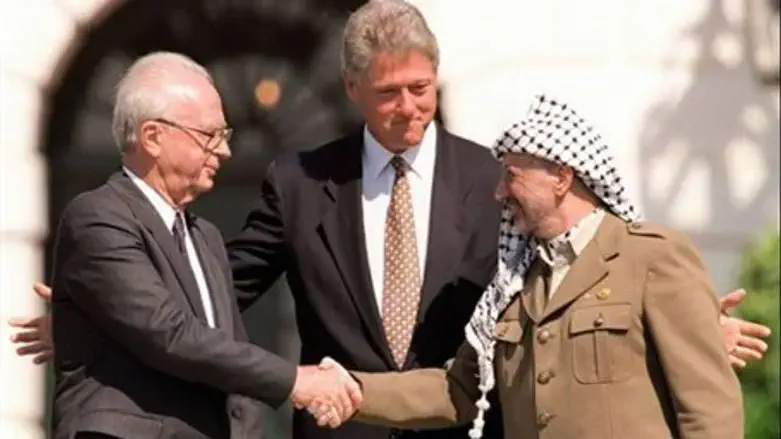
The Oslo Agreement, which has been responsible for so much devastation, was negotiated by a former Chief of Staff. Similarly, the Hitnatkut (withdrawal) from Gaza, which has become a Hamas launching pad for missiles and terror tunnels on Israel’s southern border (Ed. Note: and recently led to the most destructive and horrid terror attack in Israel’s history), was orchestrated by the hero of the Yom Kippur War.
Generals’ expertise is in the conduct of warfare. The decision to go to war is not a military, but a political one. So too is the issue of negotiation with the Arab enemies. Questions pertaining to “land for peace" and the “two-state solution" are political matters, and leaders of the Army are not especially qualified to deal with them. Sadly, the record shows that when these people decide that they should be the ones assuming responsibility for issues for which they have no special qualifications, tragic results can ensue.
The Temple Mount and the Limits of Expertise
This brings me to the matter of the status of the Har HaBayit (Temple Mount), which is the holiest place in Israel and the one most suited for prayer. There are areas where we may not ascend, according to Torah Law, because we are all in a state of ritual impurity. However, there are certain places where expert Halachic opinions maintain that we may visit.
Those who wish to do so are categorically prohibited from even uttering a word of prayer, because the Arab administrators of the site will not allow it. The Jews have always longed to return to Yerushalayim and all its holy places. When East Jerusalem was under Jordanian control, Jewish cemeteries were desecrated and Jews could not visit the Kotel (Western Wall).
All that changed in June 1967, when heroic Israeli soldiers shed much blood and fought gruesome battles to liberate the Old City and its holy places. Who can forget the immortal words of Commander Motta Gur, who simply declared, “Har HaBayit BeYadeinu" (“The Temple Mount is in our hands")?
Not for long. On that same day, Defense Minister Moshe Dayan, one of Israel’s military legends, made a misbegotten political decision to restore the “status quo" by relinquishing the day-to-day administration of the Temple Mount to the Jordanian religious authority known as the Waqf, who ruled that only Muslims could pray there; anyone of a different religion could not recite any religious supplications in that place.
A crucial decision such as that should not have been made by a Defense Minister. It should have been made by the government, which would have considered all the implications, especially the impact on religious Jews, and hopefully have come to a more just resolution. At the very least, the right of Jews to not only visit, but to also pray at their holiest site, should have been guaranteed.
It goes without saying that the generosity of Mr. Dayan was neither reciprocated nor appreciated. He was a great military leader, but he was making a major decision in an area outside his scope of expertise. Such was the sin of the spies. This syndrome afflicts us to this day. We must be cognizant of it and guard against it.
And we must develop the ability and capacity to think for ourselves and not be so beholden to “experts". According to Rashi, there was no real need for the spying mission as Hashem had already told them that He would bring them to a “good and ample land which flowed with milk and honey." (Shemot 3:8) Had they utilized their own Seichel (intelligence), they would have come to the proper decision. Instead, they allowed others, the experts, to do their thinking for them, with catastrophic consequences.
A “Holy Nation" is one whose members think for themselves in a rational manner and, while consulting genuine experts, retain the capacity to arrive at intelligent conclusions.
May we strive to reach that exalted level.
Shabbat Shalom.
Questions? Comments?
Please reach out to Mitch Rosner on WhatsApp at 054-426-3419 or by email at mitchrosner@gmail.com.