
Among the many sins recorded in the Torah, few carried consequences as far-reaching as the sin of the spies in Parshat Shlach.
The generation that had witnessed the Exodus from Egypt, crossed the Red Sea and stood at Mount Sinai found itself heading to the Promised Land. The fulfillment of centuries of longing was finally within reach.
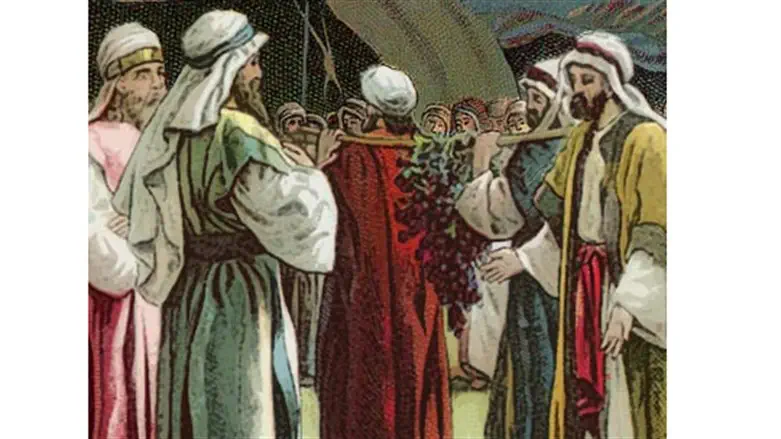
At G-d’s command, Moses sent twelve tribal leaders to scout the Land of Israel. For forty days they traversed its hills and valleys, returning with tangible proof of its extraordinary bounty. They carried a massive cluster of grapes so large that it required several men to transport it.
Yet despite the evidence before their eyes, ten of the spies returned with a message of despair.
Yes, the land was fertile, they conceded. But its inhabitants were powerful, its cities fortified and its challenges daunting. Fear quickly spread through the camp, and the nation began to question whether entering the Land was even possible.
Only two spies, Joshua and Caleb, refused to join the chorus of pessimism.
In one of the most stirring declarations in the Torah, they proclaimed: “The Land that we traversed to scout is a very, very good land" (Numbers 14:7).
The phrase demands attention.
Joshua and Caleb did not merely say that the Land was good. They described it as “מאוד מאוד" - very, very good.
Standing before the same landscape, the spies and Joshua and Caleb reached opposite conclusions. The former saw obstacles and became paralyzed by fear. The latter saw challenges but understood that no national mission worth pursuing comes without difficulty. Their faith enabled them to recognize what the others missed: that Eretz Yisrael was not merely a destination, but a calling.
Indeed, throughout the Torah, the Land of Israel occupies a unique place in G-d’s relationship with the Jewish people. It is the land promised to Abraham, Isaac and Jacob. It is the place where the nation was meant to build its society, fulfill its destiny and bring holiness into the world.
This is why the sin of the spies was so severe.
The Torah describes their conduct as דיבת הארץ, spreading an evil report about the Land. They did not merely express concern about military dangers. They transformed legitimate challenges into a rejection of the very gift that G-d had prepared for His people.
The Sages were deeply troubled by this. In Tractate Arachin (15a), the Talmud states: “Rabbi Elazar ben Perata says: Come and see how severe is the power of evil speech. From where? If the spies, who spoke evil about wood and stones, were punished so severely, how much more so one who speaks evil about his fellow."
The comparison seems surprising. Ordinarily, we think of slander as something directed against human beings. Yet the Sages understood that Eretz Yisrael occupies a special place in Jewish life. To malign the Land was not simply to criticize a geographic location. It reflected a failure to appreciate one of the greatest blessings G-d had bestowed upon the Jewish people.
In his glosses to the Rambam’s Sefer HaMitzvot (Positive Commandment 4), the Ramban writes that we are commanded, “to possess the Land that G-d gave to our forefathers… and not leave it in the hands of another nation or desolate." Eretz Yisrael is not merely the backdrop of Jewish history; it is one of its central pillars.
Perhaps this is why the punishment was so harsh.
The generation of the wilderness had experienced miracle after miracle. They had seen G-d’s power revealed in ways unmatched before or since. Yet when confronted with the challenge of entering the Land, they lost confidence in themselves and in their future.
As a result, they were condemned to wander in the desert for forty years. And only the next generation entered the Land.
The tragedy of the spies is not merely an ancient story. It remains profoundly relevant today.
We live in an era that previous generations could scarcely have imagined. After nearly two thousand years of exile, the Jewish people have returned to their ancestral homeland. Hebrew once again fills the streets of Jerusalem. Jewish sovereignty has been restored. The land has flourished, absorbing millions of immigrants and becoming a center of Torah learning, innovation and national renewal.
And yet there are still those who speak about Israel primarily through the language of complaint and criticism. They focus exclusively on its imperfections while ignoring its extraordinary accomplishments. They see only the difficulties and overlook the miracle.
Of course, no country is perfect. Israel faces serious challenges, both from within and from without. But so did the Land encountered by Joshua and Caleb.
The question is not whether challenges exist. The question is whether we allow those challenges to define our view of the Land.
At the decisive moment in the wilderness, ten leaders looked upon the Land and found fault with it. Two looked upon the very same hills and valleys and declared, “טובה הארץ מאוד מאוד", “the Land is very, very good".
More than three thousand years later, the challenge remains the same. Will we speak about the Land as the spies did, dwelling on its shortcomings and dangers? Or will we view it through the eyes of Joshua and Caleb, recognizing it as the Divine gift it so clearly is?
The future of the generation in the wilderness was determined by how it answered that question.
Ours may be as well.