Dvar Haftorah: Behar-Bechukotai
Returning to ourselves
This week's haftorah is a profound statement about resilience, about the ability to endure and even thrive amid adversity when one’s foundations are properly rooted.
This week's haftorah is a profound statement about resilience, about the ability to endure and even thrive amid adversity when one’s foundations are properly rooted.
We moved from existential fear as described in the parasha to the heights of national renewal, with the climax being the liberation and reunification of Jerusalem, together with the return to Yehudah and Shomron.
Why did G-d interrupt the sequence of the mitzvot of the Kohanim with the mitzvot of the Festivals?
In a double expression in Parshat Emor, the Torah teaches an important lesson on the responsibility of adults to guide youth and the central role of refined speech and the importance of respectful communication and moral leadership within Am Yisrael.
This week's parasha speaks of sanctifying G-d's Name, Kiddush Hashem. At the Golder's Green attack, nobody intended to perform this commandment, but it shone forth from them.

The meaning of “holy" is entwined with the sanctification of the Divine Name. How is that done?
The Hebrew word for charity, tzedakah, derives from tzedek, meaning “justice."
How the saintly Rabbi Yaakov Moshe Charlap, rav of the celebrated Beit Knesset HaGra in Jerusalem, acted with regard to the Haftarah when Parashat Kedoshim was read without being preceded by Acharei Mot.
The Torah portions of Acharei Mot and Kedoshim reveal the deeper role of Yom Kippur as the lasting day of forgiveness and true acceptance of the Torah, offering new insight into its connection with Shavuot.
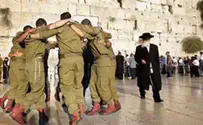
In these terrible times of war, in these terrible times of killings and the murder of Jews-times of Acharei Mot-we still remain Kedoshim.
The Rambam teaches that we must say a blessing before we eat any food or enjoy pleasant aromas.

Could it be that what we commemorate on Yom Haatzma'ut is not merely a political milestone, but the unfolding of a prophetic promise?
Various commentators are brought to bear on the reasons for the two fates for the two he-goats of Yom Kippur.
On Yom HaZikaron, as we stand in the depth of loss, we see what Rabbi Akiva shouted: We are one family. The soldiers currently on the front lines and those who have fallen do not check who is "religious enough" or "political enough.
In our prayers, we often ask Hashem to bless us with יְשׁוּעָה וְנֶחָמָה, salvation and consolation. Throughout our history, as they do this week, the two come together.
Lessons from the Torah portions of Tazria and Metzora, the exact middle of the Torah, and how all three connect to the days of the Omer.
Isaiah’s magnificent, inspiring prophecies are coming true before our very eyes. They are no longer a matter of faith: they are now tomorrow’s headlines.

A parent’s attachment to their child can become at odds with the imperative to act in the best interests of the child.

We remember a world that was destroyed, we look at the threats we face right now, and we are left with that same unanswered question: Why?
The tragic deaths of Nadav and Avihu in Parashat Shemini warn of the terrible danger of humans following their own decrees instead of G-d’s, even when they have the holiest and most exalted of intentions.

To act based on instinctive feelings of right and wrong, or even powerful religious inspiration, is to undermine the principle of Divine Revelation.
The midwives saw to it that a healthy body was accompanied by a healthy soul. So must we.
In this week's parasha, Leah thanks G-d when Yehuda is born and we thank G-d every morning before we get out of bed.
We should learn from Tzelofchad’s mistake, and stay focused on that which is enduring and eternal, and not confuse the way-station for the final destination.
The daily lifting of the ash, which was performed by the Kohen as part of the Temple service, did not serve the practical purpose of keeping the Altar clean. What then was the objective of this Mitzvah?
When you give ten thousand dollars to charity, do you think about how much gratitude you deserve or how grateful you are to help?
The letter alef (א) at the end of the word ויקרא is written smaller than the rest of the word. Many explanations have been given for this unusual phenomenon, but the Zohar's is an entire way of looking at the commandments.
What kind of blessing is it when Yaakov prays that his grandchildren increase like fish in the land?
Young religious Zionist scholars find connections between each week's Torah reading and the Holy Land.
As part of the Jewish people we must shoulder the weight of our collective destiny and responsibility for the welfare of our people.
If these are commandments, where is the command?

What prompts Moshe to raise his hands, and what significance does this gesture hold?
The Torah puts the verse regarding the commandment of Not Eating Blood next to the commandment of Orlah (Lev.19:23). Why?
Selected leading rabbis share their thoughts on this week's Torah Reading.

There is a contrast between the type of charitable giving in Parashat Terumah and Parashat Ki Tisa.
The real summation of Jacob’s last years emerges in a conversation he has, not with Joseph, but with Pharaoh.

Israel's first Chief Rabbi: Beware of beauty that covers up morally repulsive behavior.
Weekly Torah Study: Pinchas.
You will see them with their knitted kipot, M16s over their shoulders, returning from a shiur by the rosh yeshiva, an IDF officer. And you?
The parasha in halakha, mussar, and with words of chizuk .

Everything that is uttered from our mouths obligates us to the commitment attached to it.
A selection of rabbinic commentaries on the question.
Today in Israel religious soldiers prove to be dedicated fighters. Like the fighters in the parasha, they know what they are fighting for. .
The greatest framework of spiritual life without which that life begins to wither and die is consistent, constant faithfulness to mitzvot.
Jewish tradition does not often create aphorisms in vain. Here is the story of the first shlemiel.
The essence of the kohanic personality is to be responsible for the nation, overriding his personal interests.
Young Israeli Torah scholars: The connection between the land alloted each tribe and the tribe is substantive and above human comprehension.
Israel's first Chief Rabbi: Why is idolatry so intrinsically vile? Because instead of elevating us, it lowers us to coarse physical levels.
Diminutive in size, giant in spirit, Medinat Yisrael has made the world stand still more than once since its re-establishment 74 years ago.

The Chief Rabbi’s weekly insight for Parshat Vayechi.
What could have been a swift though painful meeting becomes a drawn out process. What was Joseph’s purpose behind these actions?
Yosef seemed to have allowed his emotions to overpower his judgement. Was this a failure of character?
The story of Jacob wrestling with an unnamed adversary and his new name Israel is essential to understanding what it means to be a Jew.
What are the three greatest challenges facing the Jewish people?
In his very essence Yaacov was diametrically opposed to his illustrious father and grandfather.

Literally meaning a “heel”, the Hebrew word “eikev” evolved to denote a mark left by the heel, a foot-print - and more. All in Jacob's name.
Rabbi Sacks z’’l prepared a full year of Covenant & Conversation for 5781, based on his book Lessons in Leadership.
Could others, even those seemingly much less worthy than Abraham, be part of the Divine plan of tikkun?
In this 3-min. video, Baruch Gordon answers the question, "If Moshe didn't merit to enter the Land of Israel, why should we?"
Perhaps Elul should signal a new direction for us to take, especially for this coming year.