
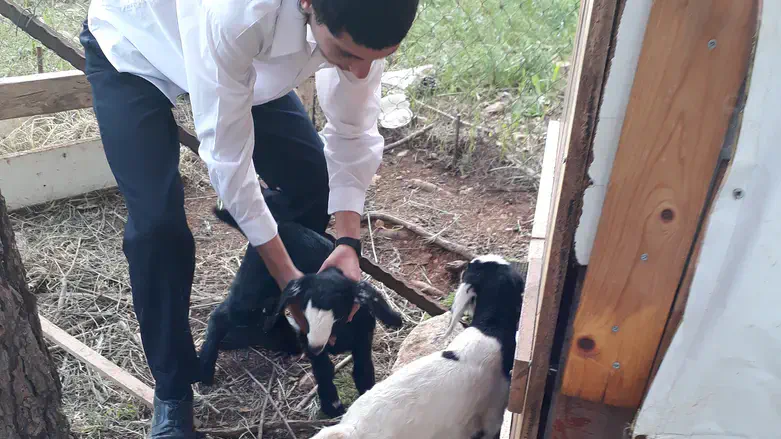
Our Parasha describes in detail the order of the service of the Kohen Gadol on Yom Kippur.
We read:(16:1- 10) ’Hashem said to Moshe: Speak to Aaron your brother:. From the Assembly of Bnei Israel he shall take two he-goats for a sin-offering.: he shall take the two he-goats and stand them before Hashem, at the entrance of the Tent of Meeting. Aaron shall place lots upon the two he-goats :one lot ‘ for Hashem’ and one lot ‘for Azazel’.
‘Aaron shall bring near the he-goat designated ‘for Hashem’, and make it a sin-offering. And the he-goat designated by lot ‘for Asazel’ shall be stood alive hefore Hashem, to provide atonement through it, to send to Azazel to the Wilderness.’
Abarbanel expounds: As to the two he-goats, my mind is that it alludes to the twins - Yaakov and Esav, to both of which שעיר can be applied - to Esav because of his nature, and that Yaakov because he was the צעיר - the younger, the letters ש and צ being interchangeable, as is known.
As to the lots, although the two were twins, by Hashem’s grace, Yaakov was separated to be Hashem’s lot, whilst Esav was distanced from the service of Hashem and His love - and it is to this, that the lots allude.
Behold: the he-goat whose lot was ‘to Hashem’, its innards were offered on the altar, in the Holy of Holies, whilst the one whose lot was ‘to Azazel’ was cast out to the Wilderness - Esav already in his youth, being a man of the field who knew hunting.
It is clear then, that Esav was not cast as an offering to Azazel - as some have posited - but cast out to distance him from men, as a sign that Hashem has distanced him from Him, and from advocating against Israel.
All of this to be a message to Bnei Israel to repent.
Another way to understand these matters, is that the two he-goats are an allusion to the congregation of Bnei Israel at different times - when they are good and upright, they will cleave to Hashem, and their innards - meaning their thoughts - will be as an offering on the altar of Hashem, alluding to their cleaving to Hashem and will merit life in the world-to-come- ‘All of this is encompassed in the ‘lot for Hashem’ - the word גורל meaning their reward and destiny.
If - on the other hand - they are unworthy and not righteous and not mindful of the mitzvot and Hashem’s honor, their lot is ‘for azazel’, to be cast away from their land, and exiled from it - distanced from the holy place.
The Kli Yakar comments: The two goats he-goats are very like the two he-goats that Yaakov prepared for Yitzchak - one in the manner that his father liked as his delicacy - in the manner of a physical bribe to Satan, to persuade him to enable Yaakov to take the blessings from the second - as the midrash says - this occurred on the first day of Pesach of Hashem.
So too, for generations, by these two he-goats, Satan was given his share, so that Yaakov would receive his share from the lot that was ‘for Hashem’ - and, as the midrash concludes - ‘the goodly he-goats: good for you, and good for your sons, as, by them, they receive atonement on Yom Kippur.’
'And the he-goat bore all their transgressions’ :this is only right, as Yaakov was an איש תם: a pure soul, and we are told that ‘one who causes many to transgress, bears their sins’ - and Satan and Edom are always seeking to cause Israel to stray - so that the ‘blessing’; ‘should Israel stray, you can remove their yoke from you’, will be fulfilled.
It is therefore right that they bear the sins they have caused the sons of the ‘pure one’ to perform.
The fate of their representative - the he-goat ‘for azazel’ - is to be sent away, fulfilling the prophecy: (Yoel 2:20) ‘And the tzfoni ‘ - an allusion to Satan- ‘I shall distance from you, and cast him to a barren land’.
The Meshech Chochma notes that, in the prayers on Yom Kippur, mention is made of the transgression of שבטי ישורון: ‘the tribes of Yeshurun’, words not found in any other prayer.
He expounds that this alludes to the tribes action in selling Yosef, which must be atoned for.
He adds: Our Sages, in the Yerushalmi, ask rhetorically:’Why doesn’t the Kohen Gadol perform his Yom Kippur service, in the garments of gold?’ - and answer:’The accuser cannot act as the advocate’ - yesterday they made for themselves a golden calf, and now they want to serve and seek atonement in garments of gold?!
Our Sages add: every transgression throughout the ages, includes a part of that transgression - meaning that the atonement of Bnei Israel in the inner Sanctuary, still carries the impression of that transgression - the weight of the tongue of the scarlet thread of the he-goat sent to the Wilderness, being two selaim, alluding to what is said in the Gemara (Shabbat 10:2):’one should never favor one child over the others, as because of the coat of two selaim which Yaakov made for Yosef, his brothers envied him - this leading to the exile to Egypt of Bnei Israel.’
This perhaps is why the atonement was in the part of the Sanctuary which was in the section of Binyamin, as he, alone of the tribes, did not participate in the sale of Yosef.
This transgression attached to all generations who still hold in the ways of Yosef’s brothers - Hashem says: ‘Should I have mercy on those who do not have mercy on their fellow men?’.
When Bnei Israel hold in this sinful way, transgressing in matters between man-and-man, the sin of the sale of Yosef by his brothers, is held against them.
This is why the Kohen Gadol does not enter the inner Sanctuary wearing the Choshen, on which the names of the tribes are inscribed as a remembrance before Hashem, when the names of the tribes awaken the memory of that transgression, when we are praying for atonement.’
Concludes the Sage: This is why - in our prayers on that day - we say: Because you are סלחן לישראל:: ‘forgiving to Israel’ - this for transgressions between man-and-Hashem- the root of which is in the sin of the golden calf - AND מחלן לשבטי ישורון: ‘forgiving to the tribes’- for sins between man-and-man, the root of which is the sale of Yosef by his brothers - the transgression of the tribes.
Rav Pinchas Friedman brings the exposition of the Meshech Hochmah and, based on it, elucidates these lofty matters.
He comments: Since both he-goats bring atonement for the transgressions of Bnei Israel, why is only the one offered on the altar in the Sanctuary, and the other not offered on the altar, but cast off into the Wilderness?
Rashi expounds the need for the two he-goats - as both atone for our sins: ‘the one ‘for Hashem’ atones only for those who enter the Sanctuary whilst they are impure, whilst the other one atones for all other transgressions, both minor and major.
This raises the question: as the one atones ‘for all.. transgressions, both minor and major’, why is there a need for the other he-goat?
More so, why the two he-goats are required to be identical physically in every respect?
The Meshech Chochmah (as we have brought above) - answers that the sin of the sale of Yosef by his brothers, AND the sin of the golden calf, each require atonement in every generation.
Why?
Because whenever we transgress in mitzvot between man-and-man, we awaken the sin of Yosef’s brothers - who acted out of hatred of their brother - and, similarly, when we transgress mitzvot between man and Hashem, we arouse the transgression of the golden calf.
Each requires separate atonement, since our Sages teach that: ‘Yom kippur atones for transgressions between man-and- Hashem, but transgressions between man-and-man are not atoned for until the offended party is appeased by the person who offended him.'
We learn a major foundation from this: When there are in Bnei Israel transgressions of mitzvot between man-and-Hashem, this awakens the transgression of the golden calf - AND, similarly, when there are transgressions between man-and-man, the sin of the sale of Yosef by hos brothers, is awakened.
Hashem therefore commanded that, on Yom Kippur, there has to be atonement for both of these transgressions - the golden calf, as it is the root of all sins between man-and-Hashem, AND for the sin of the sale of Yosef by his brothers, as it is the root of all transgressions between man-and-man.
The two he-goats are brought as atonement for these two root transgressions, thereby bringing atonement for all the transgressions of Bnei Israel, ‘minor and major’.
The Meshech Chochmah expounds that the Kohen Gadol does not enter the Sanctuary - which is in the portion of Binyamin- with the Choshen which bears the names of all the tribes, so as not to arouse the brothers lack of mercy of Yosef, when we come to plead for mercy from Hashem.
This is the reason why we pray -only on Yom Kippur - for atonement ‘because You are forgiving to the Tribes of Yeshurun’ - having in mind all transgressions between man-and-man, the root of which is the sale of Yosef by his brothers - as well as our prayer: ‘Because you are forgiving to Israel’, having in mind all transgressions between man-and-Hashem, the root of which is the sin of the golden calf.
It is also for this reason that Hashem commanded that two he-goats be taken, as one would not have sufficed, there being a separate need for atonement for transgressions between man- and man, AND one for transgressions between man-and-Hashem - the he-goat on whom fell the lot of ‘for Hashem’, was to atone for transgressions between man-and-Hashem, whilst the one on which fell the lot ‘for azazel’, was to atone for sins between man-and-man.
This is why the former was offered on the altar in the Sanctuary, as it was to atone for transgressions against Hashem, to ask His forgiveness for offences against Him and the place where His shechinah dwelled.
On the other hand, it was not proper that the he-goat brought to atone for transgressions between man-and-man be brought and offered in the Sanctuary, as it was in the portion of Binyamin, who was not party to the sale of Yosef by the brother, and it was therefore cast away from there, to the Wilderness, as befits such conduct.
The requirement that the two he-goats be identical, is the same reason that the two tablets on which the Ten Commandments were inscribed - the commandments on the right side being those between man-and-Hashem, and those on the left side, the commandments between man- and-man, to teach that we are to observe both with the same completeness, as both were given ‘by the hand of Hashem’.
A parting gem from Rav Yosef Salant: What lesson can we derive from these two he-goats that the Torah commanded to be identical at the outset, and in the end, to suffer such different fates - one to be offered in the Sanctuary, and the other, to be cast to the Wilderness?
From this we can learn a mussar lesson, about two people, who on this, the holiest day, equally stand before Hashem no, and whose fate is determined on this day.
Their lot is that one was elevated, ascending - as it were - to enter the inner sanctum of the Sanctuary, this because he has with all sincerity repented - the he-goat which was brought into the Sanctuary, alludes to that man.
The other man, sadly, was not moved by the sanctity of the day, and was not moved to repent - and, as one transgression inevitably is followed by another, descended until - as it were - he ends up - spiritually - in ‘azazel’.
This is the situation of two people on Yom Kippur, who, at the outset, identically stand before Hashem, without any outward sign as to which one is ‘for Hashem’, and which one is ‘for azazel’- only Hashem, who knows what are the thoughts of men on the Day, knows to where their hearts will take the two men.’