
For the week of Yom HaShoah and Parashas Tazria-Metzora)
This week, as we observed Yom Hashoah, we remembered the six million Jews who were murdered-one third of our people. But for us, this memory isn't just about the past. After two years of war, and with the recent terror and missile attacks on Israel, we are facing a painful reality. Why, after the horrors of the Holocaust, are we still suffering through war and facing people who want to destroy us?
How are we supposed to understand what is happening from the Torah’s view? And what can we learn from Parashas Tazria-Metzora today?
Our job isn't to explain exactly why tragedies happen. On a deep level, we can’t truly understand why things go the way they do. Instead, the real question is what these moments ask of us-how we should respond, and how we can grow from what we are going through.
There is no simple answer that gives us certainty. We don't understand why we have lived through so many years of war, why peace feels so far away, why the North is still under threat, or why missiles keep being fired at us.
Why? Why? Why?
We ask the question, but we don’t have the answer. On Yom Hashoah, that question felt even heavier because of what is happening today. We remember a world that was destroyed, we look at the threats we face right now, and we are left with that same unanswered question: Why?
The Contrast of Clarity
Chazal teach (Arachin 16a) that tzara’at was a result of harmful speech. If that’s true, you would expect it to exist in every generation. Yet, we don’t see tzara’at today. This is something we need to think about.
There is also a teaching in the Midrash (Vayikra Rabbah 15:7) that the word vehayah usually points to joy. How can a word about joy appear in a talk about tzara’at? The Torah says, “vehayah be’or besaro le’nega tzara’at"-“and it will become an affliction of tzara’at."
Rabbi Moshe Alshich explains a powerful idea. Tzara’at wasn't just a consequence. It was a sign for someone on a very high spiritual level. Because that person was so refined, even a small mistake in their speech showed up immediately on their skin. The body acted like a mirror, showing exactly what was happening inside so the person could recognize it and fix it.
The Alshich explains that this sign only appeared on someone so sensitive that even a small slip-up became visible on the outside. This is why the Torah uses the word vehayah-אין והיה אלא לשון שמחה-because there is joy in knowing that G-d is teaching us and showing us how to return to Him with great mercy.
The Reality of the Present
We aren't on that level today. Because of that, we don’t see tzara’at. Its absence is a loss of clarity; it means the way G-d's guidance shows up in the world has changed. We no longer have that direct link between a specific action and a visible sign on the body.
When tzara’at existed, there was clarity. The problem was out in the open. It was painful, but it was precise. You knew exactly what needed to be corrected.
A simple analogy: If a paper has one mistake among many right answers, that mistake is easy to find and fix. But if the whole paper is a blur of uncertainty, no single mistake stands out.
Tzara’at represented that kind of clarity. We no longer live in that system.
When tragedy happens today-whether it's the memory of the Holocaust or the missiles we face this morning-we aren't given a clear sign that lets us point to a specific cause. We can't say for sure, “this is why it happened." What is asked of us is not an explanation, but a response. We aren't meant to figure out G-d's ways, but to honestly look at how we can improve our own behavior, our speech, and how we treat one another.
The Lesson of Tazria-Metzora in Times of War
We don’t understand why we still have to struggle to survive, why families in the North are still away from home, or why our soldiers are still in danger. We live in a time where the guidance is hidden. But we believe, quietly and firmly, that we have survived until now, and we will continue to survive.
The double portion of Tazria-Metzora reminds us that even when we are dealing with "afflictions"-whether as individuals or as a nation-the goal is always to grow and start fresh. We aren't given a reason for the war or the threats. We are simply given life. And with that life comes the responsibility to live with more care.
The message of this week’s Parashot is that while we can’t control the "signs" in the world, we can control our own words and actions. In a war that tries to divide us, we respond by working on our character. We choose to be:
- More careful with our words-refusing to create more tension among our own people.
- More sensitive to the pain of others-especially those who have lost so much in this conflict.
- More honest with our own lives-thinking about how we can be better people.
- More committed to the Torah and to what is right.
This is what we have. This is how we move forward from the darkness of the Holocaust into the challenges of today's war. We build, we grow, and we remain-knowing that נצח ישראל לא ישקר, the Eternal One of Israel does not lie, and our people will endure forever.
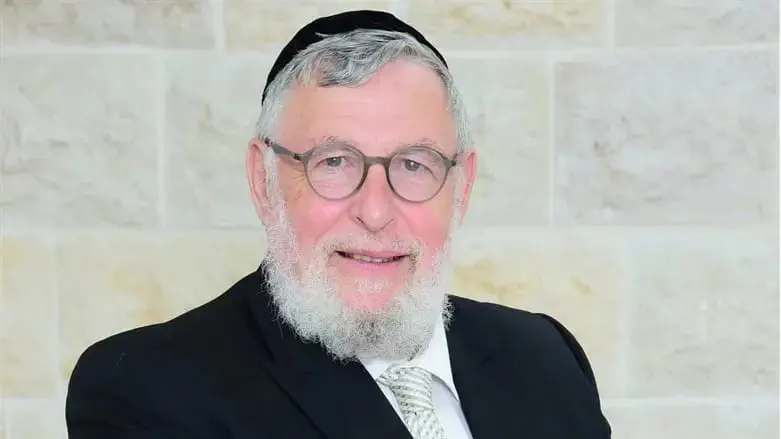
Rabbi Eliezer Simcha Weisz is a member of the Israeli Chief Rabbinate Council.