
Edited by B. Silberstein
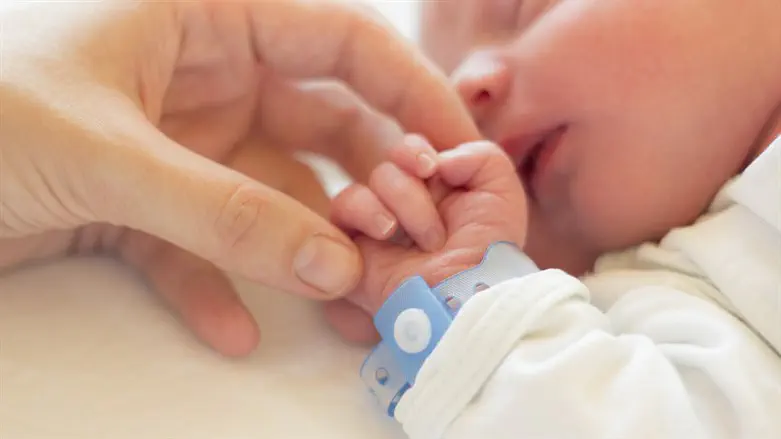
This week’s Parshiyot, Tazria and Metzora, discuss procreation. The Torah describes the laws as follows:
“When a woman conceives, and bears a male child; she shall become Tamei (ritually impure) for seven days; as in the days of her monthly Niddah (menses cycle) period when she is Tamei. For thirty-three days she shall continue with Demei Tahara (blood of her ritual purification); she shall not come into contact with anything Kodesh (ritually holy, i.e., things associated with the Holy Temple/Tabernacle) nor enter the Mikdash (Tabernacle/Holy Temple) until she has completed the days of her ritual purification." (VaYikra 12:2,4)
For a female child, these periods are doubled: fourteen days of Tumah (ritual impurity) followed by sixty-six days of Demei Tahara. At the conclusion of these days, the mother must bring two sacrifices, an Olah (a burnt offering) and a Chatat (a sin offering). When she has done so, she is restored to her complete state of ritual purity, or Taharah.
The Problem: Childbirth, Tumah, and the Sin Offering
A number of questions arise.
Firstly, what is it about the birth process that causes ritual impurity?
Secondly, we need to understand why the time period is twice as long for a girl as it is for a boy.
Thirdly, why would the gender of the child affect the duration of the Tumah?
Fourthly, and most challenging of all: the mother is required to bring a sin offering. What transgression has she committed? After all, bringing a child into the world is one of the greatest Mitzvot.
To the contrary, I would think that the woman deserves a great reward. The Rabbis say, “According to the pain is the compensation." (Pirkei Avot 5:22-23) What Mitzvah entails more exertion and discomfort than pregnancy and childbirth? Not to mention the pain and anxiety involved in raising children. In my opinion, the sacrifices women make in the process of reproduction cannot be matched by the requirements of any other Mitzvah. So why must she bring a sin offering?
The Nature of Parental Love
While it is true that bearing and raising children appears to be the most noble expression of giving, the matter is not so simple. What motivates a parent, specifically the mother, to assume such a physical and emotional burden? Certainly the desire to perform a great Mitzvah plays a role. However, the most significant impetus is the sheer power of the maternal instinct, which is a mighty force to be reckoned with.
Let us consider: Parents tend to regard the many deprivations they suffer for their offspring as examples of pure selflessness. But in actuality, that is not the case. The child is a very significant extension of the parent, who identifies with the child’s successes and failures. Nothing is more aggravating than to see one’s child in pain, nor more joyous than to witness one’s child succeed and flourish. Indeed, there is nothing more selfish than parental love. And selfish is not necessarily bad.
Judaism is fully aware of this anomaly and recognizes the difficulty it engenders. For if the parent’s attachment to the child is rooted in selfish motives, it can become at odds with the imperative to act in the best interests of the child.
The Torah’s Framework: Reframing the Parent-Child Relationship
Therefore, the new mother needs to withdraw somewhat from this intense primal love and modify her orientation to the child. What is the appropriate attitude that parents should have towards their offspring?
The Midrash on Mishlei (31:2) records a fascinating story about Bruria, the wife of Rabbi Meir, who was regarded as a great scholar in her own right. The couple had two young children who died on a particular Shabbat. Bruria kept the news from her husband until the day was over. She then gently eased him into acceptance of the bad tidings by asking him if an object that had been lent to her years earlier must be returned. He replied in the affirmative. She then led him to the bedroom where the lifeless bodies of their two sons lay. She reminded him that he had just told her that borrowed items must be returned. He proclaimed:
“Hashem gave, and Hashem has taken away; blessed be the name of Hashem." (Iyov 1:21)
These are not just words uttered to ease the pain; they express a philosophy that we all need to accept and internalize. The child does not belong to us. He is not there to gratify our personal needs. Children belong to Hashem, Who has entrusted us with the holy mission of raising them to fulfill their ultimate human potential. If we discharge this responsibility properly, we will enjoy the greatest Nachat (contentment).
The Halachic Expression of This Idea
We can now make sense of the strictures that are placed upon a woman following childbirth. She needs to undergo a period of time to come to grips with the selfish feelings generated by the maternal instinct. The time is shorter for a male child, because, as the verse states, “And on the eighth day the flesh of his foreskin shall be circumcised." (VaYikra 12:3) Subjecting the child to this procedure goes contrary to the parents’ intense protective feelings. It makes the newborn a member of the “Covenant of Avraham Avinu," the Jewish community. The parents’ task is to raise him to be a source of blessing to that group.
The mother must also bring a sin offering, but not because she violated any commandments. Rather, it is because she has come under the grip of the most powerful instinctual force in human nature. She needs to atone for any harmful ideas or ambitions that might have come about as a result.
In my opinion, these ordinances indicate the supreme value the Torah ascribes to the role of women in raising children. While the particular laws apply to the mother, their philosophical implications are relevant to all of us. We must carefully scrutinize both our good inclinations and our evil ones. Genuine self-knowledge is the most vital prerequisite for a life of genuine meaning.
May we all merit to attain it.
Shabbat Shalom.