
The haftarah we read this Shabbat carries a quiet but significant story, one that resonates with particular urgency in our embattled world. But to understand it, we must first trace a fascinating thread through centuries of halakhic history.
The Rambam, in his listing of the haftarah readings at the end of his Sefer Ahava in the Mishneh Torah, prescribes that Parshat Acharei Mot be accompanied by a passage from Ezekiel 22, and Parshat Kedoshim by a reading from Ezekiel 20. Both passages are unflinching rebukes against the abominations committed by Israel, opening with the language of judgment: “hatishpot." In addition, there is a well-established principle governing combined parashiyot: When two are read together on a single Shabbat, the haftarah follows the second parsha - this case, that of Kedoshim: Ezekiel 20.
And yet, the common Ashkenazi practice for this week ignores all the above. For Parshat Acharei Mot, we read a passage from chapter 9 of Amos, beginning "Halo khivnei khushiim," a selection not even mentioned by the Rambam for either of these parshiyot. And when Acharei Mot and Kedoshim are read together, we still do not follow the general rule of the haftarah following the second parsha - Ezekiel 20. The passage from Amos remains the haftarah that is read.
The passage in question is a beautiful prophecy that combines criticism of Israel’s failings with an inspiring vision of redemption: “I will bring back the exiled of My nation, Israel. They will build ruined cities and settle. They will plant vineyards and drink their wine" (v. 14).
This departure from two rules in a single week demands an explanation.
The Mordechai (Megilla 831) offers a direct answer: the language of the haftarah from Ezekiel designated for Kedoshim - a catalogue of Israel’s failures and failings - is simply too harsh for us to publicly direct at the people of Israel and Jerusalem. Given the choice, we prefer not to read such a passage aloud.
This instinct finds support in the Mishna (Megilla 4:10), where Rabbi Eliezer forbids reading a similarly severe prophecy from Ezekiel 16 as a haftarah. The Gemara (Megilla 25b) sharpens this point with a telling story: a man who insisted on reading that prophecy in the synagogue was challenged by Rabbi Eliezer on the spot: “If you are willing to publicly attack the integrity of the Jewish people in Jerusalem, your own integrity deserves scrutiny." And indeed, upon examination, his lineage turned out to be questionable.
The Maharil and the Shulchan Aruch (Orach Chaim 428:8) both codify the preference for the Amos reading, and the Mishna Berura confirms that the reasoning is precisely the discomfort with the harshness of the Kedoshim haftarah’s language toward the Jewish people of Jerusalem.
What happens in the rare case when Acharei Mot and Kedoshim are read separately, each requiring its own haftarah? In practice, this rarely occurs. Whenever the two parashiyot fall on different Shabbatot, one of them almost always coincides with either Rosh Chodesh or Shabbat HaGadol, each carrying its own special haftarah that effectively displaces the standard reading and leaves room for Amos. But in the exceptional case when each parsha does need its own independent haftarah, the Mishnah Berurah (428:26) rules that there is no choice: Kedoshim must revert to its traditional Ezekiel reading, which focuses on the failures of the Jewish people.
Nevertheless, a contrary custom developed within the Yishuv Hayashan (the disciples of the Vilna Gaon that made up the Haredi community of Jerusalem in the early twentieth century). Rabbinic figures of that era, including Rav Yisrael Yaakov Fisher, took the position that one should never read a haftara that speaks ill of Jerusalem under any circumstances.
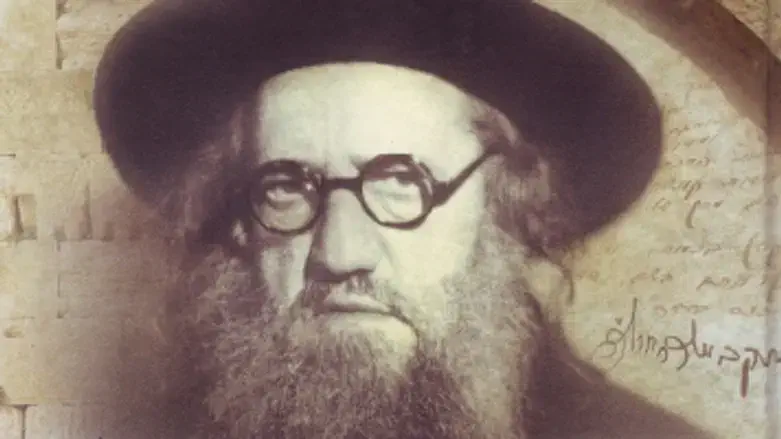
Rav Yaakov Moshe Charlap, disciple of Rabbi Avraham HaCohen Kook, and the revered rabbi of the celebrated Beit Knesset HaGra and of the Sha’arei Chesed neighborhood in Jerusalem, who later became Rosh Yeshiva of Merkaz Harav, acted on this principle. He cited the directive of his mentor Rav Shmuel Salant, the revered spiritual leader of Jerusalem's Ashkenazi community.
Rav Charlap held that even when Kedoshim falls alone, he would read the selection from Amos, "Halo khivnei khushiim", even if it meant repeating a haftarah that had already been read the previous week.
A moving story illustrates this impulse. One Shabbat, the regular baal koreh, who came faithfully every week to lein (read) the Torah portion and the haftarah, did not appear. Rav Charlap dispatched a messenger to his home. The reply came back: the reader had gone to pray at a different synagogue, fearing that Rav Charlap might on that particular Shabbat feel halakhically compelled to direct him to read the passage about Jerusalem's failings - and he could not bring himself to be the one to publicly read those words. Rav Charlap's response was immediate: He, too, would never read such a haftarah under any circumstances.
That episode, so small in its setting, carries an outsized message. Centuries of rabbinic tradition converge on a single principle: We are willing to bend standard protocols, to set aside prescribed sequences, and to depart from established norms, rather than allow the integrity of the Jewish people and the citizens of Jerusalem to be publicly called into question.
In our own day, when Israel's citizens are offering extraordinary sacrifice - in blood, in sleepless nights, in interrupted lives and shattered families - that principle is especially urgent. The courage and integrity of the people of Israel and Jerusalem are not to be condemned. They are to be celebrated and defended, in the Beit Knesset, the synagogue, as in the public square.
Rabbi Dr. Kenneth Brander is President and Rosh HaYeshiva of Ohr Torah Stone