Pirkei Avot
'If Not I' - we are responsible for ourselves
Others will not, cannot, and are not meant to be responsible in our place.
Why does Rabbi Akiva call it a "Big Rule", and not an "Important Mitzvah"...? What is 'Love your fellow as you love yourself' all about?
What does it mean to be holy?

Six essential facts that make the Holocaust a unique event in history and ten messages from a survivor.
Relationships between nations and races are shifting, so-called absolute laws of human behavior are being re-written, the East is rising.
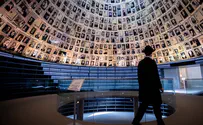
The two different dates indicate two different ways of looking at the Holocaust and the people the Nazis hoped to destroy.
Young Religious Zionist Torah scholars on the Parasha: In Eretz Yisrael we feel the joy and the sense that nothing is lacking in our lives.
We often ask for the things we need, but life is much happier, satisfying, and meaningful, when we ask what we are needed for.
The Tanya compacts four millennia of Jewish wisdom to answer the great personal and existential questions of life.
This week Israel reads Kedoshim and the Diaspora reads Acharei Mot. Arutz Sheva will alternate articles on both readings.
Rabbi Kook: Be strong...concerning the holy ways that our sacred ancestors and rabbis taught us...add to this a connection to the Holy Land.

Are Jews supposed to see everyone in a positive light?

The real significance of the Mimouna holiday is the door open to all who wish to enter.
This soulful prayer resonates acutely 4 times a year in Ashkenaz services, bringing even the non-observant to synagogue. A personal story.
This is the land promised to us. But we must believe it before we can tell the world. It is why we celebrate Passover!
Israel's first chief rabbi: In the Torah, the Jews were told to eat matza two weeks before Pesach, so what is the real reason we eat matza?
On the 4th day of Pesach 1,974 years ago a Roman soldier sparked a Jewish revolt. It took 7 years to defeat Jerusalem then. And now?
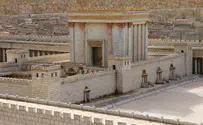
This week's Torah portion instructs us not to imitate the nations around us. Why is that? What is behind this concept?
Tzohar's Rabbi David Stav speaks to Arutz Sheva about the messages of Passover in the wake of current events and issues.
I always wondered what God was doing during the Seder at Bergen-Belsen when the Chief Rabbi of Rotterdam instructed Jews to eat chametz.
What are we "moderns" to make of the scapegoat to Azazel?
*Rabbi Jonathan Sacks* reminds us of the great secret of the holiday of Pesach: It's all about the children.
We need to renew our inner strength in this period of terror attacks. That is exactly what the Mimouna's message of joy and hope will do.
All you have to do is count until Shavuot, but it is not as simple as it seems.
Rabbi Haggai Londin, of the Sderot Yeshiva, speaks to Arutz Sheva about the essence of the Festival of Passover.

This is not just a technical counting. In order to receive the Torah, each year, we need to prepare.
Pesach on the 14th of Nissan and the Festival of Matzot which begins on the 15th and lasts for seven days are two separate Festivals
Rabbi Kook blamed Christianity's teachings for the Great War and its appalling cruelty and death, but did not advocate combatting it.
Moses received the Torah from Sinai, and gave it to Joshua, and Joshua to the elders, and the elders to the prophets.
Excerpt from the writer's book "With all your might." Two families, two Seders, one nation.
There are two and only two places where the Haggadah uses the expression, “in every generation.” What is the connection between them?
Who or what was the "destroyer" mentioned in the book of Exodus?
Israel's first Chief Rabbi: If we know the significance of matza and maror, we will understand Hillel's way of eating them.
What is this obsession with the number four at the Seder? It tells you how to deal with yourself and others.
Seder Night is all about asking questions. But is it really that important to ask questions? Why do we ask so many questions?
Delving into interpretations of Chad Gadya, the last song in the Haggada, among them the Vilna Gaon's perspective.

Focus on the wise son's question and possible answers that point to the experiential aspects of Torah observance.
Young religious Zionist Torah scholars: Is there a substantive connection between the mitzva of Pesacḥ and Eretz Yisrael?
How do you enable a person to come and partake of the Pesach experience if they have no desire; if they feel no need, no thirst?
Turning our attention to the deeper and spiritual meaning of removing Chametz. It is not just ridding our homes of Cheerios and breadcrumbs.
How to manage a Seder on Shabbat - and a primer for the holiday.
Seder night is reliving a great story, becoming part of the night it all started. Read here about its meaning and foundations of our faith.
All food needs a kosher for Passover certification, but there are things that do not. A helpful list.

The Tanya compacts four millennia of Jewish wisdom to answer the great personal and existential questions of life.
The rational child, the depressed child, the selfish child, and the apathetic child.

A wondrous midrash provides a clarification and way of looking at a difficult mitzva that we must observe on Pesach but all year as well.
Rabbi Sacks accompanies your Seder and the entire holiday in this choice of his unforgettable thoughts.
When you think of man, what comes to mind? How would you frame man? How would you label the first human, Adam HaRishon?
How to clean for Pesach, perform the search for leaven the night before the Seder, burn the chametz, and choose your matzot.

When both the beginning and end of a work refer to the same idea, it is the recurring theme throughout. Learn the Haggadah's structure.
Going out of exile requires joy. Depression and lack of life and enthusiasm are also characteristics of exile.
The Exodus from Egypt constitutes a revolution in the concept of reality.
In their memory
Israel's firrst Chief Rabbi and iconic leader of religious Zionism: Why do only Jews get tzora'at? What are the two levels of speech?
What is the worst part of this tale, that it happened or that we have talked so much about it?

Imagine a disease that looks like mildew on the walls of your home, but is of real concern.
Young Israeli Torah scholars: Rabbi Kook z”tl writes that wars raging anywhere in the world influence Am Yisrael.

In this week's Torah portion we read about leprosy of a home and of clothing. Why would an inanimate object have a spiritual disease?
The corruption of a soul that separates one from his holy essence and his people results in the spiritual eruption of Tzaraat and exile.
Shabbat ha-Gadol, “the Great Shabbat” before Pesach, commemorates our final Shabbat in Egypt, 3,334 years ago, five days before the Exodus.