

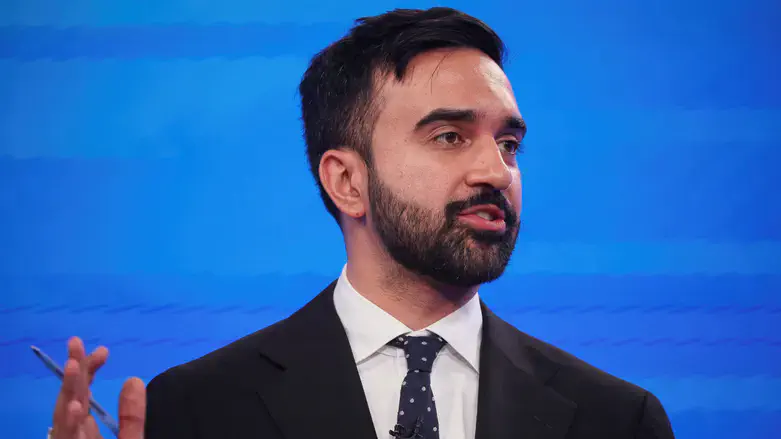
New York City Mayor Zohran Mamdani on Friday vetoed a City Council bill that would have allowed the NYPD to establish “buffer zones" around schools and educational facilities during protests, Politico reported.
The veto, Mamdani’s first as mayor, deepens tensions with Council Speaker Julie Menin, who is considering whether to seek an override.
The legislation was introduced as protests against Israel’s war in Gaza caused disruptions on local college campuses.
In a statement Friday morning, Mamdani said the bill defined educational institutions too broadly and raised constitutional concerns regarding the right to protest. He argued the measure could apply to universities, museums and teaching hospitals.
“This could impact workers protesting ICE, or college students demanding their school divest from fossil fuels or demonstrating in support of Palestinian rights," he said. “[The bill] is not a narrow public safety measure; it is a piece of legislation that has alarmed much of the labor movement, reproductive rights groups, and immigration advocates, among others, across this city."
Mamdani said he would allow a separate bill sponsored by Menin to become law, establishing protest “buffer zones" outside houses of worship.
He said that measure had initially raised constitutional concerns but that the final version “is narrower in scope and effect." He added that he does not agree with what he described as the bill’s “framing of all protest as a security concern."
“It requires the NYPD to document its existing practices related to protests near houses of worship," he said. “Following a thorough legal review, I do not believe it poses the same risks it once did, and that is why I will allow it to become law."
The houses of worship bill followed outrage over anti-Israel protests last year, including a demonstration outside an Upper East Side synagogue, in which demonstrators chanted “death to the IDF" and “globalize the intifada". The synagogue had rented space to Nefesh B’Nefesh, an organization that assists Jews moving to Israel.
Neither bill specifies the size of the NYPD buffer zones. Both measures would leave that determination to police on a case-by-case basis.
The Council passed the educational facilities bill, sponsored by Education Committee Chair Eric Dinowitz, with 30 yes votes, four short of a veto-proof majority.
According to two people familiar with internal discussions, Menin is considering trying to gather enough support to override the veto. No final decision has been made.
In a statement, Menin sharply criticized the mayor’s move.
“Ensuring students can enter and exit their schools without fear of harassment or intimidation should not be controversial," she said. “This bill simply requires the NYPD to clearly outline how it will ensure safe access when there are threats of obstruction or physical injury, while fully protecting First Amendment rights."
Leading Jewish organizations said they were “deeply disappointed with the decision."
“At a time when Jewish and other communities across our city are facing heightened threats, this legislation represented a crucial step toward ensuring that every school and community institution can be better protected," said a joint statement from UJA-Federation of New York, ADL New York/New Jersey, AJC New York, Conference of Presidents, JCRC-NY, New York Board of Rabbis, Orthodox Union, The Rabbinical Assembly, StandWithUs, Teach NYS and the Union for Reform Judaism.
“This veto is a profound failure of City Hall to demonstrate to all New Yorkers that our safety is a priority," the statement said.
New York City has seen a sharp rise in incidents of antisemitism since October 7, 2023, but tensions have risen even more since the election of Mamdani.
Mamdani, already under fire for his anti-Israel stance, caused an uproar on his first day in office when he cancelled executive orders related to Israel, which were issued by his predecessor, Eric Adams.
The move cancelled an order signed by Adams in June of 2025 formally recognizing the International Holocaust Remembrance Alliance’s (IHRA) working definition of antisemitism.
Another executive order which was cancelled prohibited mayoral appointees and agency staff from boycotting and disinvesting from Israel.
Mamdani has previously called Israel an apartheid state and supported the Boycott, Divestment and Sanction (BDS) movement.
He was also heavily criticized for his initial response to the anti-Israel protest outside Park East Synagogue.
Mamdani’s first reaction, delivered through a spokeswoman, “discouraged the language" used at the protest but also rebuked the synagogue, saying “these sacred spaces should not be used to promote activities in violation of international law", though it did not explain what about the work of Nefesh B’Nefesh can be construed as violation of international law.
He later shifted tone and published a clarification which omitted any criticism of the synagogue and emphasized protection of Jewish institutions amid rising antisemitism.
(Arutz Sheva-Israel National News' North American desk is keeping you updated until the start of Shabbat in New York. The time posted automatically on all Israel National News articles, however, is Israeli time.)