

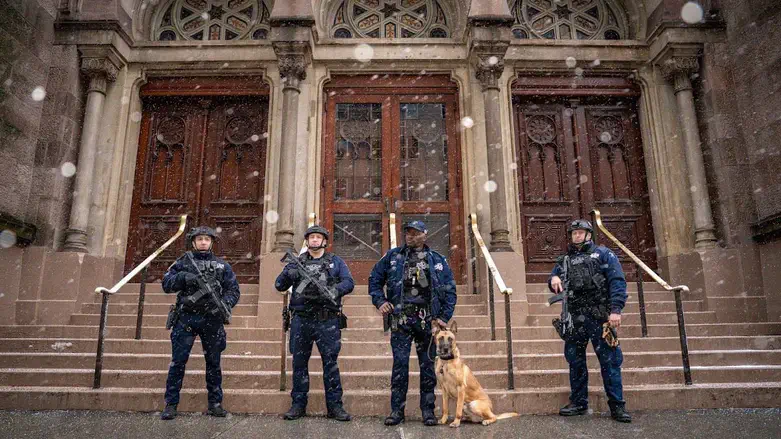
The New York City Council passed legislation on Thursday that creates protective perimeters around houses of worship and schools during protests, part of a package designed to combat Jew-hatred and hate crimes across New York City following an uptick of antisemitism and a series of demonstrations outside Jewish institutions.
"I am immensely proud of the legislative package the council passed today to combat hate, including my legislation to help protect safe access to houses of worship," stated Julie Menin, the first Jewish speaker of the New York City Council, as quoted by JNS.
"This is an urgently needed and carefully crafted bill that will ensure transparency, accountability and community engagement in NYPD plans to respond to protests, three pillars to protecting both public safety and free speech rights alike," she added.
Measures 1-B and 175-B, which Menin advanced, empower the New York City Police Department to set limits on how close demonstrators can gather near entrances to synagogues, religious schools and similar institutions to ensure unobstructed and safe access.
1-B passed with a veto-proof majority of 44 out of 51 members, but 175-B, which addresses educational institutions, passed with 30 to 19, making it subject to a veto by the mayor. Members who voted in favor of the package of bills but voted no on 175-B expressed concerns over legal issues and how it would affect student protests on campuses. Mayor Zohran Mamdani has suggested he could be reluctant to sign the bill.
Before the vote, Menin said that there was a 182 percent increase in antisemitic incidents in the city in January, and that churches had been vandalized and that there was a 69 percent increase in anti-Muslim hate crimes in 2024. "The increase in hateful acts across the city is absolutely abhorrent and we have to do something about it," she said in a press conference.
Left-wing groups, including the New York chapter of the Democratic Socialists of America, opposed the measure, encouraging their members to contact city council representatives to "hold the line against this crackdown on our right to protest." During the vote, the New York Civil Liberties Union and a coalition of anti-Israel advocacy groups protested outside City Hall.
Rabbi Marc Schneier, president of the Foundation for Ethnic Understanding, noted that he first presented the plan approved on Thursday to Mayor Zohran Mamdani just days after the election, as the then mayor-elect was traveling to meet President Donald Trump for the first time.
"When I first told Mayor-elect Mamdani at the time about this idea, he was completely on board. I am proud of NYC Council Speaker Julie Menin for taking action so quickly, especially as it was clear the mayor once again flip-flopped when it comes to protecting New York's Jewish community, and New Yorkers of all faiths. No one should have to be worried about protesters harassing them when entering a house of worship," Rabbi Schneier said in a statement.
New York City has seen a sharp rise in incidents of antisemitism since October 7, 2023, but tensions have risen even more since the election of Mamdani.
Mamdani, already under fire for his anti-Israel stance, caused an uproar on his first day in office when he cancelled executive orders related to Israel, which were issued by his predecessor, Eric Adams.
The move cancelled an order signed by Adams in June of 2025 formally recognizing the International Holocaust Remembrance Alliance’s (IHRA) working definition of antisemitism.
Another executive order which was cancelled prohibited mayoral appointees and agency staff from boycotting and disinvesting from Israel.
Mamdani has previously called Israel an apartheid state and supported the Boycott, Divestment and Sanction (BDS) movement.
He was also heavily criticized for his initial response to an anti-Israel protest outside Park East Synagogue in Manhattan in November, in which demonstrators chanted “death to the IDF" and “globalize the intifada". The synagogue had rented space to Nefesh B’Nefesh, an organization that assists Jews moving to Israel.
Mamdani’s first reaction, delivered through a spokeswoman, “discouraged the language" used at the protest but also rebuked the synagogue, saying “these sacred spaces should not be used to promote activities in violation of international law", though it did not explain what about the work of Nefesh B’Nefesh can be construed as violation of international law.
He later shifted tone and published a clarification which omitted any criticism of the synagogue and emphasized protection of Jewish institutions amid rising antisemitism.