

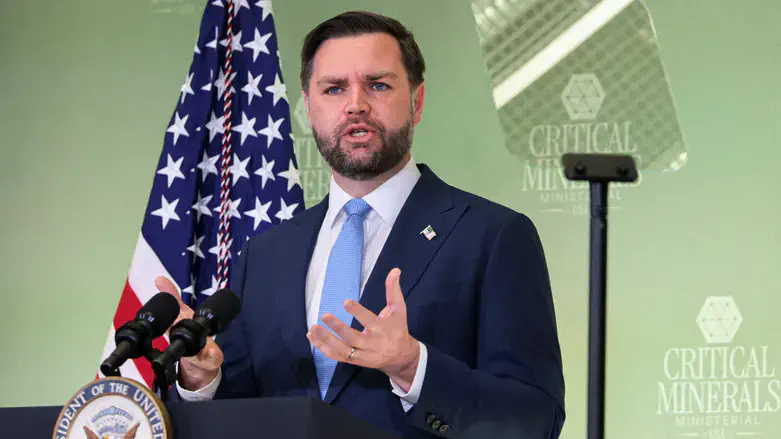
US Vice President JD Vance revealed on Monday during an interview with CNN that the newly established memorandum of understanding with Tehran is a remarkably concise document, spanning roughly "a page and a half."
He characterized the text as a high-level blueprint designed to leave intricate specifics to subsequent operational rounds of talks.
“Yes, so the MOU is about a page and a half, so it is a very general document," the vice president said.
Vance explained that while major logistical hurdles remain unresolved, the abbreviated pact creates a structured system of mutual accountability.
“On a number of issues, we are going to have to figure this stuff out during the technical negotiation phase, but what the MOU does is set up a framework whereby the Iranians get the benefits of the bargain by meeting their obligations under the bargain," he added.
The vice president emphasized that the very first section of the text sets strict, foundational behavioral guidelines for Tehran, outlining a mutual pledge toward regional pacification. Vance explicitly noted that this initial clause functions as a direct mandate for the Islamic Republic to sever ties with armed proxies.
“What paragraph one of the agreement says is effectively that Iran commits itself, just as the United States commits itself, to regional peace and stability," Vance said.
He reinforced the administration's expectation regarding this opening condition by stating, “Part of that is that the Iranians have to stop funding violent terrorist organizations, they have to stop funding regional instability."
Shortly after President Donald Trump officially announced the deal on Sunday night, the semi-official Iranian Mehr news agency published what it claimed to be the 14 foundational clauses of the agreement.
Under the reported financial framework, the United States must authorize the immediate release of $12 billion in frozen Iranian assets prior to the launch of formal negotiations. An additional $12 billion would then be unblocked during a subsequent 60-day final negotiation window.
Concurrently, all US sanctions targeting Iran's oil and petrochemical sectors would be suspended, and a comprehensive naval blockade of the country would be dismantled within 30 days.
According to the publication, the sequencing of the deal is absolute, meaning no final treaty discussions will take place until the initial $12 billion is unfettered, the energy sanctions are frozen, and the maritime blockade is removed.
A senior US official later rejected Iran’s claims that the Islamic Republic would receive billions of dollars in frozen funds before negotiations on a final agreement begin, calling the characterization a "spin."
Speaking to Axios’ Barak Ravid, the US official denied reports that Iran would gain unconditional access to $12 billion in blocked assets before the start of the 60-day negotiating period.
"This is completely not true. This is a pay-for-performance deal and no frozen funds will be released without the Iranians implementing their commitments," the official stated.