


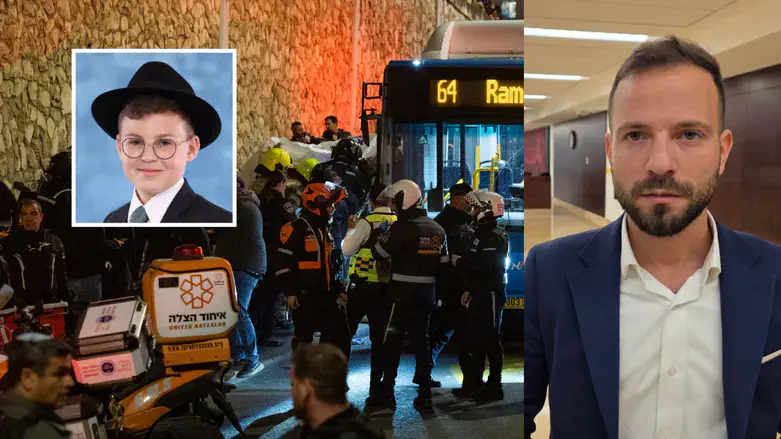
Yisrael Diskind, brother of the late Simcha Bunim Diskind, who was killed in the Meron disaster, spoke to Arutz Sheva - Israel National News hours after the deadly ramming incident at a haredi protest in Jerusalem.
The ramming left 14-year-old Yosef Eisental dead and multiple others injured.
In the interview, Diskind sharply criticized the protest's organizers, pointing out what he sees as a direct connection between the two incidents.
"It is absolutely clear that this death is an unnecessary death, a tragedy that should not have happened. A 13-year-old child should never under any circumstances return home in a coffin, whether he's coming back from Meron or from a protest, a legitimate democratic right in the State of Israel," Diskind began.
"We need to remember that, at the end of the day, there is a precise connection between the cases, because a child who returns home in a coffin from Meron and a child who returns home [in a coffin] from a protest in Jerusalem, it’s because of irresponsible businesspeople like the businesspeople [who organized the event] in Meron. They are the same people who were responsible for the protest yesterday, and every time, what they do is run and blame the State, blame the police."
Diskind also noted that the police provided the organizers with a designated area for the protest but that they did not act responsibly: "The police were not babysitters. They are not supposed to roam all the streets of Jerusalem to see where young, hot-headed people are going outside to the street to carry out [acts of] vandalism and anarchy."
"These organizers need to sit down today for a soul-searching, go to the Eisental family’s home - they didn’t come to ours - repent, apologize, and commit that in the next protests against the draft law, they will take responsibility so that after the protest, everyone returns home, and no child ends up in a situation where, God forbid, their parents have to sit shiva (the seven-day period of mourning after the death of a loved one - ed.)."
When asked if he differentiates between the businessmen and the haredi Knesset members, he replied: "Absolutely. The haredi Knesset members reach a point where those young people who incite and pressure them to act, come and protest. The businessmen try to dictate the tone within the haredi public, and they are the ones who also push the Haredi Knesset members, not allowing them to [support] the Draft Law."
Regarding the public discourse about the haredi community, Diskind told Arutz Sheva: "There is absolutely severe incitement against the haredi community. My brother did over 300 days of reserve duty since the war began, and still, he walks in the street and people shout ‘parasite’ at him. There is severe incitement here, there is heavy generalization, and we need to bring the situation to a point where, first of all, we pass a law that regulates this whole issue moving forward and [advances] a long-term process of haredi enlistment, and at the same time - nothing and no anger justifies hatred against the individual haredi."