

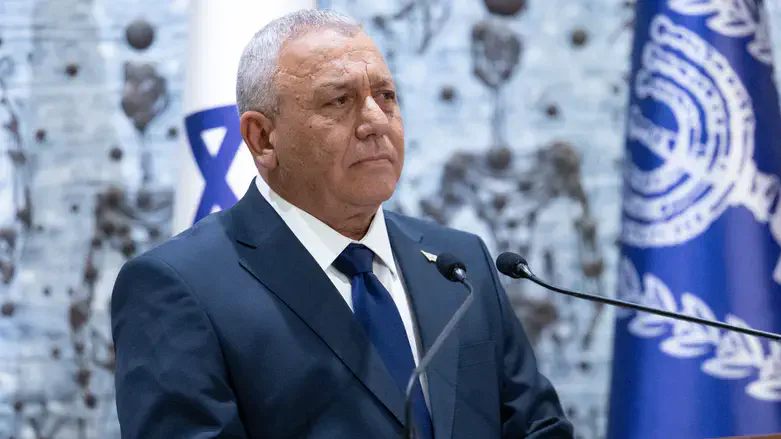
Over the past 24 hours, progress has been made in talks between senior officials in Gadi Eisenkot's Yashar party and United Torah Judaism (UTJ) as part of efforts to reach agreement on a conscription law and form a new government.
According to a Channel 12 report, the sides held meetings described by their negotiating teams as significant, but have not yet reached the stage of exchanging draft agreements.
Officials in UTJ's Degel Hatorah faction confirmed that progress had been made in the discussions, but stressed that an agreement was still a long way off.
The talks center on the conscription of haredi men, after an earlier framework presented by Eisenkot was rejected by Rabbis Landau and Hirsch, senior rabbinic leaders of the Lithuanian (non-hassidic) haredi community.
The rejected framework included a proposal to grant military service exemptions to haredi Torah students equivalent to 3% of the overall conscription cohort. According to the report, Eisenkot is expected to present haredi representatives with a revised framework this week, changing the number of haredi men eligible for exemptions.
At this stage, the talks are being held only with UTJ, not with Shas. Even if the talks produce an agreement, Eisenkot would still face the question of securing the majority needed to form a government.
Alongside the talks with UTJ, negotiating teams from Yashar and Likud met on Sunday for about four hours at a hotel in Herzliya.
During the meeting, representatives of the two parties discussed judicial reform, the establishment of a commission of inquiry and the conscription law. A rotation arrangement for the premiership was not discussed.
One disagreement that arose during the talks concerned the inclusion of Otzma Yehudit chairman Itamar Ben-Gvir in a future government. Yashar representatives demanded that Ben-Gvir not be part of the government, but Likud would not commit to that in advance.
The conscription issue also featured today in remarks by IDF Chief of Staff Lt. Gen. Eyal Zamir on the military's personnel needs. During a visit to the Southern Command, Zamir warned that the military needs to expand its ranks given its growing operational missions and the continued burden on service members.
The chief of staff said, "The IDF needs to expand its ranks to meet operational challenges that have grown significantly". He added, "This is the fourth year of fighting, and even after the steps we are taking to ease the burden, it will continue".
Zamir added that the IDF would continue working to ease the burden on reservists, compensate them and allow regular forces periods of training to maintain their readiness.
He also made clear that operational plans for the coming year remain subject to security developments, saying, "Any significant change or broad escalation in the security situation that requires the deployment of additional forces will necessitate revising the schedule".