
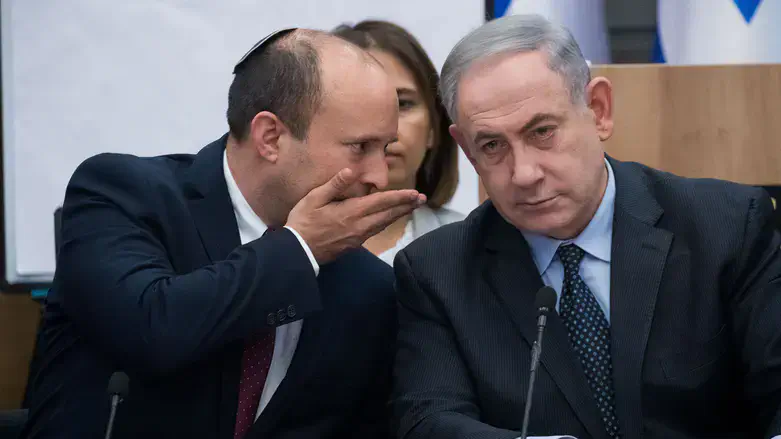
Prof. Asher Cohen, a researcher of religious Zionism and a political science expert who once ran for the Knesset in Naftali Bennett's party, analyzed Bennett's latest political moves and his options for the coming week in an interview with Arutz Sheva-Israel National News.
According to Cohen, Bennett's current moves stem in part from the failure of his original plan to lead the opposition bloc alongside Yair Lapid, following Gadi Eisenkot's rise.
Cohen explained, "We must remember that the current moves are based on an original plan that failed. Joining forces with Lapid was intended to bring them to the elections as the bloc's leaders. That plan failed when Eisenkot surged ahead".
He said, "The change bloc cannot accept a party with six or seven seats taking the premiership simply because it can for a second time. Bennett did it once, and it is not certain he can do it again".
According to Prof. Cohen, one of Bennett's main considerations is his long-term political future, particularly the possibility of seeking the country's leadership after Benjamin Netanyahu leaves office.
He said, "The other factor concerns the future. Bennett is young, and he is thinking about the post-Netanyahu era, whenever that may be. After Netanyahu, it will not be possible to become prime minister from the left or center-left, only from the right or center-right, because those are Israel's demographics. Anyone who knows this and is aiming for that has limits on how far he can go against the right and center-right. That is why Bennett is trying to pursue unity, because he knows that a large share of his voters want it. He is appealing to them, not to his party's left-wing voters".
Cohen also recalls Bennett's statements in 2021 that he had been forced to join a government with Mansour Abbas and the left because he had no choice, using that argument to justify his decision. Cohen believes that Bennett's current overtures toward unity are likewise intended to demonstrate that he did not immediately turn to the Arab parties.
Prof. Cohen further notes that there is now considerable doubt about whether the right is willing to welcome Bennett back. He certainly would not be able to return to the right if he opted for a minority government this time and went into elections with Eisenkot serving as prime minister of a caretaker government that would not last. Cohen said, "That closes off his options with right-wing voters".
Another issue is the composition of Bennett's electoral slate, which is not a unified bloc that will follow him into any government he chooses, as is the case with Avigdor Liberman's party. Cohen said, "Part of the slate is identified with the hard-line Kaplan protest wing, so he is constrained in that respect as well. We must remember that some of the seats belong to Lapid".
The situation, he says, is unprecedented. Cohen said, "We are in a black swan election campaign that no one saw coming, because of the 19 Arab-party seats holding the balance of power. That was not in any scenario". This is fundamentally different from a situation in which the right needed to draw just three seats to its side. Now, both blocs hold very few seats, and neither can reach 61 without an entire party switching sides. The Arab bloc is bringing Israeli politics into uncharted territory.
He points to another factor that further complicates the situation. Eisenkot could form a government even with a narrow majority, provided that 61 Knesset members do not oppose him. By contrast, bringing down a government requires 61 Knesset members to vote against it and support an alternative government, meaning Eisenkot would enter the next elections as prime minister. There is considerable uncertainty about what Netanyahu would do if he saw progress toward such a minority government. This would mean four to five months of a minority government led by Eisenkot, with Netanyahu out of office. Would that prompt Netanyahu to show greater flexibility?
Prof. Cohen concluded, "It is a poker game. We know what the game looks like, but we do not know what cards the players hold. The cards are problematic".