

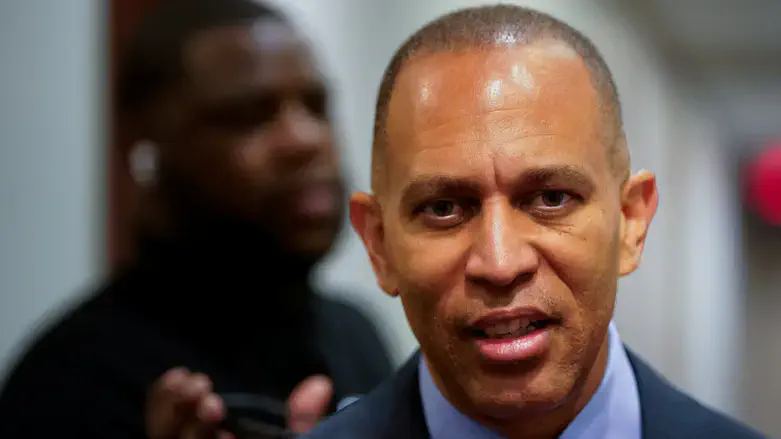
Representative Hakeem Jeffries (D-NY), who is expected to become Speaker of the House in January following the Democrats’ victory in the midterm elections, has called for significant changes in American policy toward Israel, including legislation addressing violence by Jewish residents of Judea and Samaria.
In an extensive interview with The New York Times published on Saturday, Jeffries outlined his approach to the Israeli-Palestinian conflict, discussed the controversy surrounding political contributions from the American Israel Public Affairs Committee (AIPAC), and addressed demands from fellow Democrats to restrict American weapons sales to Israel.
Asked to explain his previous statement that the status quo regarding Israel was unacceptable and that dramatic changes were necessary, Jeffries reaffirmed his commitment to establishing a Palestinian state alongside Israel.
"We have to find a path toward a just and lasting peace between Israel and the Palestinian people. To me, the foundation of that is a safe and secure Israel living side by side in peace and prosperity as a Jewish and democratic state with an independent Palestinian state that provides dignity and self-determination for the Palestinian people. That has to be the North Star," he said.
Jeffries criticized what he described as decades of insufficient American commitment to achieving a two-state solution, while praising diplomatic efforts undertaken during the Clinton and Obama administrations.
He argued that Washington must renew its efforts to advance that objective.
The incoming Speaker also expressed concern about the humanitarian situation in Gaza, calling for substantial changes in conditions affecting Palestinian Arab civilians.
"The death, the destruction, the devastation that has been experienced in Gaza by Palestinian civilians is unacceptable, unsustainable and un-American," Jeffries charged.
He called for increased humanitarian assistance, including medical care, housing support and access to clean water and air.
Jeffries was questioned about two legislative proposals supported by dozens of House Democrats: the Block the Bombs bill, which has 82 co-sponsors, and the Stop the Settlements bill, which has 76.
Asked by The New York Times whether he would bring the measures to a vote or support them, Jeffries declined to commit himself.
"No, I haven’t articulated a position one way or the other," he said.
Instead, Jeffries identified the West Bank Settler Violence Protection and Prevention Act as a priority for the opening months of the new Congress.
"What I have made clear is that within the first 100 days, I think the most decisive step that we can take relative to the situation in the West Bank is to move the West Bank Settler Violence Protection and Prevention Act," he stated.
Jeffries said he expected substantial support for the proposal within the Democratic caucus and viewed its advancement as a means of improving relations between Israelis and Palestinian Arabs.
When pressed about demands to halt American weapons exports to Israel, Jeffries acknowledged that the issue would require further discussion among House Democrats.
"What I’ve made clear is that’s a conversation that we are going to have but that the current construct is not sustainable, and it needs to change," he said.
The interview also addressed growing divisions within the Democratic Party over AIPAC's involvement in congressional elections.
Jeffries defended his fundraising record, rejecting suggestions that political contributions determine lawmakers' positions.
He said his reelection campaign had raised approximately $40 million over the previous two election cycles, with an average donation of $29. The funds, he explained, were also used to support Democratic candidates nationwide.
"I’m proud to be able to raise money from everyday Americans, not special interests," Jeffries said.
Asked whether he would continue accepting AIPAC support, Jeffries pointed to the organization's decision to discontinue direct contributions of $5,000 to candidates.
He maintained that he would continue fundraising through individual contributions while seeking to preserve public confidence that elected representatives prioritize their constituents.
Jeffries has previously advocated reconsidering the structure of future US security assistance to Israel, although he has not called for terminating the existing aid arrangement.
His previous comments likewise stopped short of endorsing the removal of the disputed NDAA provisions or an outright reduction in military assistance.
In July, Jeffries opposed a legislative initiative that sought to halt American assistance to Israel.