

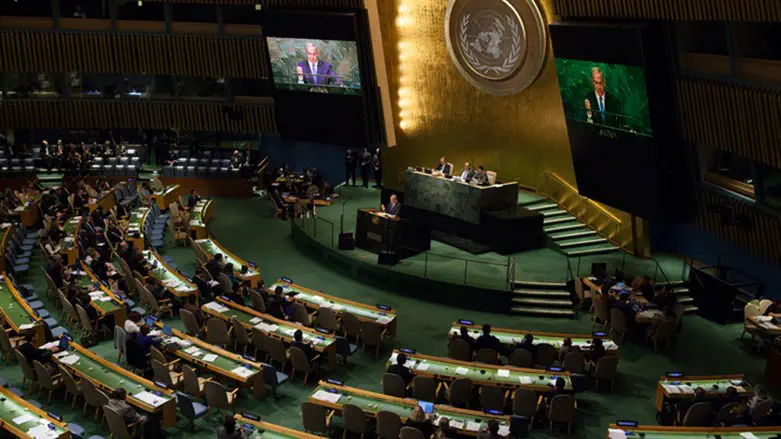
Israel and the United States abstained from a vote on a UN resolution condemning human rights violations in Iran, despite both countries expressing strong opposition to the Iranian regime's treatment of its citizens.
The resolution, titled "Situation of human rights in the Islamic Republic of Iran," was approved by the UN General Assembly's Third Committee on Wednesday with 76 countries voting in favor, 27 against and 64 abstaining.
The 27 countries voting against the resolution were Algeria, Armenia, Belarus, Burkina Faso, Burundi, China, Cuba, North Korea, Eritrea, India, Indonesia, Iran, Iraq, Mali, Nicaragua, Niger, Oman, Pakistan, Russia, Sri Lanka, Sudan, Tajikistan, Turkmenistan, Uzbekistan, Venezuela, Vietnam and Zimbabwe.
Alongside Israel and the United States, countries abstaining included Saudi Arabia, the United Arab Emirates, Qatar, Egypt, Brazil, and South Africa.
The resolution, introduced by Canada and several European countries, condemns the Iranian regime's violent suppression of protests, widespread executions, arbitrary arrests, torture and discrimination against women and minorities.
Introducing the draft, Canada's representative said Iranians had suffered longstanding human rights violations alongside the consequences of armed conflict. He emphasized that the security situation did not exempt Iran from its obligations under international human rights law.
The resolution specifically condemns the Iranian authorities' response to nationwide demonstrations that began on December 28, 2025, including the mass killing of protesters in January 2026, the detention of tens of thousands of people and nationwide Internet shutdowns intended to restrict information.
The text calls on Tehran to release those arbitrarily detained, end the use of the death penalty against protesters and allow independent investigations into human rights violations.
It also addresses the consequences of the armed conflict in Iran and the broader Middle East, including civilian casualties and damage to civilian infrastructure. The resolution expresses particular concern over a strike on an elementary school in Minab, which it says killed at least 156 people, including approximately 120 schoolchildren.
Iran's representative rejected the resolution, describing it as politically motivated and accusing other countries of using human rights concerns against Tehran.
He said Iran had faced a coordinated campaign of military strikes over the past year, alongside attempts to encourage and exploit domestic unrest, unilateral coercive measures and mounting economic pressure.
Referring to the strike on the school in Minab, the Iranian representative declared, "The mothers of those children continue to mourn."
"A vote against this resolution is a vote against the politicization of human rights," he added.
Brazil's representative also expressed reservations about the resolution, criticizing its failure to address developments in the Strait of Hormuz that had disrupted the supply of essential goods.
She argued that the resolution "employs condemnatory language exclusively against Iran for human rights violations, without explicitly addressing the responsibility of other parties to the conflict that have also contributed over recent months to serious violations of the rights of the Iranian population."
Both Israel and the United States objected to elements of the resolution, arguing that its language distracted from the central objective of holding the Iranian regime accountable.
Explaining the American abstention, the US delegation thanked Canada for leading the annual initiative but said the proposed text was insufficiently forceful.
"Unfortunately, this resolution does not go far enough in holding the regime accountable for this behavior and instead includes language that distracts from that purpose," the US representative stated.
"Let no one mistake our abstention for any softening toward Tehran," the statement continued, accusing the Iranian regime of decades of torture, executions and repression.
The American delegation also accused Iranian authorities of killing tens of thousands of protesters during demonstrations in December and January and urged the international community not to provide financial assistance that could enable further repression.
Israel offered a similar explanation, stressing that its decision should not be interpreted as reduced support for the Iranian people.
"We stand in solidarity with the brave people of Iran and condemn the Iranian regime's grave human rights violations. Our abstention should not be seen as a weakening of that commitment," the Israeli representative stated.
"Rather, it reflects our serious concerns regarding the inclusion of selective language that diverts attention from this resolution's central purpose."
Israel's delegation accused Tehran of investing heavily in its nuclear and ballistic missile programs and financing terrorist organizations, including Hamas, Hezbollah and the Houthis, while neglecting the welfare of Iranian citizens.
The Israeli statement also condemned the regime's violent suppression of demonstrations, imprisonment of political opponents, persecution of minorities and restrictions on women and girls.
"The Iranian people deserve the undivided attention and action of the United Nations without distraction or diversion," the Israeli representative concluded.
The decision to abstain drew criticism from Iranian opposition activists and former Israeli diplomats.
Iranian anti-regime activist Niyak Ghorbani questioned why Israel and the United States had declined to support the resolution.
"Why did you ABSTAIN?!" he wrote, noting that Iranians were being arrested, tortured, and shot while protesting against the regime and chanting the name of Crown Prince Reza Pahlavi.
"Israel and the United States sat among the abstentions," Ghorbani wrote. "Our closest friends couldn't even press 'yes'?"
"This is not the time for silence or games. Stand with the people of Iran, not on the fence," he added, calling for the regime's removal without negotiations.
Former Israeli Ambassador to India Daniel Carmon also criticized the abstentions, while acknowledging that both countries likely had legitimate concerns about the resolution's wording.
In a post addressed to Israel's Foreign Ministry and its UN mission, Carmon said that abstaining rather than joining Canada and Western countries in supporting the resolution created a negative public and diplomatic impression.
He pointed to a procedural option that would allow Israel and the United States to vote in favor of the resolution while formally distancing themselves from specific problematic provisions.
Carmon suggested that both countries reconsider their positions before the resolution is brought before the UN General Assembly.
Such a move, he argued, would allow Israel and the United States to join the condemnation of Iran's human rights record without endorsing the passages to which they object.