
He was among the first to be struck in the deadly terrorist attack near Havat Gilad, but even in his final moments, he managed to fight the terrorists and help stop their killing spree.
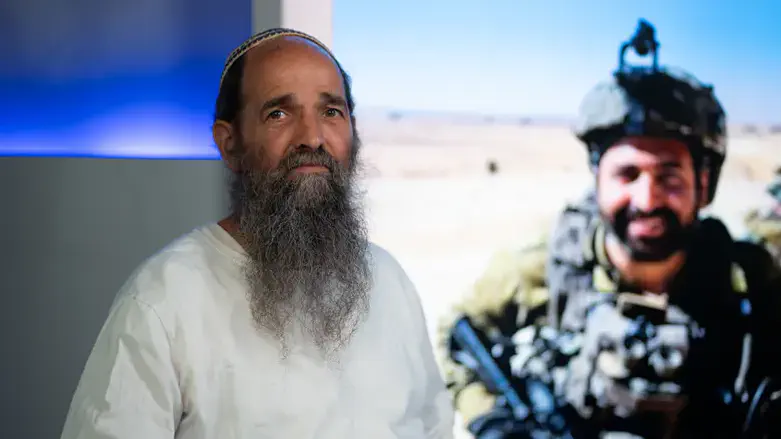
In a special interview with Arutz Sheva, Boaz Melet, the father of Capt. (res.) Benayahu Melet, who was killed in the attack, speaks about his son’s heroism, the unrelenting pain, the bond forged with the family of Maj. Yuval Ezra, who was killed in the same attack, and his feeling that the State of Israel still refuses to grasp the magnitude of the threat in Judea and Samaria.
According to Melet, IDF investigations and information gathered after the attack indicate that Benayahu was hit during the initial stages of the assault. Despite being shot and collapsing, however, he managed to recover, draw his handgun and fire at the terrorists in his final moments.
“He managed to fight until his last breath," his father says. “Knowing that he still managed to hit the terrorists and help bring the incident to an end gives us a small measure of comfort amid the immense pain."
Melet also finds it difficult to accept the public discourse that developed after the attack, in which some voices placed responsibility on the hikers who were at the scene. He says this is a distortion of reality.
“This was a veteran group of hikers who were not looking for a confrontation. On the contrary, they tried to avoid one. There were armed people there, but they did not draw their weapons because they believed the army should handle the incident. The attempt to portray them as people who came looking for a provocation is simply untrue."
During the shiva mourning period, a special bond developed between the Melet family and the family of Maj. Yuval Ezra, who was also killed in the attack. Boaz says the relationship grew out of their shared pain. He went to comfort the family, and members of the Ezra family later visited the site of the attack.
“This murder brought us together," he says. “A vineyard will be planted there in memory of both of them, and there is also a desire to establish a joint memorial site so that their memory will remain alive in the place where they fell."
For Melet, however, the central lesson from the attack is much broader. He believes Israeli society still struggles to understand the nature of the conflict in Judea and Samaria. He says Benayahu spent years gathering information about the activities of the Palestinian Authority and established an initiative intended to demonstrate to the public that, in his view, Israel is confronting an organized enemy rather than a local dispute.
“We continue to talk about disputes between neighbors while there are those who educate people toward the destruction of Israel. As long as we do not recognize this reality, we will continue to pay a heavy price."
According to Melet, the rules of engagement must also be reexamined.
“It is completely clear to me that the disaster could have been prevented," he says painfully. “Even if the regulations permit opening fire, in practice there is a great fear of doing so because of the possibility of investigations and proceedings afterward. That is a reality that filters down to the soldiers in the field, and it can cost lives."
When the conversation turns to Benayahu himself, his father’s voice softens. He describes a son driven by a sense of mission, who loved the Land of Israel and its people, fought to enlist despite difficulties, completed his military training with distinction and viewed military service as an inseparable part of his national responsibility.
“He told me that if war broke out, he was not prepared to stand on the sidelines. He wanted to be there when the State of Israel needed him."
Melet says Benayahu also continued his family’s path in the settlement movement, but did so in his own way, out of a deep belief in initiative and personal responsibility. According to his father, many developments that are now taken for granted began as initiatives by young people who did not wait for decisions from above.
“He believed that you have to act and not wait for someone else to do the work," he says.
At the conclusion of the interview, the father shares the pain that does not let go.
“I sat shiva for a brother, for my father and for my mother, but the pain of losing a son is an entirely different reality," he says, adding that he finds it difficult to comprehend the loss and accept that his son is gone and will not return.
Alongside the longing, he seeks to hold fast to the legacy Benayahu left behind: love of the Land of Israel, love of people, the ability to stand up for the truth without compromising respect for others, and the commitment to continue building and adding life even amid the greatest devastation.