

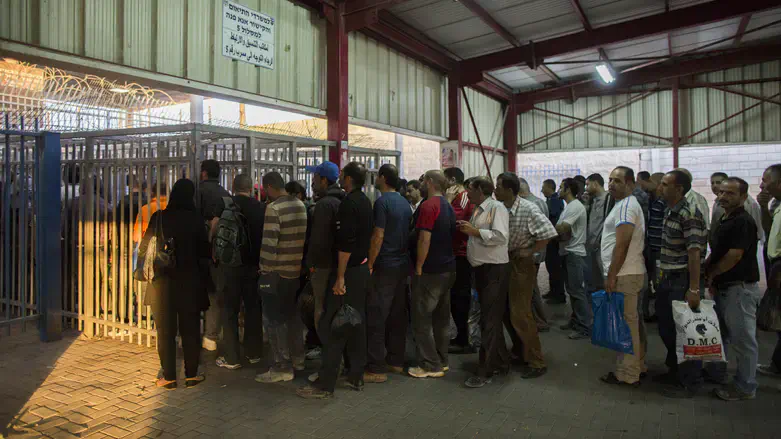
Four days after the deadly terror attack near Havat Gilad, the IDF announced that Palestinian Arab workers will once again be allowed entry into Israeli communities in Judea and Samaria starting on Tuesday, in accordance with security protocols for workers in industrial zones and residential areas.
The decision followed a situational assessment, coming just one day after Central Command Chief Maj. Gen. Avi Bluth had ordered a total ban on Palestinian Arab laborers entering Israeli communities throughout Judea and Samaria.
Maj. Gen. Bluth’s initial entry ban was issued after a tense weekend in the sector, triggered by Friday's shooting attack on the outskirts of the village of Tell. Major Yuval Ezra and Master Sergeant (Res.) Benayahu Melet - a member of Havat Gilad's local emergency response team - were murdered in the attack, and several other Israelis were wounded.
National Security Minister Itamar Ben Gvir criticized the reversal: "The Central Command chief’s capitulation in allowing 'Palestinian' workers back into Judea and Samaria communities is a severe mistake that could cost us precious Jewish lives. I call on the Prime Minister to instruct the Chief of Staff to immediately overturn Major General Bluth's decision, which sends a message of surrender to terrorism."
Following the attack, security forces launched a manhunt for the perpetrators. IDF Chief of Staff Lt. Gen. Eyal Zamir held an on-site situational assessment and initial debriefing alongside the Central Command chief and senior defense officials, with the IDF confirming that the pursuit of all those involved remains ongoing.
Hours after the shooting, Duvdevan commandos under the command of the Samaria Regional Brigade - guided by Shin Bet intelligence - raided a hospital in Shechem (Nablus). They arrested two wounded terrorists who had fled there for medical treatment. The IDF and Shin Bet stated that the identities of all suspects involved are known and operations to apprehend them continue.
Just on Sunday, Galei Tzahal (IDF Radio) reported growing concern within the defense establishment over a potential major breakdown in stability across Judea and Samaria following a series of recent security incidents over the past week. According to the report, officials have identified a shift in Palestinian Arab behavior, warning that the "fear barrier" among the population has broken down.
Security sources noted that the common thread in the weekend's events is an increasing willingness among Palestinian Arabs to mobilize in large numbers and directly confront Israelis entering villages - often sparked by such entries and what they view as provocation. Defense officials view this trend as carrying significant potential for escalation.
According to the report, one scenario being evaluated in high-level security deliberations is a widespread popular uprising by Palestinian Arab villages targeting Israelis, involving mass violence, weapon seizures, and attempted attacks on nearby communities and farm outposts.
Officials noted that these emerging threat patterns mirror the dynamics of the First Intifada far more than those of the Second.