

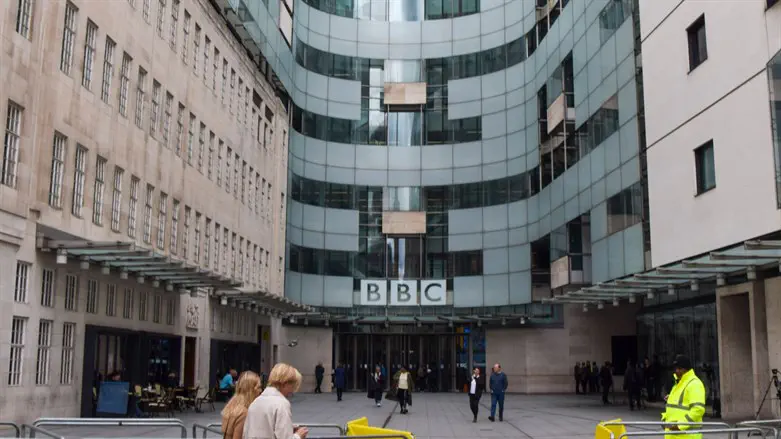
The BBC issued an apology Tuesday night after introducing its International Holocaust Memorial Day coverage without mentioning that the six million victims murdered by the Nazis were Jews, with the omission being condemned as "hurtful, disrespectful and wrong", reported The Times.
Jon Kay introduced the report on BBC Breakfast Tuesday morning, stating that Holocaust Memorial Day was "for remembering the six million people murdered by the Nazi regime over 80 years ago," without specifying that those murdered were Jews.
The Campaign for Media Standards pointed out that several of the BBC's most prominent presenters used similar introductions, accusing the broadcaster of having "used the same script all day."
Lord Pickles, who served as the special envoy for post-Holocaust issues from 2015 until last year, stated that the failure to highlight Jewish victims in the introductions constituted "an unambiguous example of Holocaust distortion, which is a form of denial."
"This kind of obfuscation was common during the Soviet control of parts of Europe," said Pickles, who currently serves as co-chairman of the UK Holocaust Memorial Foundation. "For the BBC to use it today is shocking. They should be fighting antisemitism, not aiding it."
Karen Pollock, chief executive of the Holocaust Educational Trust, said: "The Holocaust was the murder of six million Jewish men, women and children. Any attempt to dilute the Holocaust, strip it of its Jewish specificity or compare it to contemporary events is unacceptable on any day. On Holocaust Memorial Day it is especially hurtful, disrespectful and wrong."
Danny Cohen, a former BBC director of television, said the broadcaster's failure to reference Jews in introductions to some of its coverage marked "a new low point for the national broadcaster."
"It is surely the bare minimum to expect the BBC to correctly identify that it was six million Jews killed during the Holocaust," he said, according to The Times. "To say anything else is an insult to their memory and plays into the hands of extremists who have desperately sought to rewrite the historical truth of history's greatest crime."
The BBC stated in response, "This morning's BBC programming commemorated Holocaust Memorial Day. The Today program featured interviews with relatives of Holocaust survivors and a report from our religion editor. In both of these items we referenced the six million Jews murdered during the Holocaust."
"The chief rabbi recorded the Thought for the Day. BBC Breakfast featured a project organized by the Holocaust Educational Trust in which a Jewish survivor of the Holocaust recorded her memories. In the news bulletins on Today and in the introduction to the story on BBC Breakfast there were references to Holocaust Memorial Day which were incorrectly worded, and for which we apologize. Both should have referred to 'six million Jewish people' and we will be issuing a correction on our website."
The incident is the latest in a series of controversies involving the BBC and its bias against Israel and the Jewish community.
In November of 2023, the corporation published an apology after falsely claiming that IDF troops were targeting medical teams in battles in and around the Shifa Hospital in Gaza.
Before that, the BBC falsely accused Israel of being responsible for an explosion at a hospital in Gaza, which the IDF proved was caused by an Islamic Jihad rocket. The network later acknowledged that “it was false to speculate" on the explosion.
Last year, the BBC faced mounting scrutiny for using the son of a senior Hamas official as a narrator in its documentary “Gaza: How to Survive a Warzone."
Following the criticism, the British broadcaster acknowledged that there were “serious flaws" in the program.
Earlier this month, the BBC issued an apology after facing criticism for a December 26 episode of its popular program The Repair Shop, which discussed the Kindertransport without mentioning Jews, despite the operation’s central role in rescuing Jewish children from Nazi persecution during the Holocaust.