

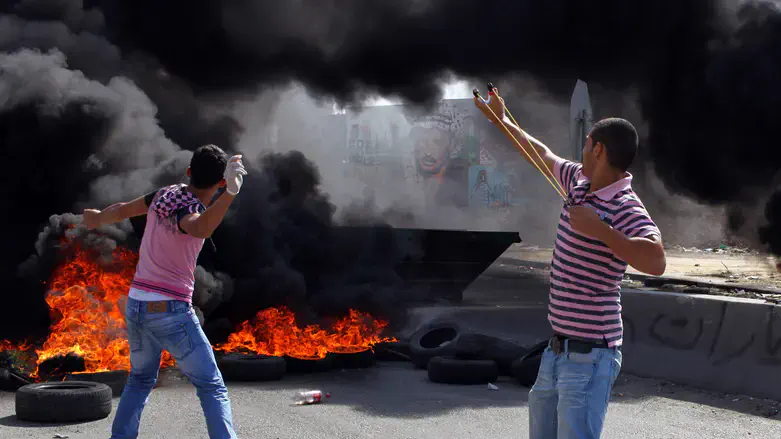
The BBC has come under fire for allegedly downplaying violence against Israelis in an article discussing police moves in Manchester and London to ban the slogan “globalise the intifada,” which Jewish groups view as a call to violence.
According to a Jewish Chronicle report, the original version of the report described the First Intifada as a “largely unarmed and popular uprising,” stating that the term "Intifada" entered common use during the Palestinian uprising against Israeli rule in Judea, Samaria and Gaza in 1987. It said the unrest continued into the early 1990s and noted the emergence of groups outside the Palestine Liberation Organisation, including Hamas.
The BBC article went on to describe the Second Intifada, which began in September 2000 following a visit by then-opposition leader Ariel Sharon to the Temple Mount. It did not mention the hundreds of bombings, shootings and grenade attacks carried out during the two intifadas, a campaign of violence that killed more than 1,000 Israelis, including a suicide bombing at a crowded pizzeria that left 16 people dead and 130 wounded.
In an updated version published later the same day, the BBC offered two interpretations of the term Intifada", saying some understand it as “a call for peaceful resistance to Israel’s occupation,” while others see it as “a call for violence against Jewish people.”
Both versions have drawn sharp criticism. Danny Cohen, former director of BBC Television, said the reporting was “appalling” and “deeply offensive” to the families of those murdered during the intifadas. He added that such coverage fuels antisemitism at a time when Jewish communities are facing rising violence worldwide.
The controversy follows the BBC’s announcement that it is introducing antisemitism training for staff after a series of high-profile editorial failures, including issues at BBC Arabic, the leaked Michael Prescott report, and the broadcast of content widely criticised as antisemitic.
A BBC spokesperson said it is routine to update stories for clarity and that the changes were made to better explain the context of the term "Intifada". The corporation later added a correction acknowledging that earlier wording “did not give a clear enough or complete picture of the history.”