
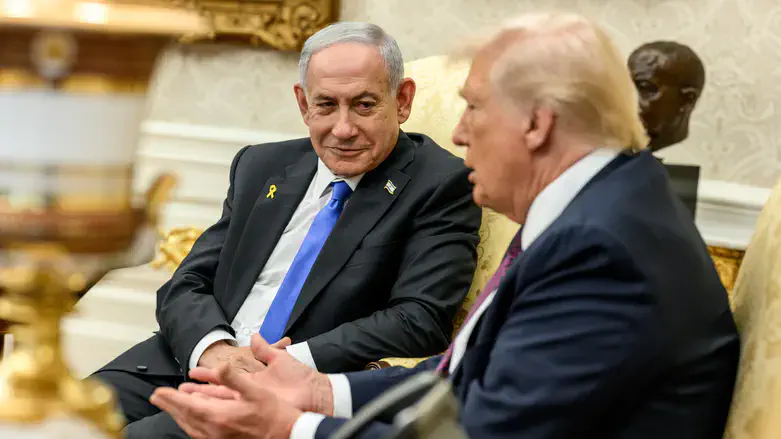
Israeli Prime Minister Benjamin Netanyahu plans to present US President Donald Trump with options for new strikes in Iran, during a meeting this month at Mar a Lago, NBC News reported.
Israeli officials are increasingly expressing concern over Iran's efforts to expand its ballistic missile program and repair sites and equipment damaged in June's "Operation Rising Lion."
Iran's work on its nuclear program is also of concern to Israel, but less immediate than the ballistic missile threat, NBC added.
Sources said that Netanyahu is planning to brief Trump on the danger Iran's activities pose to Israel and the region, and offer him to join or assist in the strikes. The meeting, though it has not been formally set, is expected to take place on December 29.
A source familiar with the missile program and former American officials warned that if nothing changes, Iran’s ballistic missile production could reach up to 3,000 missiles monthly.
A former Israeli official told NBC News, "There is no real question after the last conflict that we can gain aerial superiority and can do far more damage to Iran than Iran can do to Israel. But the threat of the missiles is very real, and we weren’t able to prevent them all last time."
Last month, Channel 13 News reported that Iran has renewed most of its missile stockpile and is close to reaching the number of missiles it had before Operation Rising Lion.
According to the report, six months after the 12-day war last June, the Iranians are working intensively on producing surface-to-surface missiles - and are expected to possess about 2,000 missiles capable of reaching Israel within a few months.
The report further stated that Israel is closely and anxiously monitoring Iran’s arms race. Most of the missiles the Iranians stored in tunnels were blocked but not damaged during Operation Rising Lion, and they are now refurbishing them. It was noted that the Iranians’ lessons from the war are to go underground and to place less importance on missile accuracy.
Meanwhile, the report said, the framework of Iran’s nuclear program is undergoing restoration, but there are no signs of renewed uranium enrichment.
International Atomic Energy Agency (IAEA) Director Rafael Grossi told Swiss newspaperNeue Zürcher Zeitung on October 18 that most of Iran’s 60% enriched uranium “remains in the nuclear facilities in Isfahan and Fordow, and some in Natanz.”
All three sites were targeted in Operation Rising Lion, the Israeli mission that initiated the brief conflict, followed by US strikes using bunker-busting bombs.
Grossi confirmed the facilities were “massively damaged,” but the uranium itself was largely unaffected.
A leaked IAEA report from September indicated Iran had 440kg of enriched uranium as of June. Grossi now estimates the stockpile at approximately 400kg.