

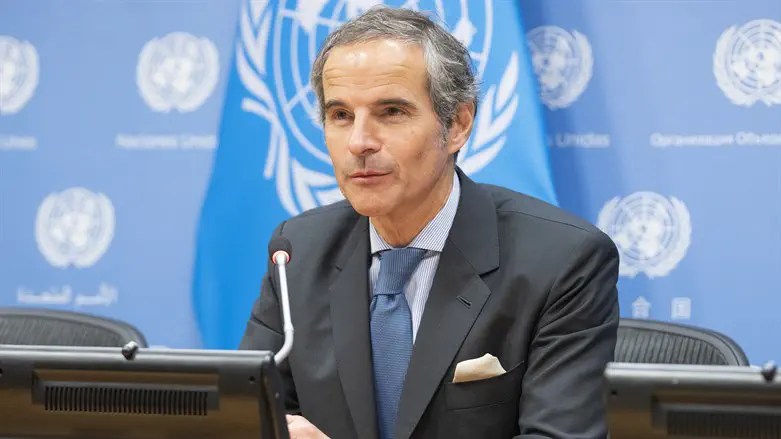
Argentina’s foreign ministry has formally nominated Rafael Grossi, head of the International Atomic Energy Agency (IAEA), to serve as the next United Nations secretary-general in 2027, the Buenos Aires Herald reported Thursday.
Current UN chief António Guterres, in office since 2017, will end his term at the close of next year.
Foreign Minister Pablo Quirno announced the nomination in an X post, calling it “an honor and a privilege.” He praised Grossi’s six years at the IAEA, saying his leadership “demonstrates his great leadership skills in the face of serious situations that affect international peace and security.”
Grossi has played a central role mediating in major conflicts, including the war in Ukraine and tensions between the United States, Israel, and Iran over Tehran’s nuclear program.
“These are essential tools to carry out the role of secretary-general in the current international scenario,” Quirno wrote.
The foreign ministry highlighted Grossi’s achievements at the IAEA, noting his contributions to “peace and international security” and his “proven performance in situations of conflict and serious international crisis as an impartial and effective speaker.”
Support for Grossi’s candidacy has already emerged internationally, according to the Buenos Aires Herald. Paraguayan President Santiago Peña said he trusts Grossi to “revitalize” the UN, while Italian Foreign Minister Antonio Tajani voiced support last week, citing Grossi’s Argentine-Italian citizenship.
Grossi, a career diplomat, became the first Latin American to lead the IAEA in December 2019. Previously, he served as Argentina’s ambassador to Austria between 2013 and 2019 and represented the country before Slovenia, Slovakia, and international organizations in Vienna. He has also held senior roles in nuclear-focused institutions, including the IAEA itself.
As IAEA chief, he has had to deal with Iran’s continued uranium enrichment and its refusal to cooperate with the IAEA in inspecting its nuclear sites.
Earlier this week, Grossi said the UN watchdog seeks to fully reengage with Iran to restore access to its nuclear sites and verify enrichment activities.
Speaking to reporters in Manila, Grossi stressed the agency’s goal is to “restore continuity of knowledge” and reestablish full verification inside Iran.
His remarks come days after the IAEA’s 35-member Board of Governors adopted a resolution demanding Tehran inform the agency “without delay” about the status of its enriched uranium stock and facilities struck in June.
The resolution followed a scathing IAEA report which revealed that Tehran has yet to allow inspectors into the nuclear sites targeted by Israeli and American strikes in June, and has failed to account for uranium enriched to 60% - a level approaching weapons-grade.
Iran maintains its cooperation with the IAEA remains within the Nuclear Non-Proliferation Treaty (NPT), but insists access to bombed facilities cannot resume until safety and legal concerns are resolved. Iranian lawmakers have warned Tehran may suspend or withdraw from the NPT in response to the censure.