

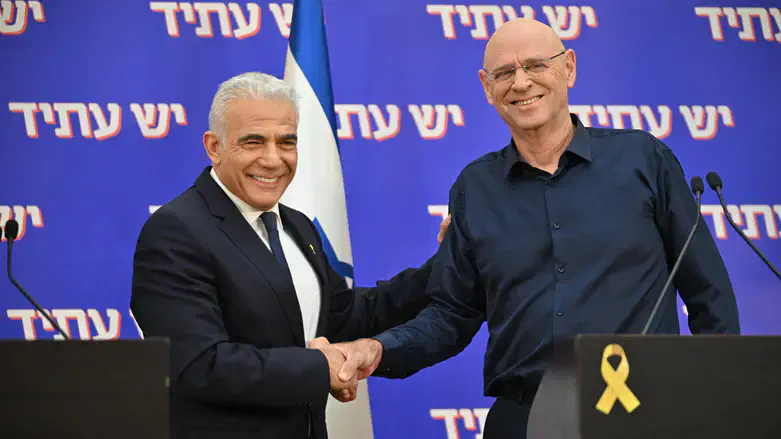
Maj. Gen. (res.) Noam Tibon, former commander of the IDF’s Northern Corps, is joining the Yesh Atid party. The party announced on Tuesday that he will be placed among the top five candidates on its slate for the next Knesset.
Party chairman Yair Lapid held a press conference with Tibon, who said he was entering politics “to save our beloved State of Israel.”
“In the past two years, I’ve seen Israel’s remarkable next generation - the male and female soldiers, the reservists, their wonderful families,” Tibon said. “But I’ve also seen their pain- the bereaved parents and siblings, the wounded in rehabilitation wards, the battle-traumatized, and the hostages who endured hell in Gaza. For their sake, we must make Israel a better, stronger, and more just country. That’s why I’ve stepped forward.”
Tibon called for a state commission of inquiry into the failures of October 7. “The next government will establish such a commission on its first day in office. This is a security imperative and a moral obligation - we will not give up on it.”
He added: “The next government must serve the public. Yesh Atid has done this twice before, and with its outstanding team, it will do so again in 2026. We deserve a different government. Instead of draft-dodging - unity. Instead of excuses - accountability. Instead of hatred - Zionism. We will rebuild the south and the north, strengthen the IDF, and support the serving public, which gives so much to the country.”
Tibon, who also commanded the Judea and Samaria Division, gained public attention on October 7 after rushing to Kibbutz Nahal Oz to rescue his son Amir and his family. He joined a military force and fought alongside soldiers until he reached them. A film about his actions was initially pulled from the Toronto International Film Festival (TIFF) earlier this year, but the decision was reversed following public outcry.
In an interview with Arutz Sheva-Israel National News nine months ago, Tibon recounted the dramatic rescue and criticized the government's handling of Hamas. “I didn’t care if I died trying to save my family. That was the situation,” he said.
Asked how such an event could happen, Tibon cited systemic failures. “There were flawed assumptions - from political beliefs that Hamas was an asset, to the infamous suitcases of dollars delivered by Netanyahu and [then-Mossad chief] Yossi Cohen, thinking money would buy quiet. Instead, it built a monster. Militarily, the assumption that Hamas was deterred proved false. The belief in an impenetrable barrier collapsed when we saw how easily it was breached. Under that illusion, the army prepared primarily for war in the north. That’s why there was such a gap in performance between the south and the north. There was also unrest in Judea and Samaria, and many forces were diverted there. The army essentially fell asleep - and so did the government. That’s why a state commission is essential. I propose a compromise: let it be appointed by the President of the Supreme Court and his deputy, Noam Sohlberg.”
Even during that interview, Tibon spoke of his intention to engage in public service, though he did not explicitly mention politics. “We have a strong and good people who understand the gravity of the moment. Meeting them brings me great joy. That’s why I fight against the ‘poison machine’ that tried to slander me, and against group labeling. When I hear people speak negatively about settlers, I say - look at the list of the fallen, stand at attention, and salute. The serving public gives me great hope that after the war, we can reboot the country and bring in new leadership from among the reservists. I have great faith in our people.”