

Hamas spokesman in Gaza Ismail Radwan has claimed that Israel is preventing the return of deceased hostages' bodies.
In an interview with Al Jazeera, Radwan claimed that Israel itself is preventing the entry of heavy equipment and blocking the work of international committees meant to assist in locating and recovering the bodies.
Blaming Israel for the delay, he also called on mediating countries to pressure Israel to adhere to the humanitarian protocol and fulfill all clauses of the first stag e of the agreement.
Radwan stressed that Hamas is determined to ensure the success of the ceasefire agreement, and urged the mediators to push Israel to immediately move on to the second stage.
Israel estimates that Hamas knows the locations of several more hostages bodies and is able to immediately access them. However, the terror group is using the ceasefire to rearm and regroup, and thus has a vested interest in delaying the end of the deal's first stage as much as possible.
Last week, Hamas politburo member Mohammed Nazzal stated that the terrorist organization intends to maintain security control in Gaza during an interim period and cannot commit to disarming.
In an interview with the Reuters news agency from Doha, Nazzal said Hamas is prepared for a ceasefire of up to five years to allow for reconstruction, but insisted that future guarantees must offer Palestinian Arabs “horizons and hope” for statehood.
He defended Hamas’s recent public executions in Gaza, claiming those killed were criminals and that “exceptional measures” are sometimes necessary during wartime.
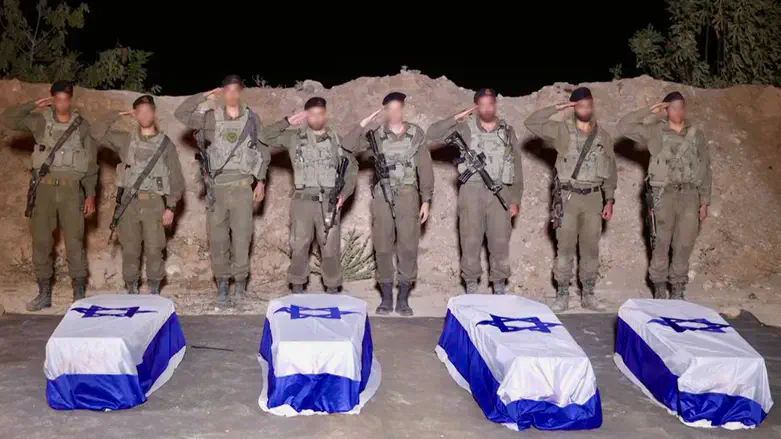
The remarks come days after the first phase of the ceasefire agreement was implemented, with Hamas releasing all living hostages but only nine of the 28 bodies of deceased hostages. Nazzal claimed that Hamas has no interest in keeping the remaining bodies and cited technical difficulties in recovering them. He added that international parties such as Turkey and the US may assist in locating the bodies.
Asked about disarmament, Nazzal said, “I can’t answer with a yes or no. Frankly, it depends on the nature of the project. The disarmament project you’re talking about, what does it mean? To whom will the weapons be handed over?”
He emphasized that the issue involves other factions and must be addressed collectively.
Prime Minister Benjamin Netanyahu’s Office responded to Nazzal’s remarks by reaffirming Israel’s commitment to the ceasefire agreement. “Hamas is supposed to release all hostages in stage 1. It has not. Hamas knows where the bodies of our hostages are. Hamas are to be disarmed under this agreement. No ifs, no buts. They have not. Hamas need to adhere to the 20-point plan. They are running out of time,” the statement said.
Nazzal acknowledged that Hamas would remain present on the ground during the transitional phase to protect aid convoys from gangs and thieves. “This is a transitional phase. Civilly, there will be a technocratic administration as I said. On the ground, Hamas will be present,” he said, adding that elections should follow.
While Hamas’s founding charter calls for the destruction of Israel, Nazzal claimed the group has proposed a long-term truce of three to five years to rebuild Gaza. “The goal isn’t to prepare for a future war,” he said. “The Palestinian people want an independent Palestinian state.”