

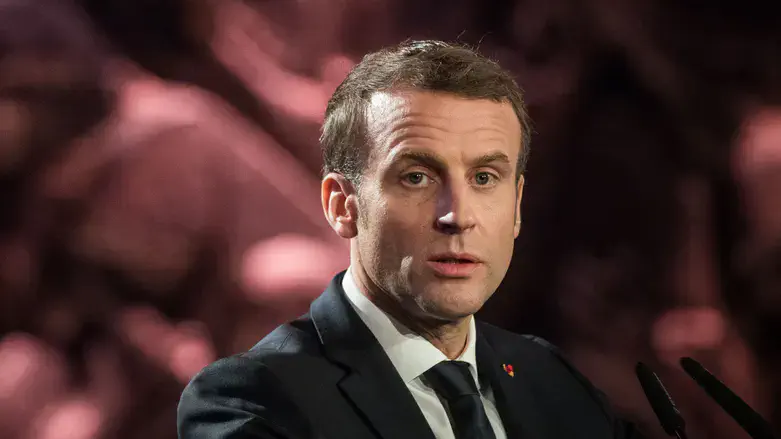
French President Emmanuel Macron defended his country's push to recognize a Palestinian state, arguing it is the only way to "isolate Hamas" and counter what he called "a failure" of Israel’s military campaign in Gaza.
During an interview with Israel’s Channel 12 News anchor Yonit Levi which aired on Thursday, Macron stated that his decision to move forward with recognition was not a reward for terrorism, as Israel has said, despite Hamas having welcomed the move.
Levi began the interview by questioning Macron's shift from being a staunch ally of Israel after the October 7th attack to now spearheading a move that many Israelis believe rewards Hamas's actions.
Macron responded, "I think everybody here does respect and shares this trauma and infinite pain. We condemned the terrorist attack of Hamas. Our top priority remains the release of all hostages. We recognize the right of Israel to defend itself. But when Israel started to have a sort of permanent war in Gaza, we expressed a disagreement very respectfully but very clearly."
Macron claimed that Israel's actions in Gaza are "totally counterproductive" and are "completely destroying the image and the credibility of Israel, not just in the region but in public opinions everywhere." He also criticized a recent vote by the Knesset that he said would "restore the colonization and the end of West Bank," asserting that this has "nothing to do with Hamas."
The French President argued that without a political solution, Palestinian Arabs are pushed into the hands of those with an "aggressive approach," like Hamas.
He noted, "The objective of Hamas has never been to make two states... They want an Islamistic state and they want especially to destroy Israel." Macron claimed that his plan would offer the Palestinian Arab people a "legitimate perspective" that has "nothing to do with Hamas."
Macron confirmed that the Palestinian Authority (PA) had sent a letter condemning the October 7th attack as a terrorist act for the first time, and had committed to reforming the PA, deradicalization, and a new education program. When Levi pointed out that such promises have been heard since 1993, Macron countered, "Yes, but we never delivered collectively. When we don't offer a political perspective, we just give the floor to those we offer a terrorist approach."
When asked about the timing of the recognition, given the ongoing trauma in Israel, Macron said he understood but believed the move was necessary "because precisely the approach of your government, some ministers especially, is to destroy the possibility of a two-state solution."
He claimed the move was an "emergency" and "probably... the last minute before proposing a two-state would become totally impossible."
Macron also stated that while Israel has had "very concrete and important results" in eliminating Hamas leaders, the organization has managed to replace its terrorists, maintaining the same number of personnel it had on October 7. "So this is a failure," he concluded.
Asked if he would support economic sanctions against Israel, Macron said, "if the Gaza City operation is pursued by the government, it's clearly a debate we will need. Because I think this is a huge mistake, this is absolutely unacceptable, this is totally incompliant with international rules." He clarified that he would not support a full boycott of Israel but would "refuse the access for some industrials or key people clearly involved in Gaza operations."
Tensions between Israel and France have been high even before Macron announced his intention to recognize a Palestinian state on September 22, during the UN General Assembly, stemming from Macron’s ongoing criticism of Israel’s counterterrorism operations against Hamas in the Gaza Strip.
The French President twice called for an arms embargo against Israel to stop the conflict with Hamas and Hezbollah, saying that "stopping the export of weapons" used by Israel in Gaza and Lebanon was the only way to end fighting there.
Later, Macron warned that Israel’s ongoing military actions in Gaza may be in breach of international humanitarian law.
In late August, Prime Minister Benjamin Netanyahu sent a letter to Macron in which he wrote that antisemitism had "surged" in France following Macron’s announcement that France would formally recognize a Palestinian state.
In his letter, Netanyahu wrote, "Your call for a Palestinian state pours fuel on this antisemitic fire. It is not diplomacy, it is appeasement. It rewards Hamas terror, hardens Hamas's refusal to free the hostages, emboldens those who menace French Jews and encourages the Jew-hatred now stalking your streets."
The French Presidency condemned Netanyahu’s accusation as "abject" and "erroneous," stating that France "protects and will always protect its Jewish citizens."