The power of permission
The Torah is not a joy-killing mechanism, but a system meant to refine the joys of life and elevate then to a spiritual dimension.
The Torah is not a joy-killing mechanism, but a system meant to refine the joys of life and elevate then to a spiritual dimension.

If Sukkot is the Festival of Happiness, why do we read on Megilat Kohelet, which seems to be a very depressing book?
Covenant & Conversation for Haazinu 5781.
Rosh Hashanah, the day of judgment, is followed by the 10 days of Tshuva (repentance). Shouldn't it be the other way around?
Within our souls are different and varied parts. Collect them, compare them and see what should be changed in the New Year.
How quickly society changes acceptable human behavior! What was unthinkable and perverse is today admired and sometimes even enforced.
The Torah stresses ‘the hands’ in the mitzva of Bikkurim, for a symbolic, moral and historic reason.
There is something illogical about the commandment of the firstborn. And why separate the first fruits from the rest?
The Hebrew word "even" means "stone" but it also is a composite of the words for father and son.
This week the Torah teaches us the key ingredient to living our lives and serving G-d, without it, everything else falls apart
It is a challenge to continue keeping the Torah with the same level of anticipation as at Mount Sinai.
Many think that in order to repent one must look evil, the affair teaches us that the secret of success is actually in looking good.
Baruch Gordon quotes a commentary on the First Fruits offering which delivers a powerful message to Diaspora Jews today...

The lockdown meant that we could listen to the poetry and passion of the prayers. And prayer is about listening, not just speaking.
Our Sages found a pattern in the commandments found in one reading that make up over 12% of all the 613 mitzvot in the Torah.
The simple and obvious things we must be sure to do can easily be forgotten or ignored. The Torah reminds us of them.
Torah from Israel's first chief rabbi, the iconic leader of Religious Zionism.
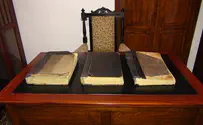
Watch: This week Yitzi and Tuvia talk about the precept of Hashavat Aveida - returning lost objects
The sages teach us that a rebellious son is condemned because of how he will turn out. But how is it possible to know he will be evil?
Only one fruit's blessing goes up a step on the ladder when it is made into juice. What does that have to do with marriage?
There are so many soldiers in Tzahal for whom fear of the enemy does not exist because in their hearts is the fear of Hashem.
Why do we see that in the case of Ishmael, Abraham did not act as the Torah prescribes for a rebellious son?
This week we read the commandment to remember Amalek. We remember Amalek because that is the memory that safeguards us.
Part of the reason for improper human behavior violating Jewish values, is the shortness of vision that our limited years impose upon us.
A seemingly minor law about inheritance is in fact a major statement of Jewish values.
In which war are we engaged all our lives?
Just how basic is 'hakarat hatov,' refraining from being an ingrate, in Judaism - and why?
No one should be invisible, no one should live and die alone.
The Torah on Jewish property rights and real estate, and the laws as they apply in the Diaspora and in the Land of Israel.

Vital parts of Torah and Jewish life are Jewish policemen, judges, kings, priestly tithes, cities of refuge, prophecy, an army - in Israel.
King David's Torah study influenced his advice to the people. That is why he arose to learn at midnight.
Do we say we are still in exile if everything is not perfect in Israel, or as religious Zionism does, show gratitude for what we do have.
The Torah is in favor of law and order and of choosing leaders who can do the job.
Self-control is a basic tenet of Judaism and a prescription for a worhwhile life.
The text in the Torah portion of Re’Eh begins with words that in their striking difference teaches us much of our journey in this world
A verse that tells us what to do, if, for some technical or practical reason, like distancing, those who are needy can’t get to our homes.
Shirley Chisholm was the first black woman elected to Congress. How the Lubavitcher Rebbe set her on her way.
This week we learn about the mitzvah to give tzedakah & the classic example is giving a loan & taking a collateral in return. Why is that?
Moses states a proposition that is the most fundamental one in Dvarim and one that would be echoed endlessly by Israel’s Prophets:
At Mount Sinai, we were given a chance to reacquire the spiritual sense of sight, lost in Eden, that enables us to see the internal reality:
Torah reading: Re'eh: How is it that the principle of determinism and the principle of free will are both part of Judaism?
Happiness is not always the result of our own acomplishments.
It is in the nature of man, to think that by his strength and acumen, he has prospered - but that is hubris.
The first paragraph of the Shema is in the singular. The second paragraph is in the plural, The order of the mitzvot is switched. Why?
Human civilization needs a little less hubris, less arrogance, more minimal expectations, realization that it is not our will that prevails.
We know the Mann was a Heavenly food with heavenly taste but this week Moshe Rabeinu describes the Mann as torture and even starvation. Why?
Moshe rebukes the Israelites telling them they didn't merit the Land thanks to their righteousness. What's the blessing hidden in this?
Sorry guys, the commandments of the Torah were given to be performed in the Land of Israel.
Eikev 5780: What is the covenant, and what is the love that is distinct from the covenant?
The transformation elicited by the mitzvot does not occur overnight.
Baruch Gordon looks at 2nd paragraph of the Shema found in Ekev Torah reading to see that commandments mean more when performed in Israel

In Parshat Va'etchanan we discuss Moshe's prayers, from which we learn many laws. But is this the model we want to learn from? Why?
'Jewish privilege' can be used sarcastically by Jews to highlight Jewish persecution, but it also poses a very different challenge.
How did Moses, the great leader who said "I am not a man of words" declaim the entire book of Dvarim? Torah from Israel's first Chief Rabbi.
Covenant & Conversation Dvarim 5780: Faced with an angry mob, a leader is not always in control of the situation.

Moshe gives a review of the Torah, but when he gets to the story of the Meraglim and the punishment, leaves out an important detail. Why?
Moshe’s fear of Og was not from the physical might of Og, but from Og’s ‘spiritual’ merits
Moses admonishes the people in Dvarim, not for the serious sins of the spies and the golden calf, but for flaws rooted in ego. Op-ed.
How do we define old age? How do we concentrate when praying?

What is the first and fundamental mitzva that Moshe explains when he teaches the Torah to his people? Not Shabbos. Not kashrus.