
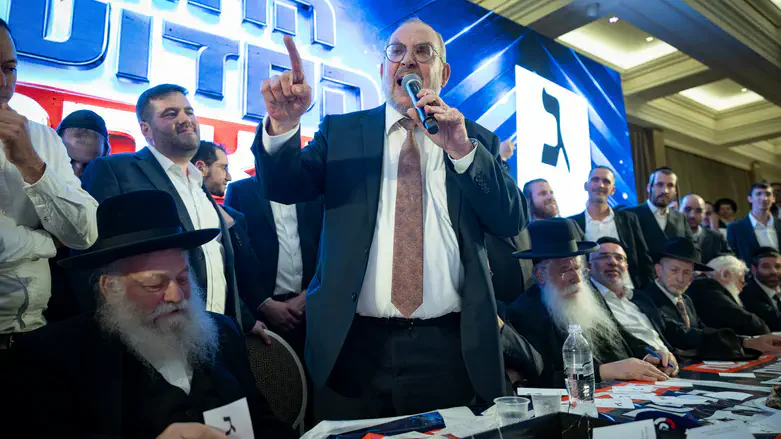
Negotiations between United Torah Judaism and the Eisenkot bloc continue away from public view, against a backdrop of deep disagreements over military conscription, divisions within the haredi party and concerns about political developments that could leave it outside the government.
Haredi commentator Yisrael Cohen, who is close to United Torah Judaism's spiritual and political leadership, explains the complexities behind the talks and the growing mutual suspicion in an interview with Arutz Sheva.
Cohen stresses at the outset that only a handful of people know the details of the talks and that the strict compartmentalization is part of the negotiating strategy.
He says, "Yaakov Asher is very strict about discretion, and that has also been the practice in Rabbi Landau's household for years. Many people close to him, including the rabbi's aides, do not know all the details or where things stand. They are keeping their cards close to their chest".
The faction's conduct adds to the political uncertainty: Its members voted with the right-wing bloc in the vote for Knesset speaker, while simultaneously negotiating with the change bloc. Cohen describes this as a smart political move by United Torah Judaism.
In his view, bridging the gaps between the sides is extremely difficult because their demands are largely at odds. He says, "The haredim have many demands. They want to resolve the entire issue of draft evaders and pass a law that would be better than Bismuth's, and the change bloc is very far from that, at least in its official positions. It is not talking along lines that would be acceptable to Rabbi LandO", also referring to Avigdor Liberman's hope of reaching an arrangement acceptable to the IDF chief of staff, the Supreme Court and Rabbi LandO.
According to Cohen, Liberman believed an agreement acceptable to all three could be reached quickly, but the reality is more complicated. Cohen says, "Eisenkot's framework looks tougher, but Liberman's bill may actually stand a chance. It is unclear whether it will be feasible, and the rabbis will want legal guarantees, but there is a sense that the Supreme Court and the media will know how to defend a proposal coming from the change bloc. The assessment is that the judiciary will allow the left to offer more than the right, and the incitement on the streets is also subsiding, as can be seen in the media, even though this is sheer hypocrisy".
Cohen believes it would be easier to make progress with Liberman's proposal. However, United Torah Judaism does not speak with one voice, nor does the change bloc have a unified position.
Opinions within United Torah Judaism are divided, Cohen notes. While Yaakov Asher and Goldknopf want to give negotiations with the Eisenkot bloc a chance, others, including Meir Porush, lean more toward the right.
There is also external pressure, with Shas aligning itself with Netanyahu, and it remains unclear what position it would take if an agreement were reached on yeshiva students. Would Shas follow United Torah Judaism's lead, and could its rabbis instruct the party to remain outside the government? Or might United Torah Judaism, in the absence of an agreed draft deal, choose to align itself with the faith-based bloc?
We asked Cohen whether United Torah Judaism fears that taking too rigid a stance could leave Eisenkot with no choice but to form a unity government with Netanyahu, Bennett and perhaps also Smotrich and Shas. Such an outcome would leave United Torah Judaism outside the government and away from the centers of influence.
Cohen believes that concern certainly exists, and that much also depends on the differing positions within the change bloc. According to him, Yair Golan opposes serving with Netanyahu and wants to serve with the Arab parties; Liberman is willing to serve with the haredim but not with the Arab parties; and Bennett is willing to serve in a rotation arrangement with Netanyahu but not with the Arab parties.
In this situation, Cohen says, "One possibility is that United Torah Judaism leaves the right, though that is less likely, but suddenly Bennett springs a surprise, and the change bloc is worried that he will take his seats over to the right. The concern that the haredim could end up losing out on both sides exists, which is why the cards are being kept close to the chest and the suspicion is so great. In a single second, you can be on top of the world or lose everything and become irrelevant".
According to Cohen, the uncertainty and mutual suspicion are generating political spin on an unprecedented scale.