

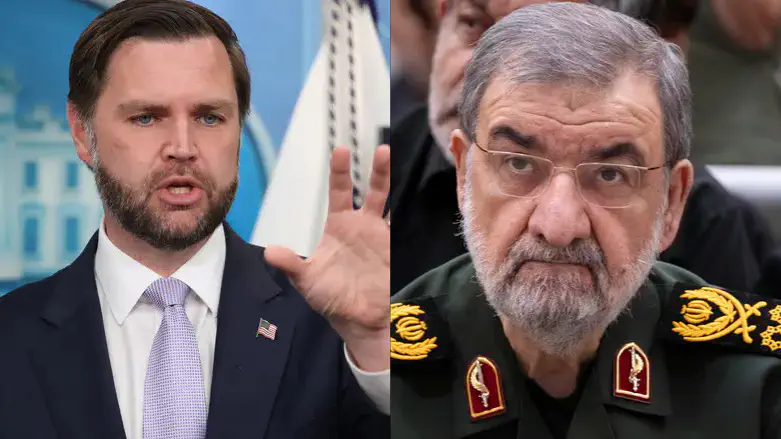
US Vice President JD Vance is weighing a direct meeting with a senior Iranian security official as President Donald Trump increasingly entrusts him with efforts to negotiate an end to the conflict with Iran, The Wall Street Journal reported Wednesday, citing American and Middle Eastern officials and individuals familiar with the discussions.
According to the report, Trump has informed senior advisers and foreign counterparts in recent days that he supports Vance resuming diplomatic engagement with Tehran and has authorized him to lead the negotiations.
Although preparations for a possible meeting are being discussed, American officials emphasized that the proposal remains at an early stage and that no final decision has been made.
Vance sent a letter in October to Mohsen Rezaei, the hard-line secretary of Iran's top security body, requesting a meeting. Rezaei later confirmed that he received the letter but stated that he did not reply to it. The two countries have since continued communicating through intermediaries and regional allies, but no date has been established for direct talks.
A meeting between an American vice president and a senior Iranian security official would represent an unusual diplomatic initiative, underscoring the administration's efforts to find a negotiated resolution to the conflict.
Vance has recently assumed a more prominent role in negotiations with Iran than special envoys Steve Witkoff and Jared Kushner, who are also involved in diplomatic efforts to end the Russia-Ukraine war.
However, officials acknowledged that the vice president's increased involvement carries substantial political risks. A failed negotiating effort could leave him closely associated with another unsuccessful attempt to secure Iranian concessions, while a breakthrough could strengthen his standing as the administration official who helped end an unpopular war.
The report also described disagreements within the administration over the results of previous negotiations.
According to two officials, Trump has privately questioned the June memorandum of understanding negotiated with Vance's involvement, suggesting that the arrangement may have allowed Iran valuable time to rebuild its capabilities and generate oil revenue before Washington imposed its naval blockade.
A White House official disputed that characterization, denying that Trump regretted the agreement and maintaining that American negotiators had acted in good faith. A spokesperson for Vance declined to comment.
The vice president has also distinguished himself from other senior administration officials by publicly attributing the Republican Party's severe midterm election losses to the war with Iran.
Trump acknowledged Vance's position but indicated that he would make the same decision to launch the military campaign again.
Secretary of State Marco Rubio and Secretary of War Pete Hegseth, meanwhile, have continued defending the military operation, arguing that Trump had no alternative if he wanted to prevent Iran from acquiring nuclear weapons.
Diplomatic activity intensified Monday when Vance met with Qatar's prime minister. The two subsequently joined Trump and other senior White House officials for additional discussions, which the President described as excellent.
Doha has emerged as a potential location for direct American-Iranian negotiations if Vance and Iranian representatives agree to meet, according to people familiar with the diplomatic contacts.
Nevertheless, significant differences between Washington and Tehran continue to obstruct progress.
Iranian officials reportedly view the Republicans' midterm election defeat as an opportunity to strengthen their negotiating position and extract additional concessions from the United States.
According to individuals familiar with Tehran's position, Iranian leaders are demanding that Washington lift its naval blockade, release frozen Iranian assets and ease restrictions on oil exports before formal negotiations resume.
Regional mediators have proposed preliminary confidence-building measures intended to reduce tensions and create conditions for further talks.
Under one proposal, the United States would move its aircraft carriers farther from Iran to reduce the possibility of renewed large-scale strikes and partially ease restrictions on Iranian ports.
In return, Tehran would permit 25 oil tankers to pass through the Strait of Hormuz, Middle Eastern officials said.
Despite these efforts, Iranian diplomats have privately expressed skepticism about the prospects for an agreement.
They reportedly fear that Trump could order additional military strikes to justify his earlier decision to go to war, pointing to previous negotiations that were interrupted by American and Israeli attacks.
Some regional mediators have also questioned whether an agreement can be reached in the coming days, citing increasingly confrontational messages delivered through representatives of Iran's Islamic Revolutionary Guard Corps (IRGC).
Rezaei himself has adopted a particularly uncompromising tone as speculation about a meeting with Vance has intensified.
In recent statements, he dismissed reports of negotiations as “imaginary talks" and declared that Iran “won’t remove even a single particle of enriched nuclear material from the country."