

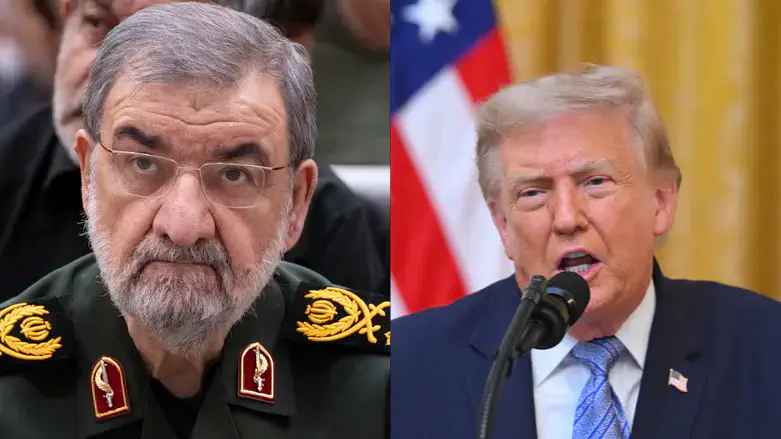
Mohsen Rezaei, Secretary of Iran's Supreme National Security Council, on Monday rejected US President Donald Trump's assertions that Tehran was engaged in negotiations with Washington, demanding that the United States accept Iran's seven conditions for ending the conflict.
In a sharply worded social media post, Rezaei accused the Trump administration of fabricating reports of diplomatic contacts and insisted that Tehran would not abandon its demands.
"The war on Iran has already wrecked the US government. But Washington flails like a desperate gambler. FOLD YOUR HAND. STOP manufacturing FAKE NEWS about imaginary talks. Stop denying the West Asian NEW ORDER. Time to SURRENDER to the seven conditions Iran has repeatedly set out," Rezaei wrote.
Iran has repeatedly maintained that its seven-point proposal constitutes the only acceptable basis for an agreement with the United States.
The conditions include American compensation for damage caused during the war, the removal of US economic restrictions and an end to the American naval blockade of Iranian ports.
Tehran is also demanding a cessation of hostilities across the region, including in Lebanon and Gaza, where Iranian-backed terrorist organizations operate, as well as the release of billions of dollars in frozen Iranian assets.
The proposal further calls for a reduction in the US military presence in the Middle East and a permanent conclusion to the war rather than a temporary ceasefire. It also excludes future negotiations concerning Iran's nuclear and ballistic missile programs.
Rezaei's remarks directly contradicted Trump's comments earlier Monday, in which the President expressed optimism that the confrontation with Iran was approaching its conclusion and suggested that diplomatic contacts were progressing.
Speaking to reporters, Trump emphasized that American forces remained prepared for further military action, although he believed renewed strikes would probably be unnecessary.
"The United States of America is fully locked and loaded, with the best equipment ever made," Trump stated. "And we don’t think there’s going to be any reason to use it, however. It’s going very well. We haven’t lost a soldier in six months."
Trump suggested that the military campaign had largely achieved its objectives and that the conflict could soon end.
"The military action doesn’t seem to be a very necessary thing, but we’re locked and loaded, ready to go for any reason," he said. "We’re seeing momentum toward the end of this conflict. I think it’s going to be ending fairly soon."
The President also claimed that Tehran was communicating with Washington in a more conciliatory manner.
"Iran is talking to us, and they’re talking very politely."
However, Trump acknowledged that a diplomatic agreement was not guaranteed and warned that military operations could resume if necessary.
"I don’t guarantee anything. But if we do have to go back in, we are locked and loaded and ready to go."
The conflicting statements followed remarks Sunday by Secretary of State Marco Rubio, who cautioned that diplomatic efforts involving Iran had made little progress.
Before departing for Paris to attend a G7 meeting, Rubio said several countries were continuing to explore possible diplomatic solutions, but there was no indication of an imminent breakthrough.
"I don't have any wonder of progress to report to you. I think you see some of these things that are out there. You have a number of countries that continue to engage them with different ideas, but I wouldn't say we're at the verge of a breakthrough," Rubio said.
He stressed that the administration continued to favor diplomacy where possible.
"The President would always prefer to solve every problem diplomatically. Sometimes that's not possible.But if there's a chance to do it, we will explore it."
Rubio also criticized Tehran's negotiating position, saying its demands had prevented meaningful progress.
"Right now it hasn't been very productive because the Iranian demands are simply not just unacceptable, but in some cases outrageous and ridiculous and really not realistic."