

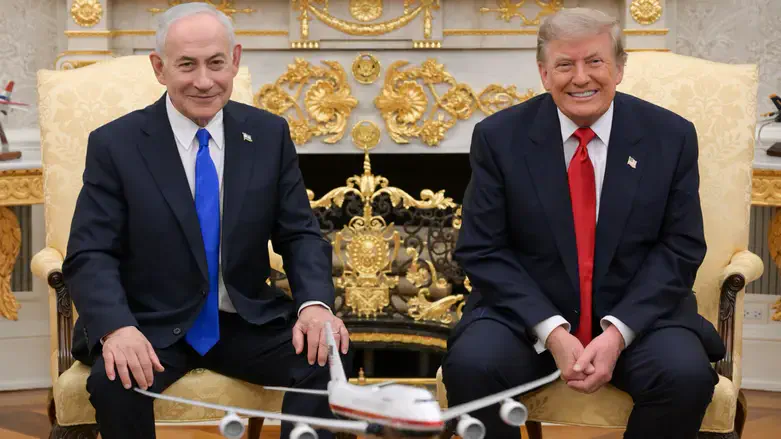
US President Donald Trump urged Prime Minister Benjamin Netanyahu during a telephone conversation Thursday to advance implementation of his Gaza peace plan, which has been stalled for months amid Israel's election campaign, Axios reported Sunday, citing two sources familiar with the discussion.
According to the report, Trump wants to move forward with the initiative now that Israel's October 27 elections have concluded, regardless of whether Netanyahu remains in office or Gadi Eisenkot succeeds in forming a new government.
The administration had previously avoided pressing ahead with the plan during the election campaign, concerned that its implementation could become a politically contentious issue. Trump endorsed Netanyahu shortly before Israelis went to the polls.
The proposal calls for the disarmament of Hamas, the demilitarization of Gaza and the transfer of governing authority to a new Palestinian Arab technocratic administration.
Israel and Hamas agreed to the first phase of Trump's 20-point peace initiative a year ago, resulting in a ceasefire and the release of the final 20 living hostages abducted during the October 7, 2023, massacre.
Since then, Trump's Board of Peace, established under the agreement, has been developing arrangements for Gaza's postwar administration, including the formation of a technocratic government and the deployment of an International Stabilization Force.
In July, the Board of Peace reached a 15-point agreement with Hamas concerning the disarmament of armed groups in Gaza and the transfer of civilian and security responsibilities to the proposed new administration.
However, Netanyahu's government has largely refrained from implementing the agreement, with Axios attributing the delays primarily to domestic political considerations.
During a visit to Israel in August, Trump's adviser and son-in-law Jared Kushner informed Netanyahu that Hamas had agreed for the first time to surrender its weapons. Kushner encouraged the Prime Minister to take steps to determine whether the terrorist organization's commitment was genuine.
Netanyahu remained deeply skeptical of the possibility that Hamas would disarm, warning that the organization was rebuilding its forces and replenishing its weapons stockpiles in Gaza.
Over the past three months, the Board of Peace has continued consultations with Israeli political and military officials to address security concerns and finalize the proposed demilitarization arrangements.
A US official told Axios that implementation would proceed gradually, with reconstruction activities beginning only after verifiable progress had been made toward disarming Hamas.
During the United Nations General Assembly in September, the Board of Peace presented a six-month recovery program for Gaza valued at $2.45 billion. The proposal includes 66 projects intended to establish the foundations for reconstruction and postwar governance.
A source familiar with the discussions said the Trump administration, the Board of Peace and Israel continued to regard the proposal as the most viable path forward, with no credible alternative currently available.
Thursday's telephone conversation, initiated by Netanyahu, also included Secretary of State Marco Rubio, Kushner and Trump's special envoy Steve Witkoff.
One source described the discussion as constructive and said the leaders also addressed the ongoing war with Iran.
Neither the White House nor the Prime Minister's Office immediately responded to requests for comment.
The diplomatic efforts continued Friday when former British Prime Minister Tony Blair, a member of the Board of Peace, visited Israel.
According to Axios, Blair met separately with Netanyahu and Eisenkot, who has been tasked with attempting to form Israel's next government.
A source familiar with Blair's visit said he encouraged Netanyahu and other Israeli political leaders to give the Gaza initiative an opportunity to succeed.