

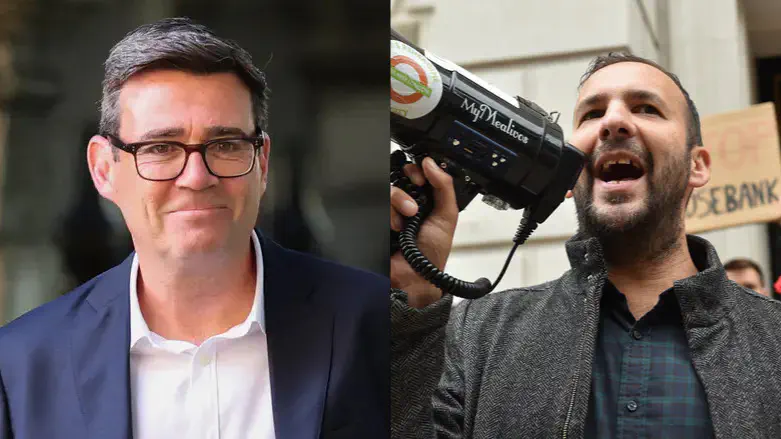
British Prime Minister Andy Burnham on Thursday urged Green Party leader Zack Polanski to overturn a controversial resolution adopted by party members that defines Zionism as a form of racism and supports replacing Israel with a single Palestinian state.
The resolution, approved Sunday during the Greens' annual conference in Brighton, describes Zionism as an ideology advocating "an ethnonationalist Jewish state" and endorses a "single democratic Palestinian state in all of historic Palestine", encompassing the territory of present-day Israel.
Burnham strongly criticized the decision, calling it "completely wrong" and an example of "terrible judgement", according to the BBC.
Speaking to reporters during a visit to Berlin, the prime minister argued that the resolution effectively rejects the possibility of resolving the Israeli-Palestinian Arab conflict through the establishment of two states.
"For that reason, it shouldn't be supported in any way, shape or form," Burnham said, as quoted by the BBC.
"I would call on the leadership of the Green Party to say that it will be reversed and it won't be Green Party policy."
Asked whether the controversy would prevent Labour from entering a future coalition with the Greens, Burnham declined to speculate about "any business about what might or might not happen in the future".
The resolution has triggered significant divisions within the Green Party, with four of its five members of Parliament opposing the measure. The party's co-deputy leaders have also taken opposing positions, while the deputy leader of the Welsh Greens resigned following the vote.
The decision has additionally drawn criticism from Green Party members and affiliated parties elsewhere in Europe.
Polanski, who did not participate in the vote because he left the conference early to campaign in London, has sought to address concerns that Jewish members could face exclusion from the party.
He said he would not tolerate anyone being excluded "because of the religious or communal body they are part of".
However, the Green leader has avoided media interviews since the resolution passed and declined to answer questions from a BBC reporter about the controversy before Burnham's intervention.
The dispute has overshadowed the closing stages of Polanski's campaign in a by-election for the parliamentary seat previously held by former Prime Minister Sir Keir Starmer. The Greens are attempting to overturn a substantial Labour majority in the constituency.
A Green Party spokesperson defended the broader context of the resolution on Thursday while acknowledging the controversy it had generated.
"This has been an emotive issue and is complex. It has rightly caused much discussion, and needs to be taken in the context that Israel's behavior has had. Israel has been responsible for a genocide, ethnic cleansing and the killing of children, and we've had a political establishment which has not only turned a blind eye but provided support," the spokesperson charged.
Burnham's criticism comes despite his own government's adoption of measures targeting Israel.
In September, Britain announced a prohibition on imports originating from Israeli communities in Judea and Samaria, following Israel's publication of construction tenders in the E1 area between Jerusalem and Ma'aleh Adumim.
Israel responded with a series of diplomatic measures announced by Foreign Minister Gideon Sa'ar.
These included closing the British Consulate in Jerusalem, removing British personnel from the International Gaza Support Center in Kiryat Gat and terminating British training activities for Palestinian Authority security forces in Judea and Samaria conducted through the “British Support Team in Ramallah."
Israel also announced entry bans against 12 British elected officials and other British nationals, citing alleged antisemitic or anti-Israel activity and denial of Israel's right to exist.
Burnham assumed office in July after succeeding Starmer as prime minister. Before taking office, he had advocated a tougher British approach toward Israel, including an apology for Labour's initial response to Israel's military campaign in Gaza.
He also pledged to consider additional sanctions against individuals and organizations and to examine restrictions on products originating from what he called "illegal settlements".