

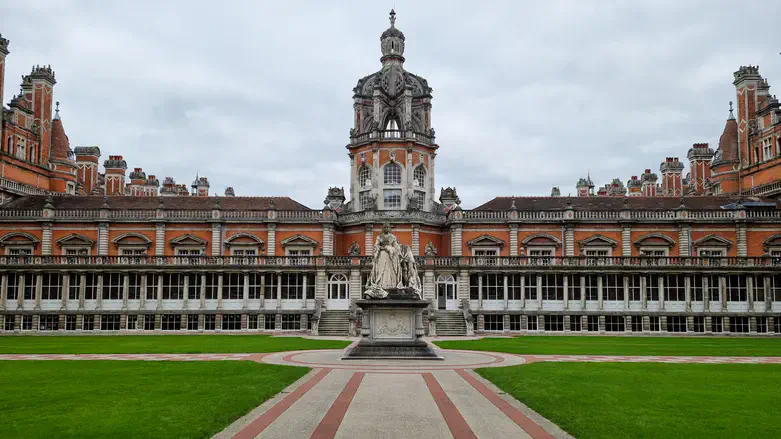
A British university secretly referred a pro-Israel student to a government counter-terrorism program after monitoring his political activities, social media posts and movements around campus, according to internal documents obtained by The Telegraph.
Brodie Mitchell, a 20-year-old politics and law student at Royal Holloway, University of London, discovered the extent of the surveillance after requesting access to records held about him by the institution.
The university provided 1,465 pages of documents, many heavily redacted, detailing internal discussions about Mitchell, restrictions imposed on his movements and a referral to Britain's Prevent counter-terrorism program.
The records also revealed that university officials monitored his attendance at a Remembrance Sunday service and contacted police after he traveled to Golders Green to express solidarity with the Jewish community following a terrorist attack.
Mitchell, who is not Jewish, has openly supported Israel and has reported receiving numerous threats because of his political views.
“The intimidation was there from the beginning," Mitchell told The Telegraph. “I’ve had so many death threats. Multiple threats to find me, assassinate me, Charlie Kirk me, wear a scarf - keep your neck nice and warm and moist, ready to be slashed."
His dispute with the university began in September 2025 during Freshers Week, when he displayed a British flag featuring a Star of David at a Conservative Society stall.
On September 23, Mitchell became involved in a confrontation with Huda El-Jamal, president of the university's Friends of Palestine society.
Mitchell alleged that El-Jamal called him a “wannabe Jew" and questioned why he was not wearing a Jewish skullcap. He subsequently began recording the encounter and referred to her head covering as a “tea towel."
El-Jamal denied making the alleged remark and accused Mitchell of approaching her stall and mocking her hijab or keffiyeh. The beginning of the confrontation was not recorded.
Following a complaint to police, Royal Holloway suspended Mitchell the next day over allegations of racially offensive and Islamophobic conduct.
The suspension severely restricted his access to university facilities, academic activities and accommodation. Even after he was permitted to return, a Campus Exclusion Restriction Order limited where he could go.
Internal correspondence obtained by The Telegraph showed that staff documented sightings of Mitchell around campus and circulated information about his appearance. The records also included security camera images of him entering a cafeteria.
In November, university administrators reprimanded Mitchell for attending a Remembrance Sunday service in the campus chapel, treating his presence as a violation of the restrictions.
The university had found him guilty of misconduct in October after a hearing he refused to attend because he had been denied legal representation, although the institution had its own lawyer.
After a nine-week suspension, Mitchell was permitted to resume his studies. However, university staff were reportedly instructed to monitor his classroom attendance and conduct, prompting privacy concerns among some lecturers.
Mitchell subsequently pursued legal action with assistance from the Free Speech Union.
The dispute was settled out of court in April, with Royal Holloway paying compensation as a “gesture of goodwill" and acknowledging that it “regrets the length of time for which he was suspended and the distress this caused him as a result".
Following the settlement, Mitchell continued receiving threats online, including messages threatening to kill or physically assault him. His address and information about his whereabouts were also circulated.
On April 25, Mitchell criticized the university on social media and called for the deportation of Pakistani Muslims whom he believed had threatened him.
Four days later, university officials referred him to Prevent, the British government's program for identifying individuals considered vulnerable to radicalization.
According to The Telegraph, the referral explicitly mentioned Mitchell's support for Israel when describing his political beliefs.
The university stated that he had expressed “Zionist & pro-Israel views" and suggested that his more recent statements could indicate increasingly extreme right-wing opinions.
However, the referral acknowledged that there was no evidence connecting Mitchell to extremist organizations and noted that he had himself reported threats of violence.
The documents also showed that university officials contacted Surrey Police after Mitchell visited Golders Green to support the Jewish community following an attack in which two Jewish people were stabbed.
Mitchell had posted photographs of his visit and described standing alongside Jewish residents in the aftermath of the attack.
Counter-terrorism police ultimately rejected the university's referral.
In a June 2 response, Thames Valley Police concluded that Mitchell did not meet the criteria for intervention under Prevent.
“There is no evidence to suggest that the subject is developing an extremist mind-set in the promotion or advancement of an ideology based on violence, hatred or intolerance," an officer wrote.
The police assessment also found no indication that Mitchell was being radicalized or encouraging others toward terrorism, and the case was closed.
Separately, Surrey Police continued investigating the original September 2025 confrontation before dropping the case on October 13 of this year.
An officer informed Mitchell that the evidence was insufficient to pursue charges and acknowledged that earlier police communications had incorrectly suggested the case had been forwarded to the Crown Prosecution Service.
Mitchell criticized the university's handling of the affair and questioned why his political activity had attracted such extensive scrutiny.
“I don’t think it’s at all normal for a university to monitor any type of political student so closely, unless he or she poses a genuine danger. In which case it should be the responsibility of the police. What happened to me is just not normal," he told The Telegraph.
Royal Holloway declined to address the specific allegations or the documents obtained by Mitchell.
“The university is aware of recent commentary circulating online. As a matter of policy, we do not confirm or discuss the content, source or status of material said to relate to the university," a spokesperson said.
“The university takes its responsibilities in relation to student welfare, freedom of speech, data protection and the safety of its community seriously.
“As this involves confidential matters relating to individuals, we are unable to comment further."