

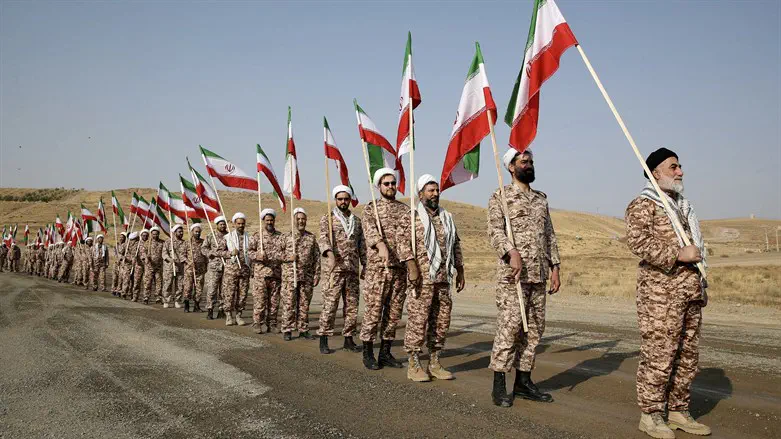
Tehran's Islamic Revolution Guard Corps (IRGC) on Monday forcefully dismissed assertions by US President Donald Trump that a secret communication path exists between Washington and the military force.
In an interview published by the semi-official Tasnim news agency, IRGC spokesperson Hossein Mohebbi characterized Trump's claims as a "delusion," asserting that no discussions are taking place between IRGC officials and American representatives.
Mohebbi further noted that even Iran's official diplomatic bodies are not presently holding talks with the United States, pointing to Washington's "breach of promises" as the reason.
Concurrently, during a Monday media briefing, Iranian Foreign Ministry spokesperson Esmaeil Baghaei refuted reports alleging off-the-record contact between Washington and the IRGC facilitated through Iraqi Kurdistan representatives, as well as rumors of a clandestine U.S.-Iran meeting in Erbil.
Baghaei stated that such reports are "media techniques and psychological operations used to sow discord among Iran's decision-making bodies".
The Iranian denials followed statements by Trump during a Fox News appearance, in which he stated that a secret channel for peace discussions between Washington and the IRGC was active.
Later in the day, Trump stated that he does not intend to seek an extension of the June framework agreement negotiated with Iran to resolve the conflict, while asserting that American forces have established "total control" over the Strait of Hormuz.
"No," Trump responded when questioned by reporters on whether he was pursuing an extension to the Iranian arrangement brokered by Pakistan in June.
The President's statements came as the 60-day negotiating window drew toward its conclusion without yielding a comprehensive settlement, which the framework deal had aimed to achieve. The timeline was set by the June agreement to allow a period for broader peace talks.
When asked if both nations were making progress toward a final resolution under the framework, Trump indicated that Iranian leaders wish to negotiate but remain unwilling to concede to terms he deems necessary.
"They want to make a deal, but they are not going to make the kind of a deal that I feel is necessary," Trump said.
He reaffirmed his position that Tehran must not acquire nuclear capabilities.
"Look, we're in there for one reason: Iran cannot have a nuclear weapon. You understand that Iran cannot have a nuclear weapon, and they won't have a nuclear weapon," he added.
When asked about his remarks last week suggesting he would declare the Strait of Hormuz a United States territory, Trump stood by the concept, arguing that a military blockade gives the US full command of the strategic passage.
“Well, I just think it's a great idea," the president said.
“I mean, we control it. We control it with the blockade. We have a blockade. We control it with the blockade, and I like the idea of declaring it a territory. We have total control over the Strait. Now, they can be a nuisance ... But the blockade has been very effective".
Trump described the naval blockade as effective and asserted that US operations were allowing millions of oil barrels to pass through the region weekly.
“We are taking out - maybe that will stop, or maybe it will open up even further - we are taking out millions of barrels of oil a week," he said.
“The strait is open, and the oil prices are coming down, and they will continue to come down unless we decide to do something far more drastic than we are doing," he said, noting that Iran is “in big trouble".