

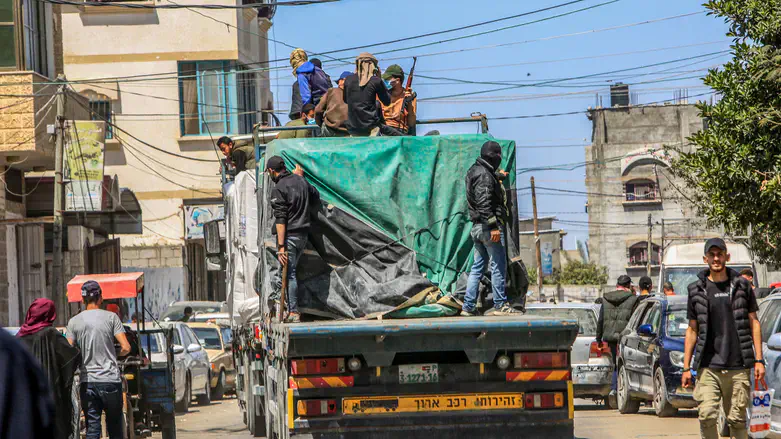
A Nukhba terrorist who took part in the October 7 massacre was arrested in the Rafah area while driving an aid truck en route to the Kerem Shalom Crossing.
Channel 12 News reported that the terrorist was transferred to Israeli security forces for further questioning following his arrest.
Security officials said the aid loaded onto the truck was intended for the private sector in the Gaza Strip. The shipment had been transferred through a private merchant in Gaza before being collected by the driver.
The suspect was apprehended while traveling in the Rafah area, before reaching the Kerem Shalom Crossing. After authorities determined that he had participated in the October 7 massacre, he was taken into custody for further investigation.
Last month, COGAT published a report revealing that approximately 1.78 million tons of food entered the Gaza Strip between October 2025 and June 7, 2026, which it said was nearly three times the monthly humanitarian requirements defined by the World Food Program. It added that humanitarian aid alone exceeded the WFP's higher benchmark, while commercial imports further increased food availability.
The report also stated that food prices in Gaza fell by approximately 72 percent between September 2025 and May 2026, which it attributed to increased humanitarian assistance and commercial supplies.
COGAT's report also noted that Hamas remains the principal impediment to the effective delivery of humanitarian assistance and to broader efforts aimed at stabilizing Gaza, while reiterating Israel's commitment to facilitating humanitarian assistance in coordination with the United States, the UN, and international partners.