

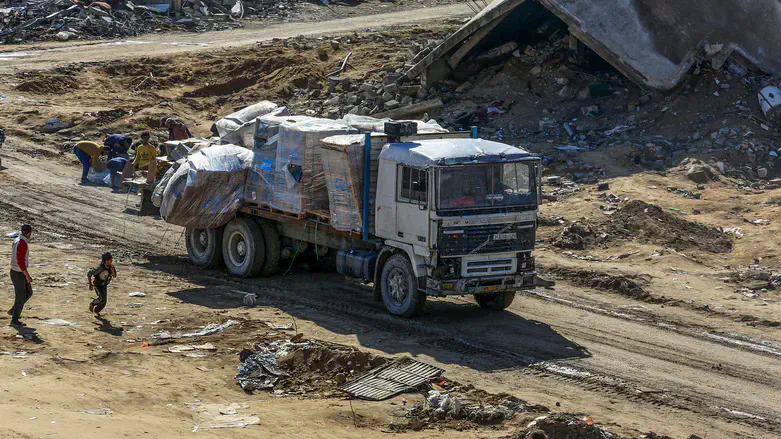
The IDF warned on Thursday morning that the Hamas terrorist organization is strengthening significantly due to the volume of humanitarian trucks entering the Gaza Strip daily, as well as thanks to smuggling carried out through additional routes into the Strip.
Official data published by the IDF shows that during the period of the war in Gaza, several extensive humanitarian initiatives were completed, including the entry of 112,000 aid trucks, the arrival of 5,000 international humanitarian personnel to the Strip, and the airdrop of 13,000 food pallets.
In addition, 600,000 children were vaccinated against polio, and several aid crossings were operated during the war. The humanitarian effort also included the entry of medical equipment in impressive volumes of 55,000 tons and 1,700,000 tons of food.
In Phase A of the ceasefire agreement, 60,000 aid trucks, 900,000 tons of food, and 9,600 tons of medical equipment were brought in. Significant achievements were accomplished without a prominent humanitarian crisis during a high-intensity war, as a functioning aid system operated over time.
Today, approximately 600 trucks enter Gaza per day, and approximately 4,200 trucks per week. This is an enormous volume, four times the volume required for the Strip according to UN standards, which state that the humanitarian need is 80,000 tons of food per month, equalling approximately 134 trucks per day.
The IDF notes that smuggling of materials such as cigarettes, tobacco, electrical products, phones, and dual-use agricultural materials enter not only through aid trucks, but also through the crossings and through the Strip's border, under the cover of Israeli security activity taking place on the Strip's border, including through civilian contractors.
Ahead of the expected opening of the Rafah crossing this coming Sunday, senior IDF officials are recommending to the political echelon to insist that the crossing serve only for the movement of people, and not for the entry of goods from Egypt to Gaza as was the case before October 7. The IDF emphasizes that until the war broke out, the main military strengthening of Hamas was done through the entry of goods from the Rafah crossing. Thousands of trucks entered annually through the crossing, and despite warnings from the defense establishment about Hamas's military strengthening through the crossing, the crossing continued to operate.
The IDF believes that Hamas is not troubled by the technocrat committee established to manage the Strip and that it is possible the organization will agree to transfer control of Gaza to the committee's hands, but will continue to actually control from a security standpoint.
Additionally, the IDF points out that even after the committee begins to manage the Strip's affairs, most of the civil service personnel who will work under it - including mayors, hospital directors and more - are Hamas members who have served in recent decades as Hamas officials. The IDF notes that the senior civil service layer must be replaced.
In the context of Syria, the IDF published data showing that Israel assisted in transporting civilian aid, including the entry of medical equipment, baby products, and diesel fuel ammunition, with approximately 370,000 liters of diesel and 13 water tankers brought into the security zone.
Meanwhile, approximately 300 patients from Syria are being evacuated for medical treatment in Israel, and additional aid includes training doctors and establishing medical centers.