


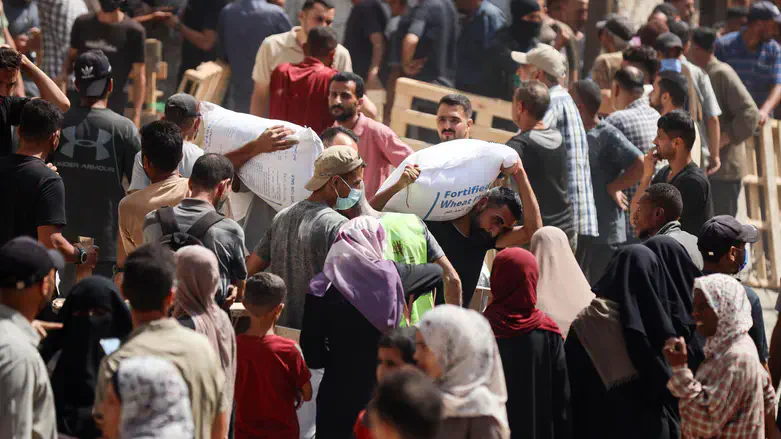
The Coordinator of Government Activities in the Territories (COGAT) on Thursday published a comprehensive report on the humanitarian situation in the Gaza Strip during the ceasefire period, saying it was intended to present "a full picture" to the international community in light of what it described as attempts by Hamas and other parties to misrepresent conditions in Gaza.
According to COGAT, the report is based on information received from international organizations, the UN, online reports, and studies conducted by humanitarian professionals and experts.
The report reviews humanitarian conditions in Gaza between October 2025 and June 2026, focusing on food security, water, sanitation, and medical support. It concludes that humanitarian assistance entering Gaza during the ceasefire substantially exceeded internationally recognized humanitarian requirements and that conditions remained stable throughout the period.
COGAT stated that approximately 1.78 million tons of food entered the Gaza Strip between October 2025 and June 7, 2026, which it said was nearly three times the monthly humanitarian requirements defined by the World Food Program. It added that humanitarian aid alone exceeded the WFP's higher benchmark, while commercial imports further increased food availability.
The report also stated that food prices in Gaza fell by approximately 72 percent between September 2025 and May 2026, which it attributed to increased humanitarian assistance and commercial supplies.
According to COGAT, the primary obstacles affecting food availability are not related to the volume of aid entering Gaza but to its management, taxation, and circulation in Hamas-controlled areas. The report cites food stockpiles alongside documented cases of spoiled food as evidence of distribution and storage challenges.
On medical assistance, the report states that more than 18,000 tons of medicines and medical supplies entered Gaza during the ceasefire. It adds that, according to the World Health Organization, hospital bed capacity increased from 2,009 beds in October 2025 to 3,120 beds by the end of May 2026.
The report also states that more than 70,000 cubic meters of water are currently available in Gaza each day through multiple sources, including water lines from Israel and desalination facilities, which it says exceeds international humanitarian standards.
According to the report, repeated predictions that Israel's policies regarding UNRWA and the vetting of international NGOs would prevent an adequate humanitarian response have not materialized. It states that Israel continues to cooperate with international organizations and UN agencies while maintaining registration requirements for organizations operating in Gaza.
In its conclusion, COGAT states that Hamas remains the principal impediment to the effective delivery of humanitarian assistance and to broader efforts aimed at stabilizing Gaza, while reiterating Israel's commitment to facilitating humanitarian assistance in coordination with the United States, the UN, and international partners.