

The Board of Peace on Monday criticized Israel's response to severe flooding in the Gaza Strip, calling for the immediate entry of additional humanitarian supplies and accusing the Israeli government of failing to fully implement its commitments under President Donald Trump's peace plan.
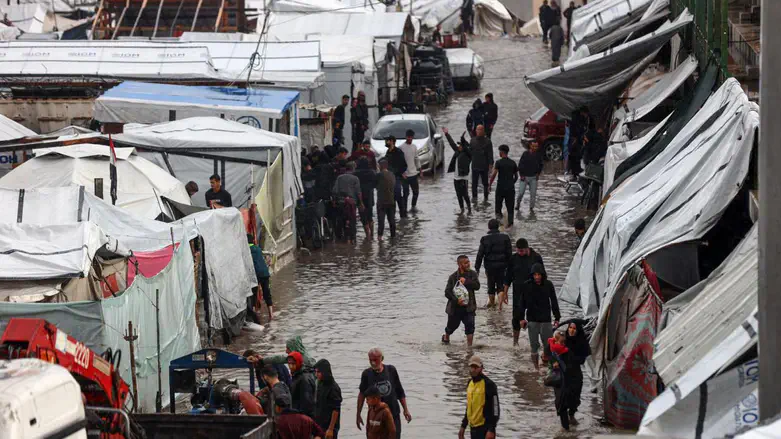
The statement followed heavy rainfall over the weekend that reportedly flooded tens of thousands of tents housing displaced Gaza residents, damaged temporary shelters, and caused fatalities.
According to Reuters, a woman and three children were killed Sunday night when heavy rain caused a sand embankment to collapse onto tents at a displacement camp south of Deir al-Balah in central Gaza. Six others were reported injured.
The Hamas terrorist organization reported that at least 70,000 tents were flooded, while the United Nations Office for the Coordination of Humanitarian Affairs (OCHA) said humanitarian organizations had received requests for assistance from more than 26,000 households whose shelters or belongings were damaged.
In its statement, the Board of Peace described the flooding as an immediate humanitarian emergency requiring the urgent delivery of shelter materials, sanitation equipment, drainage systems, and additional winter supplies.
The Board acknowledged improvements in Gaza's humanitarian conditions over the past year, particularly in food availability and nutrition, but warned that the flooding threatened to reverse those gains.
It said it had repeatedly called on the Israeli government to permit the entry of materials needed for temporary housing, water infrastructure, waste management, and sewage removal, in accordance with the Sharm El-Sheikh Humanitarian Protocol.
"While we acknowledge the steps now being considered by the Israeli government, including the Coordination of Government Activities in the Territories (COGAT), the response remains insufficient," the statement said.
The Board called on Israel to accelerate the approval and delivery of humanitarian equipment, arguing that delays had worsened the consequences of the flooding and hindered the transition of governing authority in Gaza from Hamas to the National Committee for the Administration of Gaza (NCAG).
At the same time, the Board demanded that Hamas fulfill its obligations under the peace plan, including disarming and relinquishing control of Gaza.
It warned that Hamas's recent military activities in civilian areas and near Israeli positions were endangering the population and undermining humanitarian progress.
"Nothing absolves Hamas from its responsibility for launching the attacks of October 7th, 2023, with no consideration for the consequences for the population," the Board stated.
The Board also urged the United Nations and international donors to coordinate emergency assistance and support the establishment of functioning civilian institutions under the NCAG.
In a separate statement, the NCAG expressed condolences to families whose relatives were killed when embankments and rubble collapsed onto tents during the storms.
The committee described the combination of flooding, dangerous weather, and inadequate shelter as an urgent humanitarian crisis.
"We call upon regional and international partners, mediators, and all relevant parties to facilitate the immediate entry of shelter and emergency relief supplies, including drainage equipment," the NCAG's Chief Commissioner stated.
The two statements came as the IDF and COGAT announced additional details of the measures Israel has already undertaken to prepare Gaza for the winter.
According to the Israeli military, more than 91,000 tents and over 8,200 trucks carrying winter supplies, including blankets, tarpaulins, and clothing, have entered the Gaza Strip in recent months.
The IDF said the winter preparedness program was developed in coordination with the Board of Peace and implemented in cooperation with the UN, international humanitarian organizations, and donor countries.
Israeli authorities have also advanced projects to improve water distribution, sewage removal, and sanitation infrastructure, including facilitating the entry of 12 sewage vacuum trucks for the International Committee of the Red Cross.
Additional measures include the approval of 7,500 vaccine doses for UNICEF, three mobile clinics for the International Medical Corps, and medical supplies and fuel for hospitals.
According to the IDF, more than 850 requests involving tens of thousands of trucks carrying winter-related humanitarian supplies have been approved. However, approximately half of those requests have yet to be fulfilled by the UN and international organizations, partly because of logistical and financial difficulties.
The military also said it was continuing to evaluate requests involving equipment that could potentially be diverted to Hamas for the reconstruction of terrorist infrastructure, while examining alternatives that would address humanitarian needs.
"The IDF and COGAT will continue working to improve the humanitarian response and prepare the population for winter, while preventing these efforts from being exploited to rebuild the capabilities of terrorist organizations," the military stated.