

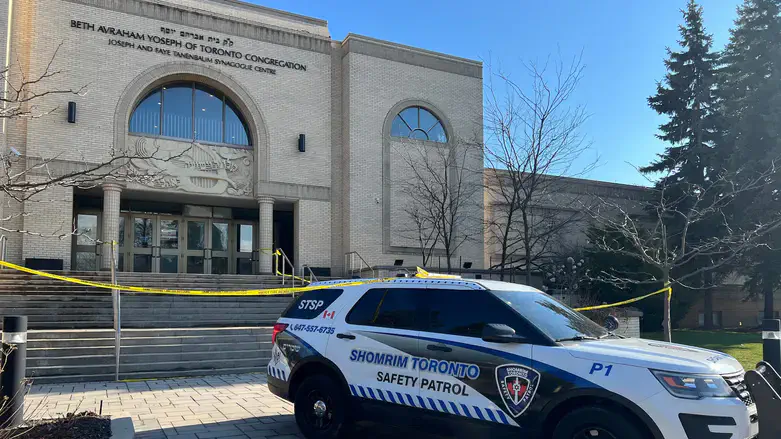
Last year, 20 people were murdered in antisemitic attacks in Sydney, Manchester, Washington, D.C. and Boulder, Colorado, making 2025 the deadliest year for antisemitic violence for the Jewish diaspora since the 1994 AMIA bombing in Argentina. Against that backdrop, the J7 Large Communities' Task Force Against Antisemitism today released its second annual J7 Report on Antisemitism, documenting more than 23,000 antisemitic incidents across J7 countries in 2025, comprising over 90% of the Jewish diaspora.
The report tracks antisemitic incidents and trends across Argentina, Australia, Canada, France, Germany, the U.K. and the U.S., comprising over 90% of the Jewish diaspora. Total antisemitic incidents among J7 countries are up 136% and violent incidents are up 97% compared to 2022, the year before Hamas' October 7 attack on Israel. This year’s report also includes a chapter examining rising antisemitism in Ireland, reflecting the broad reach of antisemitic trends beyond J7 countries.
“Antisemitism in our seven countries is no longer a surge; it is our new normal. Governments must stop reacting after Jews are attacked and start acting before, with real security funding, stronger laws and social media platforms that enforce their own rules," said the J7 Large Communities' Task Force Against Antisemitism in a joint statement.
"ADL helped found the J7 in 2023 because no country can fight antisemitism alone, and this report shows exactly why. 2025 was one of the most violent years for American Jews on record: we were targeted an average of 17 times a day. This isn't just an American crisis; every single J7 country remains dramatically above pre-October 7 levels. Antisemitism transcends borders, and our response must do so too," said Jonathan Greenblatt, ADL CEO and National Director.
Key findings from the report include:
• A total of 20 people were killed in antisemitic attacks in 2025, all in J7 countries: 15 murdered at a Hanukkah celebration on Bondi Beach in Sydney, two killed at Heaton Park Synagogue in Manchester on Yom Kippur, two killed at the Capital Jewish Museum in Washington, D.C. and one killed in Boulder, Colorado.
• Every J7 country’s antisemitic incidents remain dramatically above pre-Oct. 7 levels. Antisemitic incidents decreased in the U.S. (-33%), Australia (-20%), Canada (-16%) and France (-16%) in 2025, and rose in the U.K. (+5%), Argentina (+4%) and Germany (<+1%).
• Australia saw the sharpest rise of antisemitic incidents since 2021 (+270%), followed by followed by Germany (+215%), the United States (+131%), and France (124%).
• Germany remains with the highest rate of antisemitic incidents per Jewish capita: nearly 70 per 1,000 Jewish residents in 2025. That is nearly five times Australia's rate, six times the U.K.'s rate, and nearly 70 times the U.S. rate.
• Anti-Zionism was a key motivation behind a significant share of incidents: 48% in the U.K., 45% in the U.S. and 23% in Germany.
• Ireland: In just six months, Ireland's roughly 2,200-person Jewish community reported 143 antisemitic incidents, a rate of 65 incidents per 1,000 Jewish people, with no national strategy or dedicated security funding currently in place.
“The J7 Annual Report makes clear that antisemitism is no longer a temporary surge, but a sustained global crisis affecting Jewish communities across all seven countries. The J7 was created because no community can confront this threat alone. Governments, institutions, and technology companies must act with urgency, enforce the law, strengthen security, and ensure that Jews can live openly and safely," said William C. Daroff, CEO of the Conference of Presidents of Major American Jewish Organizations.
The J7 Task Force calls on governments and law enforcement to take preemptive action to protect Jewish communities, rather than reacting after attacks occur, and to close legal loopholes that allow antisemitic incitement, including when cloaked in anti-Zionist language, to go unpunished. The Task Force also urges technology companies to strengthen moderation of hate content and increase transparency and cooperation with civil society to counter emerging threats.