

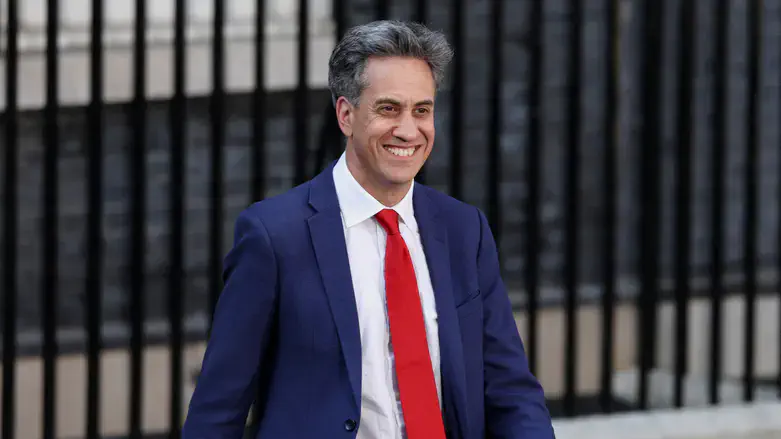
Newly installed Prime Minister Andy Burnham on Monday selected Jewish politician Ed Miliband as Britain's Foreign Secretary, replacing Yvette Cooper in a major cabinet reshuffle, the British Jewish News reported.
In a formal statement confirming his appointment, Miliband outlined his core international priorities, including continued assistance to Ukraine, preserving the transatlantic alliance with Washington, securing "a sustainable peace in Palestine and Israel," and reopening the Strait of Hormuz.
Posting on social media, Miliband highlighted his family's refugee history, connecting his personal heritage to his new diplomatic mission.
“It is a great honour and privilege to have been appointed by the Prime Minister to serve as Foreign Secretary," he said. “My parents came to Britain as Jewish refugees from the Nazis. To them, Britain was both a sanctuary and a beacon of hope in the global fight against fascism. I will carry my parents’ faith in that spirit of Britain to my role representing our country."
The 56-year-old's appointment comes after he reportedly sought the Chancellor’s post, which Burnham instead handed to former Defence Secretary John Healey to steady financial markets. Shabana Mahmood was retained as Home Secretary.
The Jewish News noted that Miliband's elevation to Britain's top diplomatic role is expected to face intense scrutiny due to his long-standing, often controversial record on Israel and Middle East policy.
As the son of Polish Jewish immigrants - his father, Marxist scholar Ralph Miliband, lost family in the Holocaust, while his late mother, Marion Kozak, survived as a hidden child in Poland before becoming an outspoken advocate for Palestinian Arabs - Miliband has navigated a complex relationship with his Jewish identity and the Jewish state.
While leading the Labour Party in 2014, Miliband drove a rift between the party and many traditional Jewish supporters by steering Labour away from its historic stance to take a far more adversarial approach to Jerusalem. During the 2014 Gaza war, he denounced Israel's military operation as "wrong and unjustifiable" and lambasted Prime Minister David Cameron for not condemning civilian casualties.
Later that year, Miliband enforced a party whip instructing Labour MPs to vote in favor of a symbolic parliamentary motion to unilaterally recognize a Palestinian state - a move that alienated key Jewish donors and communal organizations. During a visit to the region, he inspected a Bedouin site and branded Israeli community expansion "wrong and illegal."
At the same time, Miliband has maintained some key pro-Israel positions. Following the October 7 Hamas massacres, he aligned with party leadership to reject calls for an immediate, unconditioned ceasefire, voting instead for humanitarian pauses. He has denounced Hamas as a terrorist organization, condemned rocket barrages on Israeli towns as "totally unjustified and appalling," and openly rejected the Boycott, Divestment, and Sanctions (BDS) movement as an obstacle to peace.
Meanwhile Burnham, who succeeded Keir Starmer as British Prime Minister, recently laid out an anti-Israel platform, apologizing for Labour's initial response to Israel's military campaign in Gaza and promising a stronger approach toward the Jewish state if he becomes prime minister.
Burnham said a future government under his leadership would seek to increase pressure on the Israeli government, including by considering additional sanctions against individuals and entities and examining a ban on trade in goods originating from what he described as illegal settlements.
He declined to describe the situation in Gaza as genocide, saying such a determination should be left to international courts.
Burnham said he remained committed to combating antisemitism and reiterated his condemnation of the Hamas attacks of October 7th.