

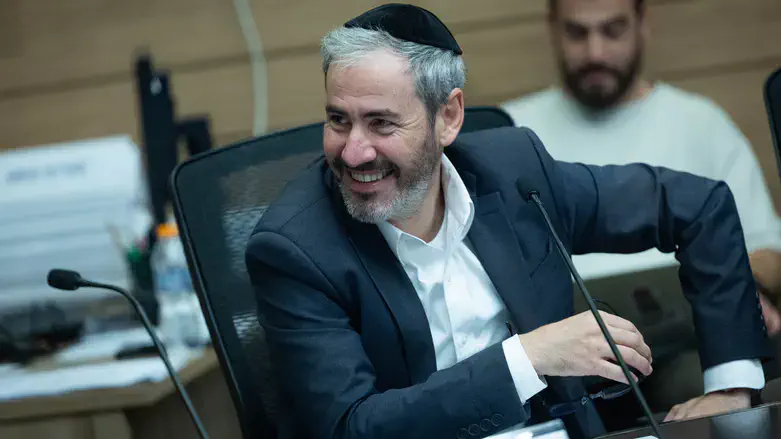
Rabbi Yirmi Stavisky, former principal of Jerusalem's Himmelfarb High School, delivered an emotional address on Tuesday during a Knesset committee discussion on the proposed Basic Law: Torah Study.
Rabbi Stavisky, who lost his son-in-law and 11 of his former students in the current war, spoke of his personal loss while calling for greater integration of the haredi community into Israeli society.
Recalling the many funerals he has attended since the outbreak of the war, Stavisky questioned why haredi yeshiva students had not come to comfort the bereaved families.
"I ask why the public across from us did not at least come to the funerals of our graduates," he said, adding that he had hoped to see members of the haredi community showing support for families who lost loved ones.
He argued that too many young men are directed exclusively toward full-time Torah study, even when it is not the right path for them.
"There are people who want to acquire a profession and become part of society but are unable to do so within the existing framework," he said, stressing that they are "good and worthy people."
Stavisky added, "The State of Israel can survive only if haredi society is part of it. It is a strong community, and there are worthy people there."
His remarks were interrupted by MK Yosef Taieb (Shas), who objected to the criticism.
"When you want to integrate them, not when you want to make them less worthy. I have four brothers in the army-don't tell me stories," Taieb shouted toward the lawmakers who protested his remarks.
As the exchange escalated, Taieb insisted that efforts to integrate the haredi community should not come at the expense of its way of life. At one point he accused Stavisky of being "arrogant and insolent."
Other lawmakers called on Taieb to allow Stavisky to finish speaking, but Taieb repeated his criticism, saying, "An arrogant and insolent man. I heard very well what he said."
Following the heated exchange, Taieb issued a statement defending his conduct.
"I respect and appreciate IDF soldiers," he said. "As I stated today in the committee, I and four of my brothers served in combat units. One of my brothers suffers from PTSD. I participated in dozens of military funerals and condolence visits, some for soldiers whom I knew personally. No one can preach to me about military service or appreciation for our soldiers and fallen heroes. When he spoke about his son-in-law, I explicitly said that I appreciate and respect him."
Taieb added, "With all due respect, there is a limit. I could not sit quietly and listen to him speaking on and on in an arrogant and patronizing way toward the haredi sector and lecturing us about changing our way of life and our faith."