


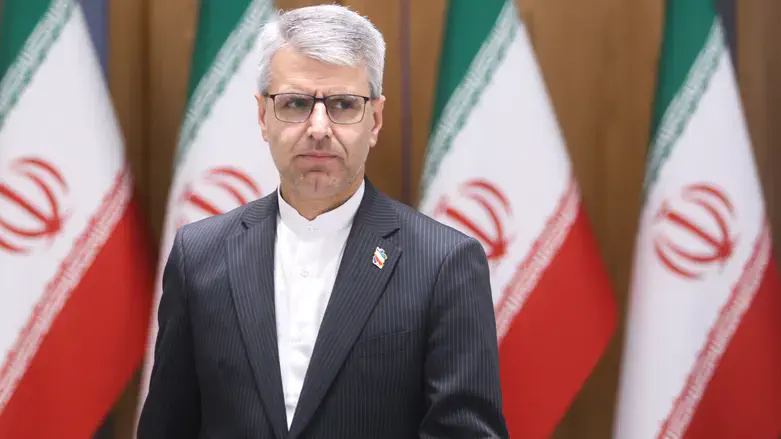
Iranian Foreign Ministry spokesperson Esmaeil Baghaei confirmed on Wednesday night that the implementation of the newly digitized memorandum of understanding between Tehran and Washington has officially commenced.
According to Baghaei, the formal electronic execution of the pact has triggered the immediate start of a 60-day window designated for intensive bilateral deliberations. Baghaei was speaking after the two sides confirmed that they had digitally signed the pact.
State media reported that the spokesperson emphasized Iran's desire to expedite the upcoming round of diplomacy.
"From the time this agreement is signed, which essentially starts from now, we are supposed to hold talks over two issues for 60 days. As for the 60 days, the sooner we reach a conclusion, the happier we will be. If we can reach an agreement within 30 days, it would certainly be better for us, because every day that we can lift the unjust sanctions is in our interest," Baghaei stated.
While noting that the 60-day timeline can be extended if both sides mutually consent to more time, Baghaei stressed that Tehran remains strictly focused on achieving rapid, concrete results.
"If necessary, it can be extended by mutual agreement. But since our negotiations have always been results-oriented and focused on outcomes, our effort is to reach a conclusion on these two issues in the shortest possible time. The issues of sanctions lifting and nuclear matters will be finalized; this is our approach, and our effort is to complete this within this timeframe," he added.
Baghaei also issued a warning to Israel and stated that any continuation of its attacks on Lebanon would constitute a violation of the other side’s obligations under the memorandum of understanding.
“We make no distinction between the United States and the Israeli regime, although differences in their methods and approaches are entirely clear," the spokesperson stated.
He further claimed that Israel is “unwilling to allow even the smallest opportunity for any diplomatic process to proceed", but stressed that it is the responsibility of the United States to compel Israel to respect America’s commitments to Iran under the agreement.
Earlier on Wednesday, the full document of principles reached between the United States and Iran was revealed, presenting a picture in which Iran secures numerous achievements while committing only not to develop nuclear weapons.
The agreement sets a fixed period of 60 days for drafting a final arrangement.
In the meantime, the United States commits to lifting the naval blockade and removing any other interference or restrictions it has imposed on Iran, as well as distancing its forces from the region.
Iran agreed to ensure the safe passage of commercial vessels, free of charge, for only 60 days, from the Persian Gulf to the Gulf of Oman and in the opposite direction.
Additional American commitments include formulating a final, agreed-upon plan worth at least $300 billion for Iran’s economic reconstruction and development, canceling all types of sanctions imposed on the regime in Tehran, including those from the UN Security Council, the Board of Governors of the International Atomic Energy Agency, and sanctions imposed by the US administration.
The United States also committed to immediately issuing a waiver that would allow the export of Iranian crude oil, petroleum products and their derivatives, as well as all related services, including banking transactions.
Israeli officials stated that the agreement between the United States and Iran is a bad deal because it "relieves the pressure too soon and removes the military threat that, until now, remained on the table," Kan 11 News reported on Wednesday.
According to these sources, the clauses linking developments in Iran to Lebanon are deeply problematic, as "they run counter not only to what Israel wants, but also to what Lebanon itself desires."
The officials added that a proposal by Trump to discuss restrictions on Iran's ballistic missile program within a regional framework - namely, led by the Gulf states - has sparked profound concern in Jerusalem.
This anxiety stems from the fact that such a framework would fail to adequately restrict the missiles directly threatening Israel.