

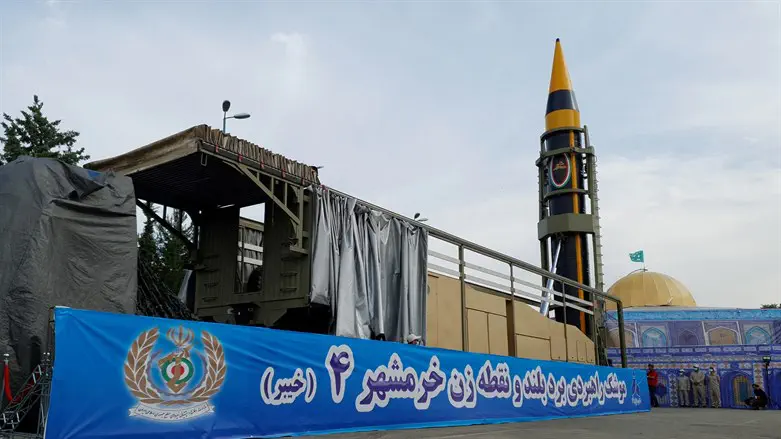
Chinese companies are holding discussions with Iranian officials regarding the supply of weapons, apparently through other countries, at least one of which is located in Africa, The New York Times reported.
According to the report, the Chinese government has not actively approved the weapons transfers, but it noted that talks of this kind could not take place without Beijing’s knowledge.
Earlier this month, The Telegraph reported that since the war against Iran began in February, four ships from China have arrived in Iran carrying precursor materials used to manufacture solid fuel for missile engines.
According to the report, the vessels departed from the Gaolan port in Zhuhai, a hub that houses some of China’s largest liquid chemical storage facilities.
Experts estimate the shipments may have included enough sodium perchlorate to enable the production of hundreds of ballistic missiles. However, it remains unclear whether Iran currently has the capacity to manufacture such weapons following recent strikes on its facilities by the United States and Israel.
In February, four days before the start of the war, Reuters reported said that Iran was close to finalizing a deal with China to purchase CM-302 anti-ship cruise missiles, quoting six sources familiar with the negotiations. The supersonic missiles, which travel at high speeds and fly low to evade detection, have a range of roughly 290 kilometres and could significantly boost Iran's naval strike capabilities.
The discussions, which began at least two years ago, accelerated after the June 12-day conflict between Israel and Iran. Iranian officials, including Deputy Defense Minister Massoud Oraei, have visited China to advance the negotiations, two sources said.
The potential transfer of these missiles would mark one of the most significant military sales from China to Iran, challenging a UN weapons embargo first imposed in 2006 and reimposed last September. Reuters noted that the US administration did not comment directly on the missile deal, though President Donald Trump recently warned of possible military action against Iran if nuclear negotiations fail.
The missile agreement comes as the United States positions a substantial naval presence near the Iranian coast, including the aircraft carriers USS Abraham Lincoln and USS Gerald R. Ford, along with their strike groups. Analysts warn that the missiles would pose a considerable threat to US forces in the region.
China, Iran, and Russia have maintained close military relations, conducting joint naval exercises and expressing opposition to renewed sanctions on Iran.