

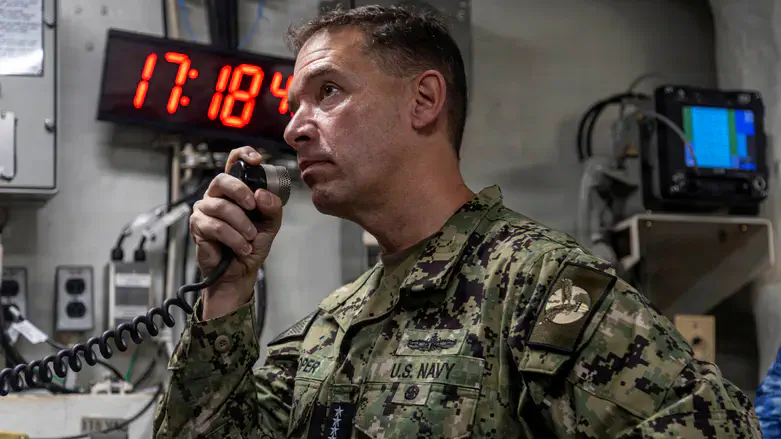
US Central Command Commander (CENTCOM) Adm. Brad Cooper stated on Sunday that Iran is increasingly targeting civilian sites across the Middle East out of "desperation" as its military capabilities deteriorate in the third week of the US-Israel war against the Islamic Republic.
"They're operating in a sign of desperation... In the last couple of weeks, they've attacked civilian targets very deliberately, more than 300 times," Cooper said in an interview with Iran International, which is identified with the Iranian opposition.
He noted a significant reduction in the scale of Iranian attacks: “At the beginning of the conflict, you saw large volumes in the dozens of drones and missiles. You no longer see that. It’s all one or two at a time."
In the interview, Cooper's first since the war began on February 28, he commented on the Strait of Hormuz, through which about a fifth of the world's oil passes, saying US and allied forces are weakening Iran's naval capabilities to secure shipping lanes. Coalition operations have sunk or severely damaged about 140 vessels since the campaign started.
“The Strait of Hormuz is physically open to transit," he said. “The reason ships are not transiting right now is because the Islamic Republic is shooting at them with drones and missiles."
Cooper blamed Iran for prolonging the conflict and endangering civilians: “They could stop this war right now, absolutely, if they chose to do so. They need to stop putting the wonderful Iranian people at risk by firing missiles and drones from inside populated areas... They need to stop immediately attacking civilians throughout the Middle East region."
He described the campaign as progressing well, with US forces “ahead or on plan" in dismantling Iran's power-projection assets. "We're also going after the manufacturing. So it's not just about the threat today. We're eliminating the threat of the future, both in terms of the drones, the missiles, as well as the navy."
Cooper added that the decision on how and when the war ends rests with President Donald Trump.
The interview was published a day after Trump issued an ultimatum to Iran, demanding that it reopen the Strait of Hormuz within 48 hours or face strikes on its power plants.
“If Iran doesn’t FULLY OPEN, WITHOUT THREAT, the Strait of Hormuz, within 48 HOURS from this exact point in time, the United States of America will hit and obliterate their various POWER PLANTS, STARTING WITH THE BIGGEST ONE FIRST!" the President wrote in a post on Truth Social.
Responding to the ultimatum, Iran threatened to strike all US and Israeli infrastructure across the region if its facilities came under attack.
On Sunday, Iranian Foreign Minister Abbas Araghchi also responded to Trump’s ultimatum, declaring that his country will not be intimidated by threats.