

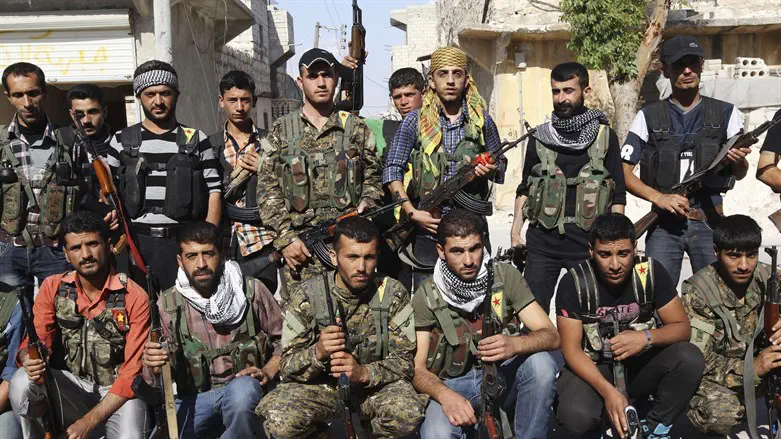
The U.S. and Israel are reportedly considering a new phase in their ongoing war against Iran, potentially involving Iranian Kurdish militias backed by the Mossad and CIA to launch a ground offensive in the country's northwest.
Iranian Kurdish factions, which formed a unified coalition called the Coalition of Political Forces of Iranian Kurdistan just days before the conflict escalated, have been moving hundreds of fighters across the border from Iraq into Iran in recent weeks. These groups are preparing for a possible attack on Iranian regime forces, though they have denied launching a ground offensive as of Wednesday and are reportedly awaiting a U.S. "green light" to proceed-potentially as early as later this week.
Israeli airstrikes have targeted Iranian military positions, Revolutionary Guard bases, and police stations along the border in the Kurdistan region, including heavy bombing reported in the city of Bukan. These actions appear to support preparations for potential Kurdish involvement.
According to U.S. and Israeli officials, the Kurdish militias receive backing from Israel's Mossad and the CIA. The initiative to arm and coordinate these groups for a ground incursion from Iraq originated with Israeli Prime Minister Benjamin Netanyahu and the Mossad, with the CIA joining later. Israeli officials have promised not only military aid but also political support for establishing a Kurdish autonomous region in a post-regime Iran. Israel has taken a very similar approach with the Druze of Syria, foreign reports claiming that Israel has actively armed, paid, and supplied them and Defense Minister Israel Katz officially confirming Israeli airstrikes to support the Druze against the new regime.
The strategy aims to seize territory in Iran's Kurdish-majority northwest, intensifying pressure on Tehran's regime and potentially sparking a broader internal uprising that could spread nationwide. As one Israeli official described: "The war started with a kinetic phase by the U.S. and Israeli militaries, but as the war continues there will be other efforts by the Mossad and the CIA."
However, concerns remain about the militias' limited capabilities. A U.S. official noted that the Kurdish Iranian factions "don't have enough military power and could end up as cannon fodder."
On the U.S. side, President Trump held phone discussions on Sunday with Iraqi Kurdish leaders Masoud Barzani and Bafel Talabani about the war and next steps, with a separate call to Mustafa Hijri of the Democratic Party of Iranian Kurdistan (PDKI). Secretary of State Marco Rubio told Congress in a closed briefing: "We're not arming the Kurds. But you never know with the Israelis." White House press secretary Karoline Leavitt stated that Trump has not approved any plan to back a Kurdish offensive.
Iran has raised alarms, with Foreign Minister Abbas Araghchi expressing concerns to Iraqi Prime Minister Mohammed Shia al-Sudani about a possible incursion. The Iraqi leader assured that Baghdad would not permit threats against Iran from its territory.
The Kurdish groups maintain thousands of fighters along the Iran-Iraq border and control key areas, drawing on long-standing historical ties with Israel and U.S. intelligence in the region. This development comes amid the broader U.S.-Israeli bombing campaign against Iran, which has already featured significant military engagements.