

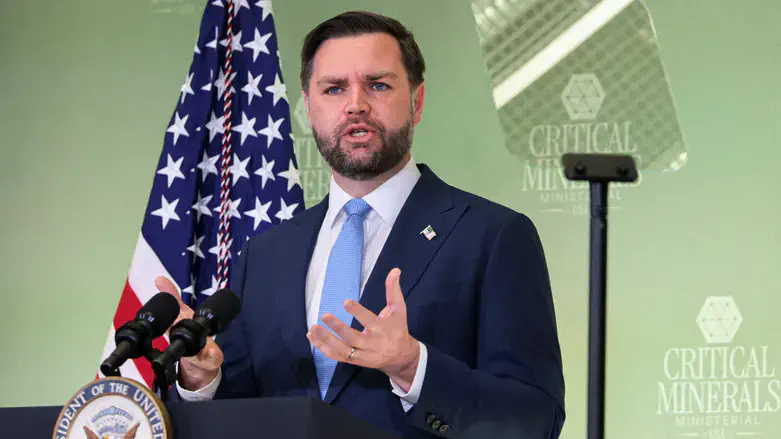
US Vice President JD Vance said on Thursday that while military strikes against Iran remain under consideration by President Donald Trump, there is “no chance" that such strikes would result in the United States becoming involved in a years-long, drawn-out war.
Speaking with The Washington Post, Vance said he does not know what Trump will decide to do about Iran. He described possibilities that include military strikes “to ensure Iran isn’t going to get a nuclear weapon" or solving “the problem diplomatically."
But if Trump proceeds with another round of strikes on Iran, which some US officials have suggested could be more comprehensive than the bombing of nuclear sites in June, Vance said confidently that it would not turn into the kind of conflict the vice president has harshly criticized.
“The idea that we’re going to be in a Middle Eastern war for years with no end in sight - there is no chance that will happen," he told The Post in an interview as he returned to Washington from an event in Wisconsin. His remarks effectively push back against predictions by some foreign policy experts that there would be no easy exit if America became involved in a larger conflict with Iran.
Vance noted that last year’s operation in Iran and the January capture of Venezuelan President Nicolás Maduro were “very clearly defined."
The Vice President clarified that he still sees himself as a “skeptic of foreign military interventions," a description he believes continues to apply to Trump.
“I think we all prefer the diplomatic option," Vance said. “But it really depends on what the Iranians do and what they say."
The interview was conducted as talks between the United States and Iran continued in Geneva amid a large-scale buildup of US forces around Iran. No deal was announced following the discussions, but Iran’s Foreign Minister, Abbas Araghchi, confirmed progress and stated that "technical talks" would resume in Vienna, Austria, next week. US officials told Axios that the meeting was positive.
Trump has openly acknowledged that he is interested in bringing about regime change to topple Iran’s Supreme Leader, Ayatollah Ali Khamenei. He told reporters this month that it “would be the best thing that could happen."
Asked whether, in his days as a commentator and senator offering criticisms of the Iraq War, he could have foreseen being attached to a presidency interested in bringing about a foreign regime change, the vice president chuckled.
“Well, I mean, look. Life has all kinds of crazy twists and turns," Vance told The Washington Post. “But I think Donald Trump is an ‘America First’ president, and he pursues policies that work for the American people.
“I do think we have to avoid repeating the mistakes of the past. I also think that we have to avoid overlearning the lessons of the past. Just because one president screwed up a military conflict doesn’t mean we can never engage in military conflict again. We’ve got to be careful about it, but I think the president is being careful."
On Wednesday, ahead of the Geneva talks, Vance said that Washington has evidence that Iran is trying to rebuild its nuclear program.
He further stressed that Trump prefers a diplomatic solution with Iran, but has other options available should that route fail.
“The principle is very simple, Iran cannot have a nuclear weapon. If they try to rebuild a nuclear weapon, that causes problems for us. In fact, we've seen evidence that they have tried to do exactly that. So the President is sending those negotiators to try to address that problem," Vance said.
He added, “As the President has said repeatedly, he wants to address that problem diplomatically, but of course the President has other options as well."
Trump made similar comments during his State of the Union address on Tuesday night. He stated that the strikes on Iran's nuclear sites last June "obliterated" Iran's nuclear program, but Iran has since killed more than 32,000 protesters and is attempting to restart its nuclear program. He further warned that Iran is developing missiles that can reach Europe and could eventually reach the US.
"We're in negotiations with them. They want to make a deal, but we haven't heard those secret words, 'We will never have a nuclear weapon'. My preference is to solve this problem through diplomacy. But one thing is certain: I will never allow the world’s number one sponsor of terror to have a nuclear weapon. Can’t let that happen."
"No nation should ever doubt America’s resolve. We have the most powerful military on earth - hopefully, we seldom have to use it," continued the President.