

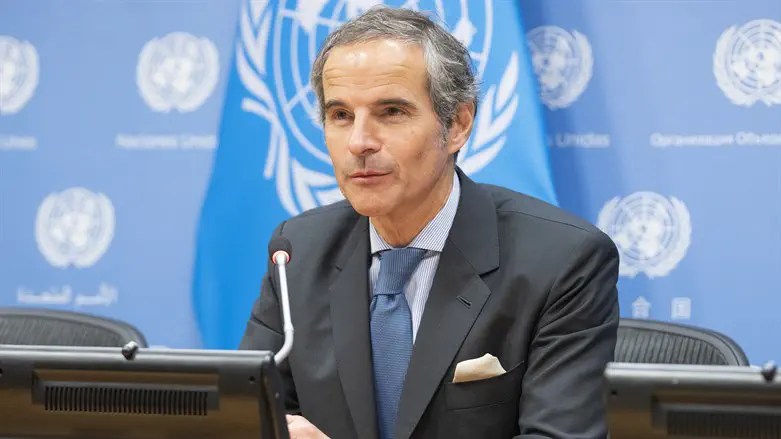
UN nuclear watchdog chief Rafael Grossi warned on Tuesday that the ongoing standoff with Iran over its stock of highly enriched uranium and blocked inspections at bombed nuclear sites “cannot go on forever."
Speaking to Reuters at the World Economic Forum in Davos, Grossi said the International Atomic Energy Agency (IAEA) has inspected all 13 declared Iranian nuclear facilities that were not struck in the US and Israeli attacks, but has been unable to access the three key sites hit in June - Natanz, Fordow and Isfahan.
Before inspections can resume, Iran must submit a detailed report on what happened at those sites and account for an estimated 440.9 kg of uranium enriched up to 60% purity - material that, if further enriched, would be enough for roughly 10 nuclear bombs according to IAEA metrics. Tehran has not submitted the required report.
“This cannot go on forever because at some point, I will have to say, ‘Well, I don't have any idea where this material is,’" Grossi said, noting that such uncertainty would mean there is no guarantee the material has not been diverted or hidden. “I do not have that conviction or conclusion at the moment, but what we are saying to Iran is that they need to engage."
Iran insists it is fully cooperating with the agency. Its government was not immediately available for comment.
The IAEA has not verified Iran’s stock of highly enriched uranium for at least seven months, despite its own guidance calling for monthly verification. Grossi said he was exercising “diplomatic prudence," but stressed that Iran must meet its obligations under the nuclear Non-Proliferation Treaty.
“This cannot go on like this for a long time without me, unfortunately, having to declare them in non-compliance," he told Reuters, adding that NPT members do not have an “‘a la carte’ option" to choose which obligations to follow. He said resolving the issue by spring was “a reasonable time frame."
Grossi added that he expects to meet Iranian Foreign Minister Abbas Araghchi in “a matter of days, weeks."
Following the US strikes on its nuclear sites, Tehran suspended cooperation with the IAEA and barred inspectors from visiting the damaged sites, accusing the agency of bias and failing to condemn the attacks.
An agreement announced in September between Iran and the IAEA, intended to resume inspections and uranium accounting, has since been declared void by Tehran after Britain, France, and Germany triggered the return of UN sanctions previously lifted under the 2015 nuclear deal.
Araghchi recently declared that the Islamic Republic will not allow the IAEA access to nuclear sites targeted during the recent war with Israel unless a specific agreement is reached.