
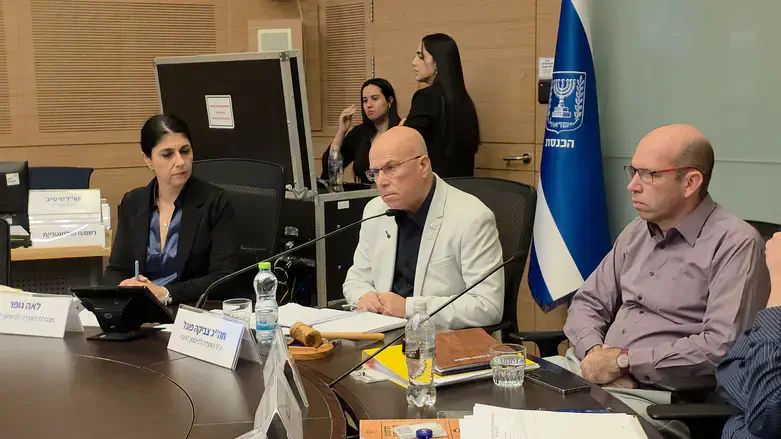
National Security Committee Chairman MK Tzvika Foghel spoke about a number of recent security and social incidents, including the ramming of a haredi boy during a protest in Jerusalem, the detention of Ran Gvili by Hamas in Gaza, and violent murders in the Arab sector.
Foghel began by referencing Gvili and said, "823 days. We are waiting for Ran Gvili. I will continue to remind everyone of this every morning." He also noted that he had recently heard, again, the story of Ran Gvili and his friends’ heroism, adding, "We must bring him home."
Regarding agreements with Hamas, he said, "We signed an agreement with evil ones, but even with evil ones who sign an agreement, it must be honored."
Regarding Tuesday night's ramming in Jerusalem, Foghel described, "I went to sleep last night with these unimaginable images, of a bus driving while dragging a boy under its wheels."
"It cannot be that this is happening in our reality," he said, adding that he would wait for the completion of the police investigation before convening a Committee discussion.
Foghel also noted that he intends to initiate a principled discussion about the method used to isolate protest areas, clarifying, "The right to protest exists, it must be allowed, but it cannot end like this." In his opinion, vehicles must not be allowed to enter protest areas, in order to protect the lives of participants.
Regarding the wave of murders in Arab society, he said, "I woke up this morning to four murder victims due to clan feuds and criminal organizations."
According to Foghel, the fight against crime cannot succeed without the local leadership becoming involved. Noting his own experience as a head of a local council in an Arab community, Foghel pointed out that the local leadership's involvement led to a reduction in murder and extortion.
Addressing the issue of the death penalty for terrorists, Foghel noted that it is a matter "both legal, ethical, and security-related," emphasizing that it is a complex issue in every respect.